

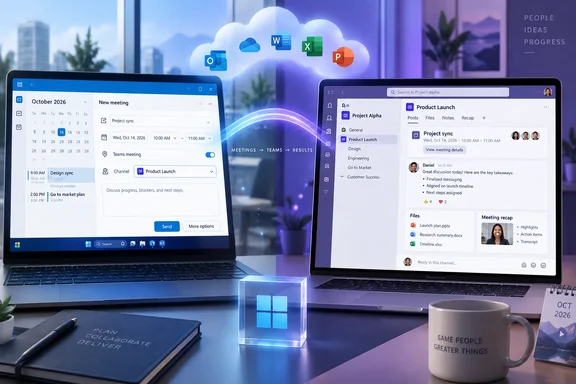
The practical change is narrower than “schedule a Teams meeting from Outlook,” which has existed for years. Microsoft’s current Outlook support documentation still states that users cannot schedule channel meetings from Outlook. They can add a Teams join link to an ordinary Outlook event, but they must open Teams to associate a scheduled meeting with a specific channel. Microsoft’s roadmap now says that limitation is due to change next month.
The missing channel field is the actual feature
A conventional Teams meeting scheduled from Outlook is primarily an event with named attendees and a Teams join link. A channel meeting has another destination: it belongs to a team channel, where the meeting is surfaced as a channel post and where its associated conversation and content remain visible to channel members.
Today, Microsoft’s documented workflow for channel meetings starts in Teams. A user selects the target team and channel, chooses the scheduling option next to Meet now, fills in meeting details, and sends it. Teams then ties the meeting to that channel; users outside the team can be added separately as attendees.
That distinction has operational consequences. Teams is often where a project team keeps its discussion, files, notes, and meeting recap, while Outlook remains where executive assistants, managers, and many knowledge workers do their availability planning. The inability to select a channel during Outlook event creation forces users to choose between scheduling where they manage calendars and scheduling where the meeting’s context belongs.
Microsoft’s wording says the change will “help keep discussions and meeting content connected in the appropriate channel.” That is accurate as far as it goes, but the more immediate benefit is eliminating a workflow split that has encouraged users to create standard Teams meetings first and later post links into a channel. Those workarounds produce a meeting chat separate from the channel conversation, which makes follow-up harder to find and weakens the channel’s value as a project record.
Microsoft has not said which Outlook experience gets it
The roadmap’s platform labels — Desktop and Mac — are unusually imprecise for a feature centered on Outlook Calendar. Microsoft has not identified whether channel selection will arrive in new Outlook for Windows, classic Outlook for Windows, Outlook for Mac, Outlook on the web, or some combination of those clients. It also has not published screenshots, a step-by-step workflow, or a Message Center notice explaining tenant controls.
That omission matters because Outlook’s Teams integration is no longer uniform. Microsoft’s current support guidance describes Teams as built into new Outlook for Windows, while classic Outlook uses the Teams Meeting option associated with the desktop integration. Organizations commonly run both during migration, sometimes alongside Outlook for Mac and Outlook on the web.
The roadmap also does not say whether the feature will require the modern Outlook client, a particular Teams build, or an Exchange Online mailbox configuration beyond the Microsoft 365 business account requirements already attached to Outlook-based Teams scheduling. The existing Outlook support page excludes personal Microsoft accounts as well as POP, IMAP, and free Exchange accounts from Outlook Teams-meeting scheduling. Nothing in Roadmap 571388 indicates that channel meetings will change those account boundaries.
For now, IT departments should treat October as a rollout target rather than an implementation deadline. Microsoft 365 roadmap dates regularly identify the expected availability month, not a promise that every eligible tenant or client will receive the feature on the first day of that month.
Channel restrictions are likely to remain important
The new capability should not be mistaken for a universal way to schedule into every Teams channel type. Microsoft’s current Teams documentation says scheduled channel meetings are not supported in private channels. The roadmap entry does not announce a change to that restriction, so administrators and users should assume the existing limitation remains until Microsoft documents otherwise.
That matters especially for organizations using private channels to separate sensitive workstreams, client matters, or leadership discussions. An Outlook option that exposes only standard channels would still solve the common departmental and project-team use case, but it would not replace workflows built around private-channel collaboration.
Shared channels need similar caution. Microsoft’s current public documentation discusses channel-meeting behavior and channel calendars differently across channel types, while the roadmap entry itself does not state whether shared channels will be selectable from Outlook. There is no basis yet to promise parity among standard, private, and shared channels.
The feature may also preserve the existing distinction between channel visibility and direct invitations. Microsoft explains that channel meetings can be visible to the team or channel while organizers can separately add attendees. Administrators should wait for the final interface before rewriting training materials around who receives invitations, who sees a channel post, and how meeting artifacts appear after the event.
Existing Teams policies could affect the rollout
Teams administrators already have a policy setting for channel-meeting scheduling. Microsoft’s Teams settings and policies reference describes “Channel meeting scheduling” as the control that permits users to schedule channel meetings within channels they belong to. A separate Outlook add-in control governs Outlook scheduling for private meetings.
Those policy names underline a likely administrative wrinkle: the new Outlook workflow may cross two areas that have historically been configured separately. Microsoft has not yet said whether the channel-meeting policy alone will govern the Outlook experience, whether the Outlook-related policy will also be evaluated, or whether new controls will be introduced.
Administrators should not preemptively change meeting policies based solely on the roadmap. Instead, they should inventory any custom Teams meeting-policy assignments, identify pilot users who schedule meetings for departments, and verify how channel-meeting scheduling is currently handled. That groundwork will make a Targeted Release test meaningful once the feature appears.
A sensible pilot should test more than whether a channel picker appears in Outlook:
- Confirm whether the chosen channel receives the expected meeting post and whether the meeting chat, files, recording links, and recap remain associated with the channel.
- Check whether a channel meeting can include internal attendees outside the team and external participants without changing the channel’s visibility model.
- Test recurring meetings, delegated calendar scheduling, room-resource booking, and rescheduling, because those are the Outlook scenarios most likely to expose integration gaps.
- Verify behavior for standard, private, and shared channels separately rather than assuming one successful test covers all three.
October will answer the deployment questions
Roadmap 571388 is useful because it establishes that Microsoft is addressing a real product limitation, not merely changing a label in Outlook. The company’s own support page currently tells users that scheduling Teams channel meetings from Outlook is unavailable; the roadmap now sets an October 2026 target for removing that restriction.
What remains missing is the information administrators need to plan a deployment: supported Outlook clients, channel-type coverage, policy evaluation, delegate support, and behavior for existing recurring meetings. Until Microsoft publishes those details or the feature reaches Targeted Release, the safest message to users is straightforward: continue scheduling channel meetings in Teams, and expect Outlook calendar support to begin appearing during October for eligible Microsoft 365 tenants.