

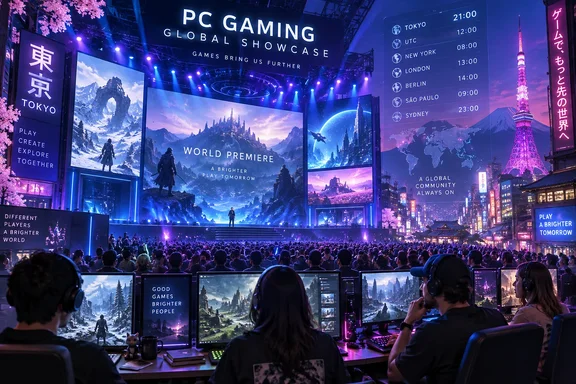
PC Gamer, which produces the showcase, says the Tokyo Direct will run roughly 90 minutes and include more than 30 games, world premieres, trailers, DLC announcements, release-date news, and on-site reporting from Tokyo Game Show. Gematsu independently reported the event’s September 20 date, 90-minute format, and the previously announced expectation of more than 35 games. The slight difference in game totals looks like ordinary promotional rounding rather than a contradiction, but viewers should treat the lineup count as a target rather than a finalized program.
For PC players, the useful part is straightforward: this is a live marketing showcase, not a hands-on Steam sale event or a Windows game launch presentation. Watch it for announcements, then wait for individual store pages, system requirements, release dates, and pricing before treating any reveal as a game you can actually install.
The time conversion is consistent, even if the dates are not
The advertised times line up precisely:
- The broadcast begins at 9:00 a.m. PDT on Sunday, September 20 for the U.S. West Coast.
- It begins at 12:00 p.m. EDT on Sunday, September 20 for the U.S. East Coast.
- It begins at 5:00 p.m. BST on Sunday, September 20 in the United Kingdom.
- It begins at 1:00 a.m. JST on Monday, September 21 in Japan.
PC Gamer’s current watch guide uses “PT” and “ET,” while its earlier event announcement used the more specific PDT and EDT. On September 20, 2026, daylight saving time is active in both U.S. time zones, so the actual start remains 9:00 a.m. Pacific Daylight Time and noon Eastern Daylight Time. Anyone setting a calendar reminder should use the fixed reference point—4:00 p.m. UTC—to avoid software or regional-label confusion.
A 90-minute running time would put the expected end near 5:30 p.m. UTC, or 12:30 p.m. EDT. That matters if you plan to watch a co-stream: the main presentation may end before post-show discussion does.
Use the official PC Gaming Show feeds first
PC Gamer says the show will be carried through YouTube, Twitch, X, GamesRadar+, Steam, Bilibili, eCLUTCH, GINX TV, ESR Network, and Kuaishou. The PC Gaming Show’s own site also confirms the September 20 return, while Future Publishing has promoted the event through its corporate channels.
The safest choice for most U.S. PC players is YouTube, Twitch, or Steam. Those platforms are the least likely to introduce regional access complications, and Steam is particularly useful for viewers who want to move quickly from a reveal to a game’s store listing, wishlist page, demo, or developer announcement.
There is one practical wrinkle: PC Gamer’s July announcement listed Facebook among the distribution outlets, but the newer September watch guide does not. That suggests the more recent list should be treated as controlling. Do not assume every outlet mentioned in earlier promotion will carry the final show, especially if you are depending on a particular social platform or embedded player.
Steam can be convenient, but it does not turn every game shown into an immediately available product. Showcase pages often collect participating titles before their release dates, prices, regional availability, and minimum PC specifications are public. A wishlist is a notification tool, not confirmation that a game is launching soon—or that it will run well on a particular Windows PC.
What has actually been named for the broadcast
The producer has identified Frankie Ward as host and said PC Gamer senior editor Wesley Fenlon will conduct interviews from the Tokyo show floor. PC Gamer has also named several games and publishers expected to appear, including Devolver Digital’s Virtue and a Sledgehammer, Firefly Studios’ Stronghold 4, and New Blood Interactive’s Tenebris Somnia.
The latest guide promises more than 10 world premieres, an exclusive release-date reveal for Virtue and a Sledgehammer, another Stronghold 4 trailer, and a deeper presentation on Tenebris Somnia. These are producer promises, not independently verified announcements; until the stream airs, there is no public record establishing the final contents, release timing, supported platforms, or technical requirements for those games.
The publisher list is broad: it includes Devolver Digital, Fireshine Games, The Game Bakers, Clear River Games, Firefly Studios, New Tales, and several smaller labels. That mix suggests the show will lean toward PC-friendly independent and mid-sized releases rather than a platform-holder briefing centered on Windows, Xbox, PlayStation, or Nintendo hardware.
For Windows users, this affects how the show should be watched. A trailer labelled “PC” answers very little about compatibility. It does not establish whether the title needs Windows 11, supports ultrawide displays, uses anti-cheat software, includes Steam Deck support, requires an online account, or will arrive with features such as DLSS, FSR, XeSS, HDR, ray tracing, mod support, or local multiplayer. Those are the details worth checking once the announcements are public.
Shadowdrops deserve a second look before downloading
PC Gamer says the program may include shadowdrops—games or demos released with little or no advance notice. Those are the announcements most likely to send viewers directly to Steam while the presentation is still underway.
That is also where viewers should slow down. A surprise launch can arrive with incomplete store information, rapidly changing review data, server congestion, or a launch-day patch. The first version available at showtime may not be the build that early buyers end up using later that day.
For a full game release, check the Steam page’s supported operating system, storage requirement, minimum GPU, recommended GPU, controller support, language availability, DRM disclosures, and online-service requirements. For a demo, check whether it is limited-time, whether saves transfer to the finished game, and whether the demo’s requirements are likely to reflect the final release.
The show’s Steam event page is likely to make discovery easier, but its collection should be viewed as a directory rather than an endorsement. Participating games can be at very different stages: some may be out now, others may have only a trailer, and others may still be years away from release.
Co-streams will add commentary, not confirmation
PC Gamer says streamers will be able to watch along and that the organizer is accepting co-stream requests. Co-streams can be a better social viewing option, particularly for viewers who want live translation, genre expertise, or immediate reaction to a surprise reveal.
They are less reliable for technical details. A streamer’s first impression of a trailer, an alleged launch date, or a platform logo can be wrong, particularly in a fast-moving presentation where several trailers run back to back. Use the developer’s own Steam page, official social post, press release, or storefront listing to confirm a release date and PC availability after the stream.
The same rule applies to trailers that announce a game for “PC and consoles.” Unless a publisher specifies a storefront, a PC release may mean Steam, Epic Games Store, Microsoft Store, GOG, or another launcher—and the release timing may differ by platform.
The immediate action is simple: set a reminder for September 20 at 9:00 a.m. PDT, noon EDT, or 4:00 p.m. UTC, then use YouTube, Twitch, or Steam for the primary stream. The announcements may arrive quickly, but the consequential information for Windows players—price, requirements, launchers, anti-cheat, performance features, and actual release availability—will begin appearing on individual game pages after the broadcast starts.