

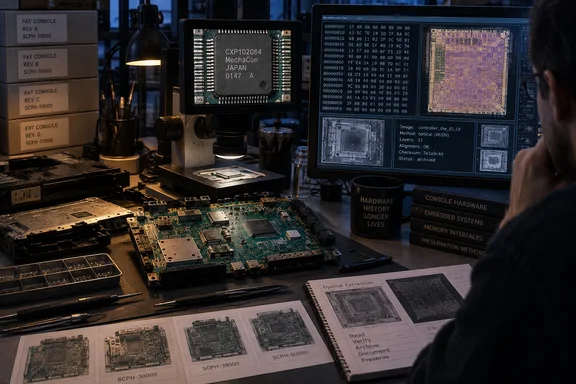
Tom’s Hardware first reported the breakthrough after Canadian hardware researcher DiscoStarslayer announced it on September 13, crediting collaborator Libby with finding an exploit from imperfect optical reads of the chip. Independent coverage from Frandroid, Retroacademy, and Japanese outlet Sumahodigest confirms the basic sequence: physical decapping of a sacrificial chip, optical extraction of mask-ROM data, then analysis sufficient to identify a route for software-based extraction.
The most important practical detail is the last step. Decapping a chip can establish what resides on one individual die, but it does not scale to the installed base of original consoles. A software dumping method potentially lets researchers compare firmware revisions across surviving machines without destroying each controller. That is the difference between a historic silicon photograph and a preservation program.
The CXP102064 Was More Than a Disc-Drive Controller
“MechaCon” is shorthand for mechanics controller, but the name understates its role. On these early PS2 boards, the controller supervises parts of the CD/DVD drive operation while also participating in disc authentication, regional behavior, MagicGate memory-card security, and handling of protected KELF executables.
That concentrated responsibility explains why a firmware dump matters to more than collectors. When a proprietary controller governs both hardware calibration and security decisions, a failed or undocumented component can become a repair dead end. Researchers can see the rest of a console’s logic, replace capacitors, repair traces, or emulate the main CPUs, yet still be blocked by the device that decides whether optical media and protected software are accepted.
For PC users, the long-term value is in accurate behavioral documentation rather than an instant compatibility fix. Mature emulators such as PCSX2 already run a large PS2 library without needing a full MechaCon firmware image. But software that reproduces a system’s edge cases—disc initialization, regional variants, protected executables, peripheral authentication, and failure behavior—benefits when developers can inspect the original implementation instead of inferring it from test results.
The work also reaches beyond retail consoles. PSDev Wiki documentation identifies a special CXP102064-651R MechaCon in Sony-derived arcade hardware used by Namco System 246 boards. Those systems powered arcade releases including Tekken 4, Soulcalibur II, Time Crisis 3, and Wangan Midnight, with their own security dongles and customized boot behavior. A retail firmware dump will not automatically unlock or emulate those arcade boards, but it provides a much better baseline for identifying where arcade firmware and authentication diverged.
“26 Years” Applies to the Platform, Not Necessarily This Exact Chip
There is a small but meaningful chronology problem in the circulating reports. Tom’s Hardware describes the CXP102064 as having arrived in 1999, while PSDev Wiki’s MechaCon hardware chronology places the earlier CXP101064 in October 1999 and the CXP102064 at the January 2000 GH-003 board revision.
Sony launched the PlayStation 2 in Japan on March 4, 2000, so calling this a 26-year-old PS2 security barrier is fair in September 2026. Calling the precise CXP102064 part a 1999 chip is less secure on the available record. The distinction will matter as dumped images begin to be cataloged: MechaCon part number, firmware revision, board revision, region, and console chassis are all relevant identifiers, and treating “fat PS2 MechaCon” as one uniform target will create bad archival data.
That also corrects a likely reader assumption. The CXP102064 is an early-generation target, associated with original large-case hardware and an SPC970-family controller architecture; it is not the same as the later ARM-based “Dragon” MechaCon used in SCPH-500xx systems, slim consoles, and Sony’s PSX DVR units.
The later family was already accessible through the open-source MechaDump project and related MechaPwn research. MechaDump’s own documentation says it supports SCPH-500xx, slim, and PSX systems—explicitly excluding earlier consoles—and warns that a mistake can brick a console. DiscoStarslayer’s result closes a conspicuous gap left by that older toolchain, rather than superseding it.
The Current Method Is a Research Milestone, Not a Consumer Utility
The announcement’s phrase “software solution” should not be read as an invitation to run code on a prized launch-era console. Sumahodigest reports that the present extraction approach uses the console’s EEPROM as part of the dumping process and may damage or exhaust it; the outlet says DiscoStarslayer had completed roughly six dumps at the time of reporting and acknowledged the risk of a non-booting system.
That warning is plausible in context. Early MechaCon firmware lives in mask ROM, which is fixed at manufacture and cannot be read like an ordinary flash chip. If an exploit has to repurpose the much smaller writable EEPROM as temporary storage or a communication channel, repeated write cycles and a failed restore become preservation risks rather than theoretical inconveniences.
Owners should therefore resist a familiar retro-hardware mistake: confusing the availability of a proof of concept with a safe maintenance procedure. The correct use of the news today is for specialists to preserve representative firmware images and document the exploit’s behavior on expendable test hardware. It is not a reason to experiment on a working SCPH-10000, SCPH-30000, or SCPH-39000 system without a verified recovery path and a backup of its machine-specific data.
The same caution applies to claims that this immediately solves PS2 optical-drive replacement. The MechaCon clearly affects drive control and calibration, so documented firmware could remove unknowns that have limited repair and optical-drive-emulation projects. But a firmware dump does not manufacture compatible replacement lasers, reproduce every analog characteristic of the original drive, or bypass the separate authentication and timing work required for a reliable replacement device.
What the Dump Changes for Preservation Work
The highest-value outcome is comparative analysis. Researchers can now begin matching code paths against observed behavior on early PS2 revisions, isolating regional differences, documenting formerly opaque commands, and distinguishing firmware bugs from board-level failures. This should make repair guidance less dependent on folklore and more dependent on known controller behavior.
It may also clarify old assumptions about the security chain. MechaCon is one important participant in authentication, but it is not the entire PS2 security architecture. Existing MechaPwn documentation, for example, notes additional DSP-related protections in some scenarios. A readable early MechaCon ROM will illuminate one crucial component without converting every protected disc, arcade dongle, or console configuration into an open system.
There is a broader archival benefit in getting the firmware out of individual aging devices. Mask-ROM firmware survives only as long as enough intact chips survive to be read and verified. Multiple dumps from different regions and board revisions can be checksummed, compared, and preserved alongside physical-board metadata, creating a record that can outlast the consoles themselves.
The hard work now is less glamorous than chemical decapping: verifying dumps, identifying version boundaries, documenting EEPROM side effects, and producing recovery-safe tooling if that is technically possible. Until then, the CXP102064 breakthrough should be treated as a new source of evidence for PS2 research, not as a finished modding product.
References
- Original Sony PlayStation 2 security chip ‘broken wide open’ after 26 years — chemical decapping and four years of reverse engineering unlocks MechaCon secrets Tom's Hardware · 2026-09-16T10:30:00+00:00