

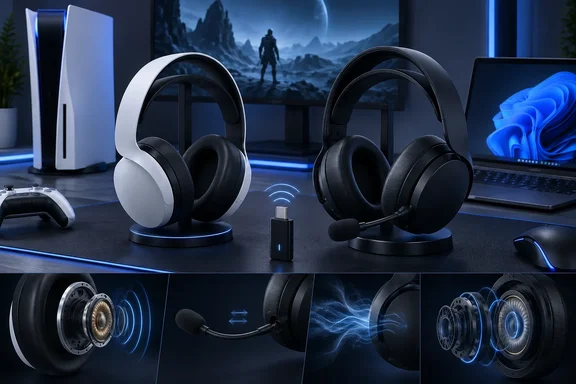
Neowin first highlighted the pair as a refresh of Sony’s PS5 audio lineup, while Sony’s own PlayStation Blog sets the release window: the standard PlayStation Pulse Wireless Headset is due in select markets during the 2026 holiday season, and the higher-end Pulse Edge Wireless Headset follows in early 2027. Sony has not disclosed US pricing, exact launch dates, battery-life figures, driver dimensions, or the list of countries included in the first rollout.
For Windows gamers, the hardware matters less as a conventional Bluetooth headset than as another expansion of Sony’s proprietary PlayStation Link accessory line. Each headset ships with a USB-C PlayStation Link adapter, which is the connection intended to deliver Sony’s promised lossless, ultra-low-latency wireless audio on PS5, PC, Mac, and PlayStation Portal.
A replacement line built on Pulse Elite’s foundation
Sony is repositioning the Pulse name rather than introducing a wholly new wireless standard. Pulse Elite already brought planar magnetic drivers to PlayStation’s over-ear headset range in 2024, alongside the Pulse Explore earbuds, so the new release is a product refresh with a clearer two-tier structure: Pulse as the base model and Pulse Edge as the premium edition.
The naming may cause confusion for buyers who remember the original Pulse 3D headset or own a Pulse Elite. Sony has not yet said whether Pulse replaces Pulse Elite outright, whether Elite will remain on sale after the holiday launch, or how the new entry model will be priced relative to the existing headset. That missing comparison is significant because Pulse Elite’s combination of planar drivers and PlayStation Link has been its central selling point.
Sony’s stated hardware upgrade is larger “studio-inspired” planar magnetic drivers. In simple terms, planar designs use a thin diaphragm moved across an array of magnets, rather than the voice-coil-and-cone arrangement found in most mainstream gaming headsets. The potential benefits are lower distortion and better detail retrieval, but they are design goals rather than a guarantee of superior sound: tuning, amplification, wireless processing, fit, and microphone performance still decide whether a finished headset performs well.
Sony says the larger drivers should produce more substantial bass without sacrificing sound separation and positional detail. Those claims have not been independently tested for either new model, so PC players should regard them as vendor targets rather than evidence that an upgrade from Pulse Elite is warranted.
Pulse Edge adds the features Windows users will notice
The standard Pulse has four magnets per planar driver, while Pulse Edge has eight. Sony describes that as double the magnet volume and says it should provide richer, deeper bass while retaining detail. The company has not published frequency-response measurements, distortion figures, maximum volume, codec information, or other technical data that would allow buyers to evaluate that claim against existing gaming headsets.
Pulse Edge also carries the more tangible feature advantage. It adds active noise cancellation, a detachable boom microphone with a fallback hidden microphone, a carrying case, a 3.5mm audio/microphone jack, and PS5 game-versus-chat balance controls. The standard Pulse uses an integrated microphone and lacks those premium features, including the analog jack.
For desktop users, the 3.5mm jack is more consequential than it looks. A wired fallback can be useful when a work laptop blocks USB accessories, when a console is not available for firmware maintenance, or when Bluetooth and USB radio congestion makes a dedicated low-latency connection unreliable. Sony has not said whether the jack will function while the headset is powered off, whether it supports microphone input on PCs, or whether its active noise cancellation is available in wired mode.
Both models use Sony’s AI-enhanced noise rejection for voice chat. That language describes microphone background-noise filtering, not active noise cancellation for the listener; only Pulse Edge is confirmed to include the latter. It is an easy distinction to miss in feature summaries, particularly because Sony presents the two capabilities alongside one another.
PlayStation Link is the PC feature, not a replacement for Bluetooth
Sony says both headsets can switch among compatible PlayStation Link devices, including PCs and Macs, and can connect simultaneously to supported Bluetooth devices. That arrangement follows the approach used by Pulse Elite: PlayStation Link handles the gaming audio path through a USB adapter, while Bluetooth can carry a second connection such as a phone.
The practical upside for a Windows gaming desk is straightforward. A USB-C adapter avoids relying on a PC’s built-in Bluetooth stack for the primary game connection, and it gives Sony control over the wireless link, audio latency, headset firmware, and device switching. Sony’s support documentation for existing PlayStation Link devices says compatible Windows PCs can use the adapter and that the PlayStation Link PC Driver can update hardware and adjust settings.
But the current support page explicitly names Pulse Elite, not the unreleased Pulse or Pulse Edge. Sony’s announcement confirms PC compatibility for the new hardware, yet it does not confirm whether the existing Windows driver will support either model on day one, what settings it will expose, or whether active noise cancellation and microphone processing will be configurable in Windows. Buyers who expect a fully fledged Windows headset app should wait for that confirmation.
The adapter also changes the laptop compatibility equation. USB-C is convenient on newer Windows hardware, but Sony has not said whether the included adapter will be bundled in both launch regions, whether a USB-A version or official adapter option will be available, or whether an adapter through a USB-C hub will preserve the intended low-latency behavior. Those are ordinary deployment details for PC accessories, but they can determine whether a headset works cleanly across a gaming desktop, docked notebook, and console.
The real decision waits on price and PC software support
Sony has released product images in White and Midnight Black and confirmed rotating earcups designed to lay flat for travel. FullCleared independently reported the same scheduled sequence and feature separation between the two models: the holiday-season Pulse first, then Pulse Edge in early 2027 with noise cancellation and the detachable microphone.
What Sony has not supplied is the information that would settle the buying decision. There is no price, no battery estimate, no weight, no charging specification, no Windows-driver compatibility statement specific to these headsets, and no technical measurement supporting the claimed driver improvements. There is also no public confirmation of how existing Pulse Elite owners will be treated if the standard Pulse occupies its price band.
For now, Pulse Edge is the model with the more complete PC-use case because it has a boom mic, noise cancellation, a carry case, and an analog fallback. Pulse may be the more sensible purchase if Sony prices it aggressively, but its value cannot be judged until Sony reveals the number it has left out.
The standard Pulse is expected first during the 2026 holiday period, meaning Sony still has time to answer those questions before customers are asked to choose. Until then, the announcement establishes a new PlayStation Link headset pair for Windows PCs, not a breakthrough debut for planar magnetic audio—and not enough evidence to declare either one a Pulse Elite replacement worth buying sight unseen.
References
- Sony reveals PlayStation Pulse and Pulse Edge headsets with planar audio Neowin · 2026-09-16T00:16:02+00:00