

Business Intelligence Strategy Starts With a Named Decision
The framework's main idea is easy to say and hard to do. Every major analytics effort should be tied to a decision that affects revenue, costs, risk, customers or operations. That decision needs a named owner, a deadline, reliable data, useful metrics, a clear next action and a way to measure the result. Analytics Insight uses a sales forecast as its example. The forecast is worth something when a leader actually uses it to set targets, change a market plan or move resources. A chart nobody acts on is just output.
This matches where Gartner's research has moved. In its June 16, 2026 data and analytics trends announcement, Gartner warned that AI agents are executing more strategic, tactical and operational decisions, meaning ungoverned decision-making increases exposure to legal, operational and reputational risk. Its answer is what it calls decision governance, which applies governance principles to decision intelligence so automated decisions are explainable, auditable and aligned with outcomes.
In practice, this changes how a BI team takes requests. "Build me a churn dashboard" becomes a short set of questions. Which decision will churn data inform? Who makes it, and when? What can they actually do about it? How will anyone know if the decision worked? If a request can't answer those questions, it becomes another report without an owner.
A useful way to write this down is as a chain. Business goal leads to a decision, which has an accountable owner. The owner relies on approved measures and definitions, which sit on a governed data model. Analysis or AI assistance produces an action, and the action produces a measured result. This is an implementation pattern that follows from the research, not a model that BARC or Gartner published. But every link in it maps to something a Power BI administrator already controls or can document.
BARC's 2026 Trend Monitor Ranks Data Quality Above AI
The framework's second argument is that AI can't fix weak source data. The best evidence comes from BARC's Data, BI and Analytics Trend Monitor 2026, published in November 2025. BARC surveyed 1,579 data, BI and analytics professionals worldwide. Data quality management took back the top spot, closely followed by data security and privacy. Both scored 7.9 out of 10 for importance. Data-driven culture, data and AI governance, and data and AI literacy made up the rest of the top five.
BARC's founder and CEO, Dr. Carsten Bange, said in the release that the survey shows organizations understand AI's real challenges are "clean data, secure data and people who can work with it." BARC also found a maturity gap. Top-performing organizations rate quality, governance and culture above average, but they also focus on monetization, decision intelligence and embedded analytics. Less mature organizations tend to stay focused on compliance and infrastructure.
These are survey findings about what professionals say they prioritize. They don't show that any particular data-quality investment pays off. Still, they are a useful sanity check for budget discussions: the people doing this work rank the basics above the newest AI features.
For a BI team, "data quality first" means a few specific controls. Each important source needs a named owner. Freshness and accuracy need defined thresholds. Business terms need clear definitions, lineage (where data comes from and how it changes along the way) should be documented, and access should be secured. The framework notes these matter more once AI tools can query large amounts of company data, because one bad source can spread errors into reports, forecasts, recommendations and automated decisions.
Semantic Models Are Where Power BI Copilot Gets Its Context
The part of the framework that matters most to Microsoft shops is the semantic layer. This is a shared set of business terms, fields, rules, relationships and approved metrics that sits between raw data and the tools people use to query it. The problem it solves is familiar. Finance, sales and operations can each have a different definition of "revenue," "active customer," "churn" or "margin," and every dashboard that picks one quietly disagrees with the others.
Gartner's February 2026 research on this topic is more cautious than vendor marketing. It says a single universal semantic layer remains out of reach. It identifies composite semantic layers as the trend to watch. These coordinate different semantic artifacts across systems to close context gaps, reduce analytical silos and keep business logic consistent. That fits most enterprises, where Power BI semantic models sit alongside semantic definitions in other tools rather than replacing them.
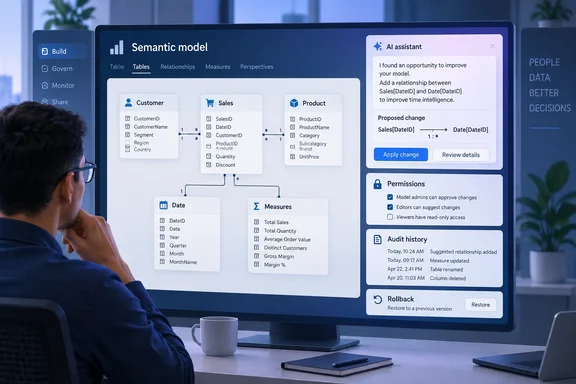
In Power BI, the semantic model is where these definitions live. That's why Microsoft's own Copilot guidance is so direct about it. Microsoft says Copilot's output quality depends on how well the data, the semantic model and the users are prepared. Unprepared models can produce low-quality, inaccurate or misleading results. According to Microsoft, some Copilot experiences use model expressions, field properties and synonyms as grounding context. It recommends consistent naming and useful descriptions.
So having a semantic model doesn't guarantee correct AI answers. The model gives Copilot its context, and that context is only as good as the naming, descriptions and measure logic the modeling team puts in.
Other vendors are moving the same way. Tableau's August 2026 release notes list the Semantic Model Builder (Smart Canvas) in Tableau Next as generally available. The same notes label Tableau Agent's data-connection and analytics-creation features as beta. That's a vendor status claim and useful for comparison. It doesn't show that one platform leads to better decisions.
What the June 2026 Power BI Update (2.155.756.0) Changes for Modelers
Microsoft's release archive identifies the June 2026 Power BI Desktop update as version 2.155.756.0. Several of its changes connect directly to the semantic-model argument, and their status labels matter:
| Feature (June 2026) | Status in that release | What it does |
|---|---|---|
| Fabric Apps for semantic models | Preview | An AI-first way to build operational data apps on semantic models, reusing the model's governance and business logic |
| Copilot in web modeling | Preview | Analyzes model structure and applies schema changes (renames, relationships, DAX measures) from natural-language prompts |
| DAX user-defined functions | Generally available | Reusable, typed DAX functions across Desktop and web modeling, now with optional parameters that have default values |
| Shape map | Generally available | Built-in maps, custom TopoJSON/GeoJSON uploads, URL-based map references and downloads of uploaded custom maps |
Analytics Insight's summary gets the June update mostly right. It correctly calls Copilot web modeling a preview. DAX user-defined functions (UDFs) reached general availability in that release and also gained optional parameters. For model governance, UDFs may matter more than the Copilot preview. Reusable, typed functions let a team define a calculation once and call it everywhere, instead of copying slightly different versions of the same logic into dozens of measures.
The same release also included Fabric IQ data answering in Microsoft 365 Copilot Chat for Frontier program users. There, people ask business questions grounded in governed Power BI data. Frontier is an early-access program, so this isn't a general rollout. It does show where Microsoft is heading: the semantic model will answer questions well outside Power BI reports.
July's update (2.156.951.0) continued the model-governance work. Model options came to the Power BI service, TMDL view arrived on the web, and authors can now add measure descriptions with triple-slash (///) comments in DAX query view that write straight into the model. Those descriptions are the kind of metadata Microsoft says improves Copilot grounding.
How Copilot in Power BI Web Modeling Handles Permissions and Rollback
Since Copilot can now change a production semantic model, admins should understand its controls before anyone turns it on. Microsoft's documentation for the preview gives specific boundaries.
Where it runs and what it can do
Copilot in web modeling works in the Power BI service. To use it, open a semantic model in Model view, switch from Viewing mode to Editing mode using the dropdown, and select Copilot from the ribbon. According to Microsoft, it can do three kinds of work:
- It can analyze a model and flag problems such as unclear structure or inconsistent naming, with best-practice recommendations.
- It can create and update tables, columns, measures and relationships, generate DAX business measures, and create row-level security (RLS) roles.
- It can suggest descriptions, propose display-folder structures and recommend which technical fields to hide from report authors.
The guardrails Microsoft built in
Before answering the first prompt in a session, Copilot asks permission to review the model or suggest changes. Once you approve, it can change that specific semantic model for the rest of the chat session. It may also run DAX queries against the model's data to generate its responses. After permission is granted, Copilot creates a restore checkpoint using semantic-model version history. You can use it to roll the model back to its state before that session's changes.
Copilot follows existing Power BI permissions. Only users with Write permission on the semantic model can use it to make changes, and workspace Admins, Members and Contributors all have that access. It can edit only the model open in the current pane. It can read schema information from other models the user can access in the same workspace, but those models stay read-only. The feature is also subject to Copilot for Power BI's licensing and capacity requirements. In practice, that means the workspace must be on qualifying paid capacity, not a Pro-only workspace.
Microsoft lists some limitations. Using this experience to set up "prep data for AI" isn't supported, and requests outside semantic-modeling tasks may not work. Microsoft also says unclear or incomplete prompts can produce less accurate suggestions, and recommends reviewing every change.
The Contributor role is the one to watch. Because every Contributor has Write access, anyone in that role on a workspace with qualifying capacity can use natural language to change a shared model's measures, relationships and security roles once the preview is enabled. The restore checkpoint limits the damage from a bad session. It doesn't replace change control on models that feed executive reporting.
Gartner's 2028 and 2029 Forecasts Treat Governance as a Speed Gain
The framework uses two Gartner forecasts, and both appear in Gartner's June 16 announcement. The first is the governance claim: Gartner predicts explicitly modeled business decisions will be five times more trusted and 80% faster than ungoverned decisions by 2029, enabled by decision intelligence platform adoption. The second is about real-time data: Gartner predicts disruptive pressure for real-time responsiveness will drive adoption of data streaming for agentic AI beyond 60% by 2028, from under 15% in 2025.
Both are forecasts, not measured results. They are still useful because they reverse a common assumption. Governance usually looks like overhead that slows analytics down. Gartner argues the opposite: decisions that are modeled in advance move faster because nobody argues about the inputs each time.
On streaming, Gartner describes the reason as agents needing fresher data than batch pipelines can deliver. Continuous, event-driven data flow enables D&A leaders to deliver data faster, empowering AI agents to take on more tasks with speed and accuracy. The framework adds a sensible limit. Real-time data pays off where decision speed matters, not everywhere. Gartner itself tells organizations to prioritize use cases that actually need real-time data.
Gartner also recommends that data and analytics leaders adopt AI governance platforms to operationalize governance, which will provide centralized oversight, apply risk management frameworks and enforce necessary controls. Speaking at Gartner's Sydney summit, Gartner VP Analyst Carlie Idoine described organizations moving rapidly toward an AI-first operating model, where AI is now a core consideration in every business decision, workflow and investment.
Measure BI by Decisions Made, Not Dashboards Published
The framework's last argument is about proving value, and it's where many BI programs are weakest. A count of dashboards shows activity, not results. Analytics Insight suggests measures that track the chain from data to outcome instead:
- Decision cycle time, meaning how long it takes from a question arising to a decision being made.
- Forecast accuracy, tracked against a baseline taken before the new model or process.
- Data-quality failures detected and resolved over time.
- How widely approved, certified measures are used compared with ad-hoc calculations.
- Manual reporting hours removed from recurring work.
- AI answer accuracy against a set of known questions with verified answers.
- Financial or operational results that can be traced to a changed decision.
None of these come with universal targets, and the right mix depends on the decision being supported. What they share is that each needs a baseline taken before the change. A team that turns on Copilot without first recording how long recurring reports take, or how often Copilot answers match certified figures, won't be able to show later whether it helped.
AI answer accuracy is the measure most specific to this moment. Microsoft ties Copilot quality to model preparation. A small set of business questions with verified answers therefore works as a regression test. Run it before and after any model change, whether a person or Copilot made the change.
What This Means for Power BI and Fabric Teams
If your organization plans to use Copilot in Power BI, get your semantic models ready before you widen access to the preview, not after. Teams on Pro-only workspaces can't use the capacity-bound Copilot features anyway. They can spend that time on naming, descriptions and certified measures, which pay off either way. Teams on qualifying capacity should decide who holds Write access to production models before enabling the web modeling preview.
- Audit who holds Admin, Member and Contributor roles on workspaces with business-critical semantic models, because all three can use Copilot to edit those models.
- Treat Copilot in web modeling and Fabric Apps for semantic models as previews from the June 2026 update (2.155.756.0), and keep them out of production workflows that need supported, generally available features.
- Standardize measure names and add descriptions, including with July 2026's
///comment syntax in DAX query view, since Microsoft uses this metadata to ground Copilot. - Move duplicated calculation logic into DAX user-defined functions, which became generally available in June 2026, so there is one definition of each business rule.
- Build a small set of test questions with verified answers and run it after every model change to track AI answer accuracy.
- Tie each new BI request to a named decision, an owner and a way to measure the outcome before any building starts.
The framework's advice will sound familiar to anyone who has run a BI program. What's new is the stakes. With Copilot able to edit semantic models in the Power BI service and Fabric IQ bringing governed Power BI data into Microsoft 365 Copilot Chat for Frontier users, the semantic model now drives answers far beyond the report canvas. Organizations that put the next few months into definitions, ownership and permissions will be ready when these features leave preview. Those that don't will find their inconsistent metrics repeated in Copilot's answers.