

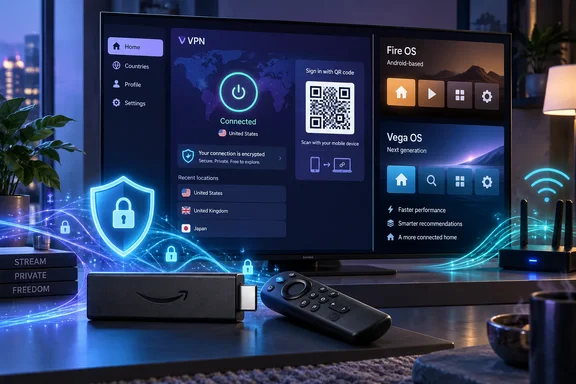
The news, first reported by TechRadar and confirmed by Proton VPN’s own setup documentation, matters less as a new streaming feature than as an example of the disruption behind Amazon’s operating-system transition. Vega OS does not run ordinary Android APKs, so the old Proton VPN Fire TV app cannot simply be sideloaded or installed on these devices. Proton has had to ship a separate app for the new platform.
Amazon’s own software-update listings now identify the Fire TV Stick 4K Select and the second-generation Fire TV Stick HD as Vega OS devices, while the Fire TV Stick 4K, 4K Plus, and 4K Max remain on Fire OS. That means this is not an upgrade path for existing Fire OS hardware. A Fire TV Stick that already runs Fire OS will continue using Proton’s Android-based application; Amazon has not announced a plan to convert those installations to Vega.
Proton’s app removes a real compatibility problem
Proton’s Vega OS support page says users can search the Fire TV Appstore for Proton VPN, sign in through an on-screen QR code or a verification code, and approve the device’s VPN permission prompt on the first connection. The setup is familiar to anyone who has used a TV VPN application, but its availability is consequential because Proton’s prior Fire TV route depended on Android compatibility.
For a household that already pays for Proton VPN, a native app avoids the most awkward workaround: configuring WireGuard or OpenVPN at the router. Router-level VPN setups can protect devices that lack a dedicated client, but they also route every selected device through the VPN, may complicate local-network access, and require hardware with a capable VPN client implementation. A TV-side connection offers more control, allowing the streaming stick to use the VPN without changing traffic policies for work PCs, game consoles, or other devices on the same home network.
There is an important qualification in Proton’s own documentation. Its free plan can install and connect on Vega OS, but streaming support requires a paid Proton VPN plan. That makes the app useful to free-tier users seeking a protected connection, but it does not turn Proton’s free service into a general-purpose route for accessing Proton-supported streaming services while travelling.
The company also says paid users can choose individual countries or, where available, cities and states, while free users are directed to the fastest available free location. Those are account-tier rules, not a capability of Vega OS itself.
Vega OS has made app support a vendor-by-vendor exercise
Amazon introduced Vega with the Fire TV Stick 4K Select in September 2025. Amazon describes Vega as a new operating system built for its devices and built around a React Native application framework; its developer materials also confirm that Fire OS remains Android-derived while Vega is a separate target for developers.
That distinction explains why an established Fire TV application catalogue cannot be treated as a guarantee of compatibility. A provider may have years of Fire OS support and still need to develop, test, submit, and maintain another application for Vega OS. In Proton’s case, the company plainly tells customers that its Android app cannot be installed on a Vega OS Fire TV Stick.
Amazon has tried to soften that transition with a Cloud App Program that can stream some legacy Fire OS apps from AWS containers to Vega hardware. But Amazon’s eligibility rules specifically exclude utility apps. A VPN client falls squarely into the category that needs a local Vega-compatible replacement rather than a cloud-delivered Android application. Proton’s release therefore addresses a limitation that Amazon’s compatibility bridge was not designed to solve.
For developers, the lesson is broader than VPNs. Amazon’s Vega documentation promotes React Native and web-based development paths, but a platform rewrite shifts maintenance costs onto application makers. Major services can justify the work; niche utilities, media clients, and regional streaming apps may take much longer to arrive, if they arrive at all.
The VPN catalogue is growing, but Vega hardware is still limited
Proton joins a small but expanding group of VPN suppliers that have issued Vega-compatible Fire TV apps. NordVPN and IPVanish were among the early providers to support the platform, while Surfshark and ExpressVPN have also announced Vega availability. The arrival of another major provider reduces the chance that buyers of Amazon’s newer sticks are locked into a particular subscription merely because their prior app is unavailable.
Still, the language around a “Vega OS Fire TV” can mislead consumers into believing that Amazon has already changed its entire TV family. It has not. Amazon’s current update page separates devices by operating system, and it continues to list a large number of Fire TV Sticks, Fire TV televisions, and Fire TV Cube models on Fire OS. Amazon has also said it will continue releasing Fire OS devices.
The current split creates an unusually confusing purchasing situation. The Fire TV Stick 4K Select and second-generation Fire TV Stick HD appear in Amazon’s update records as Vega OS products. Yet an identically broad phrase such as “Fire TV Stick HD” can refer to an older Fire OS model, and the more expensive 4K and 4K Max models are still identified as Fire OS devices. Shoppers should check the actual software name under Settings > My Fire TV > About, rather than rely on the stick’s general product category or assume that a newer purchase automatically means Vega.
Proton’s support guidance makes a similar point: the company says only Fire TV Sticks bought after October 2025 may run Vega OS, while Amazon continued selling Fire OS devices after that point. The model and installed OS are more reliable indicators than purchase date.
Privacy protection and streaming access are separate claims
Proton’s marketing emphasis is predictable: a VPN encrypts the connection between the Fire TV device and the VPN provider, and it substitutes the provider’s exit IP address for the household’s public IP address as seen by online services. That can be valuable on untrusted networks, can reduce what a local network operator can infer from the connection, and can allow travellers to use services from another server location where permitted.
It does not make a Fire TV anonymous to Amazon, a streaming provider, or every tracker inside a signed-in application. If a viewer is logged into Prime Video, Netflix, YouTube, or another service, that provider can still associate viewing activity with its account. Nor does a VPN override a streaming platform’s licensing rules, account region requirements, or policies on VPN use. Proton’s own streaming guide tells users not to use the service to evade copyright regulations and to maintain a legitimate account with the service they are using.
The more defensible benefit is control over the network path. On a Vega Fire TV Stick, Proton subscribers can now choose that path at the device level through a supported app rather than depending on a router configuration or abandoning their chosen VPN. That is a meaningful improvement, but it should not be confused with a blanket solution to smart-TV tracking or content licensing restrictions.
What Vega Fire TV owners should do
Existing Proton customers should first establish whether they have a Vega device. On the stick, open Settings, select My Fire TV, then choose About; the operating system is listed as either Fire OS or Vega OS. Fire OS owners should retain the existing Android-based Proton application. Vega owners can search the Appstore for the new Proton VPN entry and sign in with the QR-code or verification-code flow.
Before replacing a router-level VPN setup, administrators of home networks should consider whether other devices depend on that shared tunnel. Moving only the Fire TV Stick to Proton’s native client can be cleaner for most homes, but it also means phones, tablets, smart TVs, and consoles outside the stick no longer receive router-wide VPN coverage.
Proton’s arrival does not resolve Vega OS’s larger application-transition problem. It does, however, remove one of the more visible missing utilities for a privacy-conscious streaming setup—and confirms that VPN vendors see enough of Amazon’s new Fire TV base to maintain a second, non-Android app platform.