

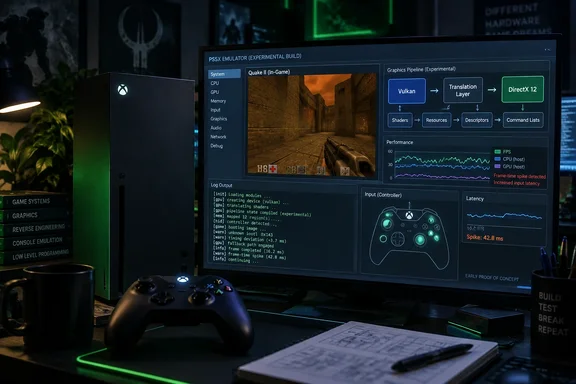
The project was shown by developer Devran Cosmo Uenal in a September 8 video and surfaced more widely in reporting from TechPowerUp. Uenal describes PS5X as a research port of KytyPS5 rather than a finished emulator, and the visible results match that description: a handful of titles appear in the launcher, controller input works, and some audio is present, but compatibility, stability, frame pacing, and latency remain largely unmeasured.
What has been demonstrated is a meaningful software-porting milestone. What has not been demonstrated is a viable replacement for a PlayStation 5, a commercial Xbox application, or even a repeatable performance result across a full game.
PS5X is adapting a PC project, not running native PlayStation software
KytyPS5’s own documentation describes it as a free, open-source PlayStation 5 emulator written in C++ for Windows and Linux, with experimental macOS support. Its maintainers also state plainly that the emulator remains in an early development phase, with limited compatibility and behavior that can change significantly from one build to the next.
PS5X is therefore not an Xbox feature, a Microsoft project, or a new emulator built from scratch around the Series X. It is a porting effort based on KytyPS5, undertaken by Uenal, that tries to make the existing emulator operate within Xbox’s development environment.
That distinction changes how the demo should be read. Getting code to boot on a Series X is one problem. Reproducing the console’s graphics, operating-system behavior, memory access, shader handling, audio, storage, and input expectations accurately enough to run a broad PS5 catalogue is the much larger one. A game menu or a short gameplay sequence shows progress, but it does not validate save behavior, level transitions, cinematics, crash recovery, extended sessions, or compatibility with different game engines.
The title most clearly shown running is Quake II. The reported launcher also includes GEX Trilogy, Hellboy: Web of Wyrd, and Marvel Cosmic Invasion. Uenal has said that controller support works and that sound operates in at least some cases. Those are important components to bring up in an emulator port, but the project has not published a compatibility database, test methodology, downloadable build, source repository, or standardized performance results.
DirectX 12 is the port’s central obstacle
The most consequential technical claim in the original report is also the easiest one to verify: KytyPS5’s existing renderer targets Vulkan, while Microsoft’s Xbox development stack centers on Direct3D 12. Microsoft’s Game Development Kit documentation says Xbox supports D3D12.x and does not support D3D11.x for GDK titles. KytyPS5’s public build documentation, meanwhile, lists Vulkan 1.3 as a runtime graphics requirement and identifies Vulkan and SPIR-V as central to its host GPU backend.
That means PS5X cannot simply compile KytyPS5’s Windows code for Xbox and call the job finished. Its graphics work needs a DirectX 12 equivalent, whether that is a new backend, a translation layer, or a hybrid approach. Each option creates fresh work around command submission, resource barriers, synchronization, shader translation, texture formats, and the many rendering assumptions an emulator accumulates as it matures.
This is why progress in the upstream PC emulator will not automatically translate into Xbox progress. A KytyPS5 improvement that fixes a guest CPU issue or improves filesystem behavior could be shared. A Vulkan-specific rendering fix, shader compiler change, or host GPU optimization may need independent adaptation and debugging on PS5X.
The Xbox version is thus effectively developing along a separate technical branch at the point where emulation performance often becomes most difficult: the graphics pipeline. Calling the absence of Vulkan support a minor platform inconvenience understates the work. For an early emulator, the renderer is not an interchangeable checkbox.
The footage does not establish usable performance
TechPowerUp estimated that Quake II runs at roughly 25 to 45 frames per second in the video, with dips below 20 fps during startup and noticeable input delay. Those figures should be treated as observation from a capture, not a benchmark. There is no public test scene, no stated resolution, no frame-time graph, no build identifier, and no evidence that the run reflects sustained play rather than a favorable segment.
Frame rate alone would not settle the issue anyway. Emulation can exhibit shader-compilation stalls, uneven frame pacing, sudden hangs after loading new assets, and severe latency even when an overlay occasionally reports an acceptable number. In a console environment, those problems are more significant than a momentary maximum frame-rate reading.
The demo’s visible input lag is particularly relevant. An emulator that produces a picture at 30 fps but adds substantial control delay does not offer a practical experience for action games. Until PS5X publishes measured end-to-end latency and extended gameplay captures, the only defensible conclusion is that it has reached an early proof-of-concept state.
There is also no basis yet for predicting how it would handle demanding PS5 releases. The Xbox Series X and PlayStation 5 both use AMD-based Zen 2-era CPUs and RDNA 2-class graphics hardware, but similar component families do not remove the computational cost of emulation. The host machine has to run its own operating environment while translating or reproducing the guest system’s behavior. A lighter or older title being demonstrated does not make a current PS5 blockbuster a plausible target.
KytyPS5’s fast PC progress should not be confused with maturity
The timing of PS5X has attracted attention because KytyPS5 has made highly visible progress on PC. Recent reporting from Tweakers, Tom’s Hardware, and DSOGaming documented builds that could render portions of Demon’s Souls and boot other 3D PS5 software, while brief footage of the PS5 release of Grand Theft Auto V showed frame rates reaching as high as 60 fps before instability interrupted play.
Those milestones are impressive for a young project, but they also show why short clips need careful reading. Demon’s Souls reaching 30 fps in selected scenes is not the same as being fully playable from beginning to end. Grand Theft Auto V rendering a sequence at 40 to 60 fps before crashing is not evidence of compatibility. The KytyPS5 maintainers themselves warn that support is limited and evolving.
PS5X begins behind that moving target because it must both inherit KytyPS5’s incomplete PS5 emulation and solve the separate host-rendering problem on Xbox. Its current success is therefore a demonstration that the Series X can host this kind of development work under Developer Mode, not a sign that PS5 emulation on the hardware has crossed into everyday use.
Uenal has also said artificial-intelligence tools were used during the project. That disclosure does not establish how much code was generated, reviewed, or retained, and it does not answer the questions that matter most for emulator users: whether the code is auditable, whether it will be released, and whether the renderer works reliably across games.
Developer Mode does not make this a retail Xbox feature
Microsoft’s own Xbox developer documentation draws a sharp line between Developer Mode and the ordinary retail environment. A console can switch back to Retail Mode to play its normal games, while development work is deployed and tested through the development environment. Publishing software to Xbox still requires Microsoft’s approval process and, for games using the modern Xbox stack, participation in the appropriate Xbox developer program.
That leaves PS5X with no apparent path to becoming an Xbox Store app. Even before considering the technical work, an emulator built to load PlayStation 5 game data would face certification, licensing, and platform-policy questions that the demonstration does not address. Microsoft has not announced support for PS5X, and neither Uenal nor the KytyPS5 project has indicated a retail release route.
For Windows and Xbox enthusiasts, the practical takeaway is narrower but still notable: a developer has shown that an open-source PS5 emulator can be brought into the Xbox Series X development environment and made to render at least one PS5-era title. The next meaningful milestone is not another menu screen or a higher instantaneous fps number. It is a reproducible build, a documented DirectX 12 graphics path, sustained gameplay testing, and evidence that the port can survive beyond a short technical demo.