

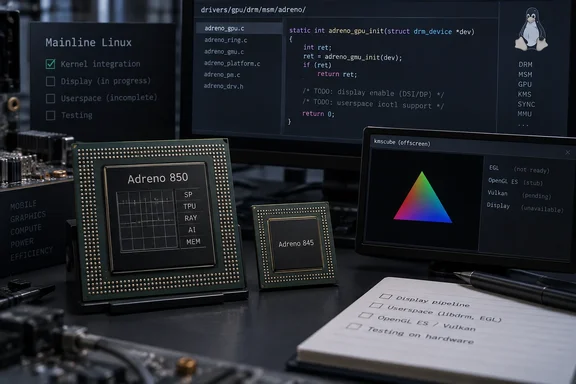
Qualcomm's Adreno 850 patches for the MSM driver arrive a day after the Snapdragon launch
The news comes from Phoronix, which reported that Qualcomm had announced the Snapdragon 8 Elite Extreme Gen 6 the day before and that patches for the Adreno 850 GPU found with the Hawi SoC, which now is presumed to be the newly-announced Snapdragon 8 Elite Extreme Gen 6, hit the kernel mailing list that morning. No other outlet has covered the patch series itself. Treat the Hawi-to-Snapdragon link as Phoronix's reasonable inference, not something Qualcomm has confirmed.
Hawi is Qualcomm's internal codename, and the Linux community has seen it before. Phoronix notes that for other areas of the Linux kernel there have been Qualcomm Hawi patches coming about the past several months. Public mailing-list archives support that. A September 2026 devicetree binding patch for Arm SMMU (the IOMMU that sits in front of the GPU) already lists qcom,hawi-smmu-500 next to other Qualcomm platforms among the Adreno SMMU compatibles.
So the GPU patches don't come out of nowhere. They sit on months of groundwork for the platform's clocks, interconnects and memory management. The GPU piece arriving right after the retail announcement suggests Qualcomm held the graphics work until the product name was public, then sent it upstream. That's an inference from the timing; Qualcomm hasn't said so.
The target is the MSM driver, the upstream Direct Rendering Manager (DRM) kernel driver for Qualcomm's Adreno GPUs and display hardware. This is mainline Linux, not the separate vendor kernel trees that phone makers ship. Userspace graphics for Adreno in open-source stacks comes from Mesa's Freedreno and Turnip drivers. That's why the promised Mesa patches matter as much as the kernel code.
Adreno 850 patches reveal a MALU matrix core and new power rails
The cover letter, as quoted by Phoronix, places the new GPU inside Qualcomm's existing 8xx generation. It says the Adreno 850 is the next generation of A8x GPU present in Hawi SoC, sharing the ADRENO_8XX_GEN2 family and slice architecture with the Adreno 840 while adding what Qualcomm calls many architectural improvements.
The biggest disclosed change is a new compute block. Qualcomm's text describes a new Matrix core, called MALU, that helps accelerate certain compute workloads. The patches don't name those workloads, give performance figures, or say which API will expose the block. Qualcomm says MALU support will be brought in separately, together with its Mesa support. Even after the base driver lands, the matrix hardware will be unused on mainline Linux until that later work arrives.
The other disclosed changes are about power delivery:
- A new power rail, which Qualcomm calls the Bx rail, powers part of the GPU IP.
- The GPU Management Unit (GMU), the microcontroller that handles the GPU's power states, is now powered by its own GDSC (a hardware power-gating domain), which is in turn fed by an MxG rail.
These aren't user-facing settings, and nothing here claims an efficiency gain. For kernel developers, though, they explain why the A850 needs its own driver changes and can't just reuse the A840 code with a new chip ID. On Qualcomm SoCs, bringing up a GPU means sequencing the GMU and its power domains correctly, and a new rail means new code for power-up and power-down.
Adreno 845 "Maili" is the same GPU without the matrix core
The series covers a second GPU as well. Phoronix reports that the patches bring up the Adreno 845, codenamed Maili, which is very similar to the Adreno 850 but lacks the MALU matrix core. Qualcomm's own wording is that the Maili GPU is very similar to A850 except that it doesn't have the MALU block.
That makes the Adreno 845 a separate part, not another name for the 850. Qualcomm hasn't publicly tied Maili to a retail Snapdragon product, and nothing in the reporting maps it to one. Pairing a flagship GPU with a cut-down sibling in one series is efficient: the shared driver code gets reviewed once, and each part gets its own catalog entry.
For anyone watching future devices, this gives the dividing line ahead of time. On Maili hardware, the base graphics driver work applies but the MALU work later on won't.
Offscreen glmark2 tests show how early the Adreno 850 bring-up is
The cover letter is candid about testing. Qualcomm writes that, because there is no display support available for Hawi or Maili yet, its engineers validated offscreen test cases that render basic triangles, plus glmark2-offscreen and similar tests.
That tells you exactly how far along things are. The GPU can take command submissions from the kernel driver, run shaders and render into memory buffers. The display side, meaning the controller and panel pipeline that would put those frames on a screen, isn't supported on these platforms in mainline yet. glmark2-offscreen is an OpenGL benchmark that renders without a window system. Here it works as a functional smoke test, and no benchmark results were published.
Two other pieces are missing. Qualcomm says it will post Mesa and linux-firmware support "soon". Adreno GPUs need signed microcode blobs, which go into the linux-firmware repository, and they need userspace drivers in Mesa. Without both, a mainline kernel carrying these patches can't do anything useful with the GPU on a normal distribution. No kernel version has been targeted publicly, the patches haven't been merged, and no dates have been given for the Mesa or firmware releases.
The A8xx family on Linux: Adreno 840, Adreno 830 and the X2-85
The Adreno 850 series builds on about a year of Adreno 8xx upstreaming, and that history helps with expectations. In September 2025, Qualcomm engineer Akhil P Oommen posted the series that introduced Adreno 8xx family support to the MSM driver. Per the LWN-archived cover letter, rest of the patches add A8x HWL and Adreno 840 GPU support, alongside platform work for the Kaanapali SoC. At that point, Mesa support for A8x/A840 GPU is WIP and will be posted in the near future.
The A850 announcement follows the same pattern: kernel first, userspace promised. The Adreno 830 series from August 2026 shows how things look once the family matures. Its cover letter calls the Adreno 830 is the first GPU in AdrenoeA8xx family [sic], and explains that architecturally A830 is very close to A840 GPU, so we just need to add a catalog entry to describe the GPU along with the necessary register lists. When that series was posted, both Mesa support and firmwares at linux-firmware repo are already available.
The comparison is useful. The A830 was a catalog-entry job with userspace already in place. The A850 introduces new hardware (MALU and a new power topology) and platforms with no display support, so it starts further back even though the patch timing is quicker.
The same code path matters to PC users. The A830 patch changes an a8xx_set_hwcg function in the driver, and that function already had a special case for a GPU the driver identifies as adreno_is_x285. The X2-85 name matches the Adreno GPU in Qualcomm's Snapdragon X2 laptop chips, which run Windows 11 on Arm. That identification is our reading and isn't stated in the patch. If it holds, the phone GPUs and the laptop GPU share the upstream A8xx driver, so shared-code fixes and refactors from phone bring-ups like this one also go through the code that Linux on Snapdragon X2 laptops relies on.
What this means for Linux-on-Snapdragon users and developers
Most readers don't need to do anything. The only people with an immediate reason to act are kernel and Mesa developers working on Qualcomm platforms, and people who build or maintain Linux images for Snapdragon hardware. Windows users on Snapdragon laptops aren't affected. The patches only touch the Linux kernel's MSM driver, and Windows uses Qualcomm's own graphics drivers.
If you're planning to run mainline Linux on an Adreno 850 device, you'll be waiting on several separate milestones: the kernel series being reviewed and merged, firmware landing in linux-firmware, Mesa support, and display support for the platform. MALU acceleration is a separate item after all of those. Until they arrive, Qualcomm's own testing only shows offscreen rendering.
- Qualcomm posted initial MSM kernel driver patches for the Adreno 850 and Adreno 845 on September 23, 2026. They are unmerged and not in any released kernel.
- The Adreno 850's link to the Snapdragon 8 Elite Extreme Gen 6 goes through the Hawi codename, which Phoronix only says is "presumed" to be that chip.
- The Adreno 845 (Maili) is the same design without the MALU matrix core, so later MALU enablement won't apply to it.
- Qualcomm has promised Mesa and linux-firmware support but hasn't given dates. Without them, the kernel patches alone won't give working graphics on a standard distribution.
- There's no display support for Hawi or Maili yet, and validation used only offscreen tests like
glmark2-offscreen, so desktop use and gaming aren't possible yet. - The Adreno 8xx code shared with the laptop-class X2-85 GPU means reviewers working on Snapdragon X2 Linux support should watch this series for changes to common code.
Qualcomm's Adreno 8xx upstreaming has gone from "Mesa is work in progress" for the A840 to "Mesa and firmware already available" for the A830. The A850 series puts its newest GPU on the first rung of that ladder a day after launch. The next concrete signs will be the promised Mesa and linux-firmware submissions, and after that the separate MALU work. That last piece will decide whether the chip's headline compute hardware does anything on mainline Linux.
Update: Qualcomm publicly outlines Adreno Neural Fusion gaming features (September 24, 2026)
Notebookcheck reports from Qualcomm’s Snapdragon Summit that the Snapdragon 8 Elite Extreme Gen 6 includes “Adreno Neural Fusion,” described as hardware-assisted upscaling and frame generation for mobile games. The outlet also says the GPU has dedicated Matrix Cores, providing a public product-level context for the matrix hardware that Qualcomm’s Linux patches call MALU.
That does not yet confirm that MALU is the exact hardware block behind every Neural Fusion feature, nor does it change the upstream Linux status. Qualcomm’s kernel submission still says MALU enablement will arrive separately with Mesa support, and display support for Hawi and Maili remains unavailable.
Notebookcheck also cites early Qualcomm reference-design benchmark testing, including Geekbench 6.7 and several 3DMark workloads, but its report provides no independently reproducible figures in the published summary. For Linux users and maintainers, the immediate dependency list is unchanged: merged kernel support, firmware, Mesa, display bring-up, and then separate MALU support.
References
- Qualcomm Posts Open-Source GPU Driver Patches For Adreno 850 One Day After Announcement Phoronix · Wed, 23 Sep 2026 11:45:48