

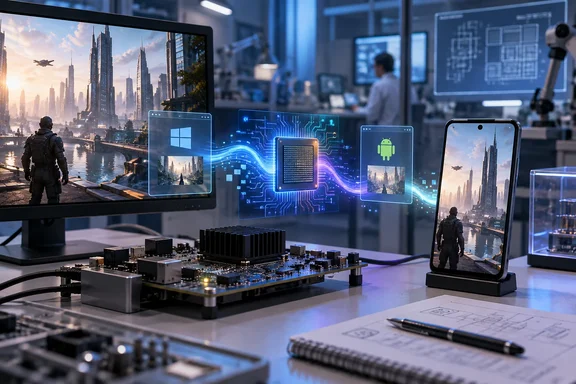
Qualcomm’s reported Android drivers target a real PC-game bottleneck
The account traces back to Geekerwan, a tech video creator who examined Qualcomm’s Snapdragon 8 Elite Extreme Gen 6. Digital Trends and ChannelNews report that Geekerwan heard from a Qualcomm contact that the company was working on GPU drivers with PC-game emulation in mind. Android Authority separately covered Geekerwan’s claim and said it had asked Qualcomm for comment. Those reports provide multiple accounts of one underlying claim, not independent confirmation of a Qualcomm development program.
There is a confirmed chipset announcement alongside that unconfirmed driver story. Qualcomm introduced the Snapdragon 8 Elite Extreme Gen 6 and Snapdragon 8 Elite Gen 6 on September 22 and described mobile gaming improvements, including its Adreno Neural Fusion graphics technology. Its announcement did not establish a release of Android drivers for translated PC games. Keeping the two developments separate matters to anyone considering a device purchase: an announced chip feature is a different proposition from a reported driver plan.
The reported focus also fits a familiar problem for enthusiasts. Android users running PC games on Adreno hardware often turn to Turnip, a community-developed graphics driver, in search of better compatibility. Mesa, the open-source graphics project behind it, documents Turnip as a Vulkan driver for Adreno GPUs. If Qualcomm delivers driver improvements that work with PC-game translation software, it could give that software another supported graphics path. No published comparison establishes that a future Qualcomm driver would beat Turnip in any particular game.
DirectX 12 on Android remains a proposal, not a shipping feature
The two games in Geekerwan’s reported demonstration used DirectX 12 mode through a translation layer on Android. DirectX 12 is the graphics interface the PC games use; the translation layer is what lets their graphics work reach a different software and driver setup. Seeing a game run in that mode does not mean Android has gained a complete Windows gaming environment or that Qualcomm has shipped native DirectX 12 support for Android.
Geekerwan also reportedly said Qualcomm was considering more direct DirectX 12 support in its Android drivers. Considering is the operative word: the accounts describe an idea under exploration, with no implementation or release commitment. Qualcomm’s Snapdragon PC documentation describes native DirectX 12 driver support on Windows-based Snapdragon systems, but that is a separate platform from the Android phones at issue here. A capability documented for one cannot be assumed to carry over to the other.
For a player, the graphics driver is only one part of the route from a Windows game to an Android screen. The reported demonstration depended on translation software, whose identity and setup the available accounts do not specify. Better driver behavior could help a compatible game render more reliably, but it would not, by itself, settle which PC titles can be launched, how they are obtained, or how they are controlled on a phone.
The Snapdragon demonstration shows games running, not retail performance
Digital Trends and ChannelNews describe Cyberpunk 2077 and Black Myth: Wukong running on a Qualcomm engineering device. Android Authority likewise reports Geekerwan’s account that both worked in DirectX 12 mode through a translation layer. ChannelNews calls the results smooth; TweakTown notes that the accounts provided no frame-rate figures for the two PC-game tests. The useful observation is that the titles were demonstrated in that test environment, without a measured performance result a buyer can compare against a gaming PC or another phone.
An engineering device is also a different test bed from a phone sold to customers. Retail designs can differ in cooling and software, and the reports do not supply sustained-play measurements for these games. Until there are named retail devices and repeatable game tests, “runs” is the defensible conclusion; a dependable portable Cyberpunk 2077 experience is still a possibility, not a product claim.
Both submitted stories also discuss Adreno Matrix Core hardware and Adreno Neural Fusion, including a reported Genshin Impact result rising from 60 to 120 frames per second. Qualcomm has separately introduced Neural Fusion for AI-assisted rendering and documented its Super Resolution and Frame Generation techniques for developers. That is relevant to the new mobile GPU, but Genshin Impact is a separate test: its reported result supplies no frame-rate figure for either translated PC game.
What this means for you
Do not buy a Snapdragon phone on the assumption that Qualcomm’s reported PC-game driver work will reach it. Readers already experimenting with Android PC-game translation can follow the development, but the present reports offer no driver download, rollout date, older-device support commitment, or verified compatibility list. Android Authority specifically raises the unresolved question of whether any improvements would be confined to the new Snapdragon 8 Elite Gen 6 series or extend to existing hardware.
- Qualcomm has announced the Snapdragon 8 Elite Gen 6 platforms and Adreno Neural Fusion, but its Android PC-game driver work remains a report attributed to Geekerwan.
- Cyberpunk 2077 and Black Myth: Wukong were reportedly demonstrated through translation on engineering hardware, without published frame-rate figures for those tests.
- Turnip remains a documented community Vulkan driver for Adreno; there is no measured Turnip-versus-Qualcomm-driver comparison on which to base a switch.
- More direct DirectX 12 support on Android is described as something Qualcomm is considering, not a feature available to install.
- Before relying on the reported work, look for a Qualcomm release that names supported devices and software, followed by repeatable results on retail hardware.
Qualcomm’s confirmed mobile graphics announcements make the reported interest in PC-game translation worth watching. The decision point for Windows gamers is more concrete: a released Android driver, a stated compatibility scope, and retail-device tests showing what happens after the opening minutes of play. Until those exist, the Geekerwan demonstration is an intriguing engineering result, not a reason to retire a gaming PC.