

Qwen-Image-2.1 Puts Generation and Editing in One 7B Checkpoint
Alibaba's GitHub repository calls Qwen-Image-2.1 "a unified text-to-image generation and image editing model in the Qwen family. With just 7B parameters in its visual generation component, Qwen-Image-2.1 balances generation quality, inference efficiency, and versatility". It is a single-stream DiT with 32 layers, 7B parameters, a single-stream architecture and block-causal attention. A DiT, or diffusion transformer, is the transformer-based design that most current image generators use.
The previous generation looked quite different. The original Qwen-Image shipped in August 2025 as a 20B model under Apache 2.0, with editing in a separate Qwen-Image-Edit checkpoint. Qwen-Image-2.1 folds both jobs into one model at about a third of the size. In practice, you write a prompt and get an image, or you hand it an image and an instruction and get an edit.
The feature list is concrete. The model supports native 2K output, transparent RGBA images, local edits, and compositions that use as many as 10 reference images. Tom's Hardware gives one example of multi-reference editing: you supply a photo of a person plus images of clothing, and the model composites the person wearing those clothes. The Qwen team says people and products stay consistent across edits. That is a vendor claim, not a measured result.
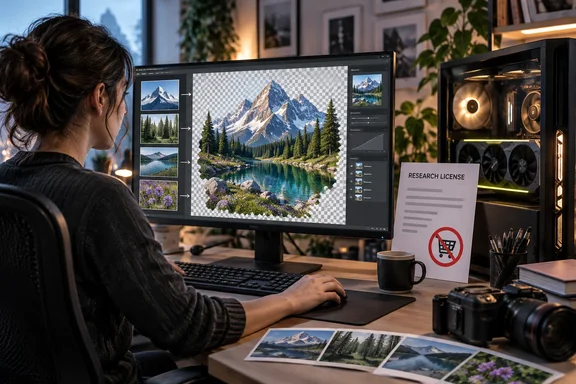
Transparency is the most practical new feature. The VAE is a 64-channel RGBA autoencoder with 16× spatial compression, which supports native transparency. In other words, the model writes the alpha channel itself. You don't need a separate background-removal step. Mixed News notes that this gives anyone cutting UI panels, stickers or decals a usable alpha channel without a separate background-removal pass. Tom's Hardware points to the same benefit for print-on-demand work.
The "7B" Label Undercounts What Your GPU Must Hold
The 7B figure covers only part of the pipeline. Alibaba's architecture notes list a second large component: a Qwen3-VL 8B vision-language text encoder that encodes both text instructions and condition images into a unified representation. Local capacity planning also has to account for the Qwen3-VL 8B encoder, the VAE and runtime state.
Tech AI Wire's advice is blunt: a 7B generation component plus an 8B text encoder is the number to size against, not the 7B headline alone, so budget for both before assuming a 24GB card is enough. Alibaba doesn't say how much memory you need. According to DataNorth, the model card offers CPU offload but publishes no VRAM figure. For GPUs with limited memory, the README suggests model offloading, which moves parts of the pipeline to system memory as they are needed and trades speed for fitting on a smaller card.
Some of the speed comes from how the model reuses work. Input images and text instructions are computed once at the first denoising step and cached for all later steps. This prefix KV cache reuse helps most when you edit with several reference images, because those images don't need to be re-encoded at every step.
Qwen-Image-2.1 Runs on RTX Cards Today, Through Familiar Tools
Qwen-Image-2.1 had software support at launch. Day 0 support covers Diffusers, ComfyUI, vLLM-Omni, SGLang and LightX2V. The weights are on Hugging Face and ModelScope, and the code is on GitHub. Alibaba's basic generation examples use PyTorch and Diffusers on a CUDA device with bfloat16 precision. The model card example runs 40 steps at 2048 by 2048 pixels. Qwen also ships two prompt-rewriting models, PE-T2I and PE-I2I, built on Qwen3.5-VL 9B, that turn a prompt in any language into English.
The official materials don't list supported graphics cards. The 3090 claim comes from other outlets: The Decoder reports that the model "runs on capable consumer GPUs like a 3090", while Qwen's README does not name a card. Early speed figures come from individual users, not controlled tests. Tom's Hardware collected these reports:
| Reported hardware | Reported result | Reported by |
|---|---|---|
| RTX 4090 | A 1MP image converted in about five seconds | Hacker News user Vunderba, developer of GenAI Showdown |
| RTX 5070 / RTX 5080 | 1MP images in about 25 seconds; editing and heavy reference-image use were slower | r/StableDiffusion user cgs019283 |
| RTX 3060 with 64GB system memory | 2K images in about 50 seconds | Unnamed user |
| RTX 6000 Pro | 1024×1024 images in a few seconds | Unnamed user |
These reports don't share settings. Step counts, precision, offloading, and whether each run was generation or editing are unknown, so treat the figures as rough and don't compare them card against card. The RTX 3060 report hints that offloading to plenty of system RAM can get the model running on a 12GB-class card, but that is an inference from one user's report, not a documented minimum. The main takeaway is simpler: people are running Qwen-Image-2.1 on ordinary Windows-class Nvidia hardware with tools like ComfyUI, and nobody is reporting that it needs datacenter GPUs.
Alibaba's Benchmark Win Over Nano Banana 2.0 Is Narrow and Self-Reported
The headline claim comes from the Qwen Image Benchmark, a leaderboard Alibaba built and ran itself. Tom's Hardware reports these scores on it:
- Qwen-Image-2.1 scored 60.2, and Google's Nano Banana 2.0 scored 59.82.
- GPT Image 2.5 Sunburst from OpenAI scored 67, and Muse Image scored 62.34.
The Qwen score differs slightly between outlets. MarkTechPost reports that it scores 60.28 on Qwen's own benchmark, first among listed open-weight models, and DataNorth also gives 60.28. The gap is small and probably a rounding difference. It makes no difference to the ranking: 60.28 is still less than half a point above Nano Banana 2.0 and well behind the two proprietary leaders. Only Tom's Hardware reports the Nano Banana 2.0 and rival scores. They don't appear in the official repository pages that were reviewed, and those pages give no detail on test design, sample size, or margin of error.
The benchmark's stronger message is about open models. By Alibaba's measure, Qwen-Image-2.1 leads every other model whose weights you can download. Tom's Hardware notes that among the compared models, only Meituan's LongCat-Image was smaller, at 6 billion parameters. AiCybr puts the evidence in context: the measurements are vendor-reported results on Qwen's own benchmark, and independent launch coverage confirms the architecture, feature set and release, while broad independent quality benchmarking remains less mature.
Crowd-voted rankings show a less favourable picture for text-to-image. On AI Arena, where people vote between anonymous outputs, Tom's Hardware reported preliminary scores of 1,228 for Qwen-Image-2.1, 1,260 for Nano Banana 2, 1,276 for Muse Image, and 1,423 for GPT Image 2.5 Sunburst. On that board, Qwen is behind Nano Banana 2, which contradicts the headline. Being about 30 points behind with a much smaller open-weight model is still a strong result.
Editing is where the independent results look best. Arena's image-edit board, dated September 21, 2026, lists Qwen-Image-2.1 at 1,367 ± 9, marked preliminary and ranked 16th overall. Arena's own announcement called it the top open-source model in both its Image Edit and Text-to-Image arenas, and said the edit score was 3 points behind GPT-Image-1.5-high-fidelity at 15th. Arena's "open source" label refers to downloadable weights. As the next section explains, it doesn't mean you can use the model commercially.
Alibaba Replaces Apache 2.0 With the Qwen Research License
The licensing change is the biggest practical change from earlier releases. Qwen-Image, released in August 2025, and Qwen-Image-2512 after it were both Apache 2.0, which lets you sell what you build. Qwen-Image-2.1 is not. The repository is licensed under the Qwen Research License Agreement.
The agreement defines "Non-Commercial" as research or evaluation purposes only. It grants a non-exclusive, worldwide, non-transferable, royalty-free license to use, reproduce, modify, create derivatives of and distribute the "Materials" for non-commercial purposes only. Materials include the model weights, parameters and code. Commercial use requires a separate license requested from Qwen by email. The agreement gives no price and doesn't promise that a commercial license will be granted.
Tom's Hardware described the restriction mainly as a ban on reselling the model. The license text goes further: it prohibits any commercial use of the Materials without a separate license. Running the model on your own machine doesn't change that. MarkTechPost sums it up: is it deployable? Yes, for research and evaluation. Commercial deployment needs a separate license from Qwen.
The license has other conditions you should know about before building on the model:
- If you redistribute the model, you must include a copy of the agreement, mark any files you changed, and include Qwen's attribution notice.
- If you use the Materials or their outputs to create, train, fine-tune or improve an AI model that you distribute or make available, the product documentation must prominently say "Built with Qwen" or "Improved using Qwen."
- You can't use "Qwen" as the main name of a derivative product, though you can mention it descriptively.
- The agreement is governed by Chinese law, with exclusive jurisdiction in the People's Courts in Hangzhou City.
Outputs are handled differently. On September 21, after questions from the community, the Qwen team posted on X that outputs are not part of the licensed Materials and that users keep the rights to images they generate. That statement doesn't appear in the license text reviewed for this article. It also leaves a separate question open: owning the images you generate is one thing, while having permission to run the model for commercial work is another, and the written license restricts the second. Here "open-source" means the weights are downloadable and inspectable. It does not mean you can put them to work for a client without asking.
What Qwen-Image-2.1 Means for PC Creators and Developers
If you're a hobbyist, researcher, or developer evaluating local image models, you can download Qwen-Image-2.1 now and try it in ComfyUI or Diffusers. If you plan to use it for client work, a product, or a paid service, wait until you have a commercial license or a lawyer's reading of the agreement. Hobby use is the grey area. The license defines non-commercial use as research or evaluation, while Tom's Hardware reads it as leaving most individuals free to make images and use them as they like. Those two readings don't fully match. If you're comparing it with Nano Banana or GPT Image for production quality, test it on your own prompts, because the only benchmark showing a win is Alibaba's.
- For sizing a PC, count the 7B diffusion transformer and the 8B Qwen3-VL text encoder together. Alibaba publishes no VRAM figure, and offloading to system RAM is the documented fallback for smaller cards.
- Early reports show Qwen-Image-2.1 running on RTX 3060, 4090, 5070/5080 and RTX 6000 Pro cards. These are individual users' results under unknown settings, not guaranteed performance.
- Alibaba's benchmark puts Qwen-Image-2.1 (60.2 or 60.28, depending on the outlet) just above Nano Banana 2.0 (59.82). On AI Arena's early text-to-image votes, Qwen trails Nano Banana 2, at 1,228 against 1,260.
- On AI Arena's image-edit board, Qwen-Image-2.1 has a preliminary score of 1,367 ± 9 and ranks 16th overall. That is the strongest independent result so far, and editing is where the model competes best.
- Unlike the Apache 2.0 Qwen-Image and Qwen-Image-2512, Qwen-Image-2.1 is under the Qwen Research License. Any commercial use of the model needs a separate agreement with Qwen, even if you run it on your own PC.
- If you need a transparent-background or multi-reference workflow for paid work, test it now for evaluation, but budget time for a commercial license or keep your current Apache-licensed Qwen-Image setup running.
Qwen-Image-2.1 shows that a 7B generator can come close to much larger proprietary models, especially at editing, and that it runs on the RTX cards many enthusiasts already own. Alibaba paired that with a license that stops the model being used in products without permission. The benchmark claims will get clearer as the preliminary Arena scores settle and independent testers publish results with documented settings. Until businesses know what a commercial license from Qwen costs, and whether they can get one, the Apache 2.0 Qwen-Image releases remain the ones you can build products on without asking.