

Compute Module 5’s RAM restriction goes beyond soldered memory
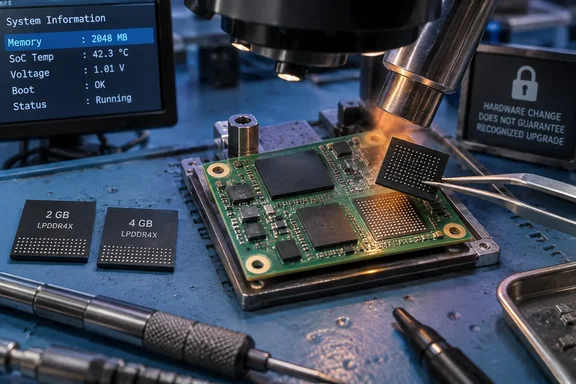
According to Notebookcheck, a user replaced the soldered memory on a 2 GB Raspberry Pi Compute Module 5, or CM5, with a known-good 4 GB chip taken from another CM5. The system nevertheless continued to report its original capacity. Raspberry Pi engineer and forum moderator PhilE explained that the restriction was intentional, rather than simply an unexplained failure to detect the replacement.
This is already a specialist operation. The memory package is soldered directly to the board, and replacing it requires BGA rework: removing and fitting a package whose solder connections sit beneath the chip. It is substantially different from inserting a memory module into a desktop PC’s DIMM socket.
The important finding is therefore narrower—and more useful—than a blanket claim that Raspberry Pi memory cannot be upgraded. In the reported CM5 case, the physical replacement worked sufficiently for the system to operate, but it did not deliver the expected additional capacity. Hardware rework and acceptance of a different memory configuration are separate hurdles.
Nor does this establish that Raspberry Pi has just removed an ordinary, supported user upgrade feature. The reporting describes an intentional restriction encountered during a board-level modification. It does not establish a single introduction date or a complete list of affected models and firmware versions, so owners should not generalise the result to every Raspberry Pi ever sold.
Raspberry Pi’s resale policy also constrains legitimate modifications
PhilE’s explanation, as reported by Notebookcheck, centres on modified boards being sold as higher-capacity products. Raspberry Pi wants to prevent a third party from buying a lower-memory device, fitting cheaper memory of uncertain origin, and reselling it as though it were a factory-built higher-memory model. The company’s concern is that unvalidated memory could cause instability that customers subsequently attribute to Raspberry Pi.
XDA Developers, covering the same explanation, also reports that devices are locked to their original RAM size. It quotes PhilE dismissing swaps between authorised devices of different capacities as an unlikely use case and stating that such a conversion “won’t work.” These reports describe the same underlying exchange, rather than two independent hardware tests.
That last point is particularly relevant to repair enthusiasts. The reported donor chip was taken from another CM5, not merely purchased as an allegedly compatible loose component. Yet a genuine donor did not make the receiving module behave like the higher-capacity product.
The practical inference is that genuine donor memory does not, by itself, establish an upgrade path. The restriction addresses the receiving device’s accepted configuration, not simply whether the replacement component came from a reputable source.
Raspberry Pi also argues that its volume memory purchases leave little legitimate financial incentive for such conversions, according to Notebookcheck. That is the company’s economic rationale, not a demonstrated calculation for every repair shop or owner with spare parts. Whatever an individual transplant might cost, the reported capacity restriction remains the immediate obstacle.
CM5 memory repairs depend on more than matching gigabytes
The restriction is not described solely as a stored capacity limit. According to Notebookcheck’s account of PhilE’s explanation, Raspberry Pi also programs memory-related attributes into some devices, covering density, organisation, and tuning or timing parameters as it accommodates more SDRAM suppliers and configurations. Consequently, a different chip with the same headline capacity is not guaranteed to work.
Capacity tells an owner how much data memory can hold; it does not describe every characteristic needed to configure that memory. Here, Raspberry Pi’s explanation identifies additional characteristics that the platform expects. A “4 GB” label therefore cannot establish interchangeability by itself.
The reported distinction between repairs and upgrades is important:
| Proposed modification | What the reporting supports |
|---|---|
| Replacing a failed chip with an identical part carrying the same part code. | PhilE says this can still work as a repair; it is not a guarantee that the rework will succeed. |
| Installing a different chip of the same capacity. | Compatibility is not assured because additional memory attributes may differ. |
| Installing a higher-capacity chip from another authorised Raspberry Pi device. | The reported CM5 attempt remained at its original capacity, and PhilE says cross-capacity swaps will not provide an upgrade path. |
These distinctions come from Raspberry Pi’s explanation reported by Notebookcheck, with XDA Developers also reporting the warning about same-capacity substitutions and other device attributes.
Calling this a universal ban on memory repair would therefore overstate the evidence. An identical replacement remains a potentially viable specialist repair. Calling any physically compatible package an upgrade option would make the opposite mistake: it would ignore the configuration restriction demonstrated by the reported transplant.
CM5 buyers should choose capacity without counting on a later transplant
Buy the factory RAM capacity your project requires, rather than treating a lower-capacity CM5 as a dependable starting point for a later chip-level upgrade. The reported behaviour makes that distinction relevant even to owners who have the equipment and expertise to replace soldered memory.
For technicians, the first decision is whether the job restores an existing configuration or attempts to create a different one. The former may be technically viable with an identical replacement; the latter runs directly into Raspberry Pi’s stated restriction. The available reporting does not establish a supported bypass or a broadly applicable firmware rollback procedure.
- Treat the reported 2 GB-to-4 GB CM5 transplant as evidence of a capacity restriction, not proof that every Raspberry Pi model behaves identically.
- Do not assume a known-good chip from a higher-capacity donor board will expose additional RAM on the receiving module.
- Distinguish an identical-part repair from a same-capacity substitution, because matching capacity alone does not establish compatibility.
- Do not budget for a chip-level RAM upgrade as though it were a supported alternative to purchasing the required factory configuration.
- Treat a seller’s claim of a modified, higher-capacity module separately from a claim that it is a factory-built higher-capacity product.
Raspberry Pi’s explanation establishes a concrete limit for hardware modification: on the affected devices, replacing the memory package does not necessarily change the configuration the platform will accept. Identical-part repair remains a different proposition, but capacity expansion should be planned at purchase rather than left to a future soldering job.
Update: Firmware locking reportedly began rolling out in late 2024 (September 22, 2026)
Tom’s Hardware reports that Raspberry Pi’s RAM-capacity locking was introduced through firmware updates beginning in late 2024, adding a tentative timeframe that was not established in the earlier coverage.
That timing suggests the restriction may depend on the firmware installed on a particular device, rather than solely on its hardware revision. However, the report does not identify affected models, specific firmware builds, or a tested downgrade method.
Tom’s Hardware also notes that using older firmware could theoretically avoid the lock where such firmware remains available. That should not be treated as a supported workaround: Raspberry Pi has not published a general rollback procedure or confirmed that earlier firmware will restore upgrade capability across devices.
Update: Older bootloader may reportedly bypass the RAM-capacity check (September 23, 2026)
The Register reports that Hackaday has identified reports suggesting the restriction can be avoided by installing an older Raspberry Pi bootloader that predates the RAM-capacity check. If confirmed for a particular device, that would qualify the earlier conclusion that no broadly applicable rollback route had been established.
This is not an official Raspberry Pi workaround, and neither outlet identifies a supported procedure, compatible bootloader versions, or the models on which a downgrade is safe and effective. Firmware replacement also carries obvious recovery and security risks, particularly for devices deployed in production.
The Register further says Hackaday found GitHub reports involving boards whose usable installed RAM exceeded the capacity reported by the system, reinforcing that the lock can affect identification rather than merely whether a transplanted chip physically works. Raspberry Pi has not publicly confirmed those individual cases.
For technicians, the practical position remains cautious: an older bootloader may be a research avenue for experienced hardware modifiers, but it should not be treated as a reliable upgrade method or as grounds to buy a lower-capacity module with a planned RAM transplant.
References
- Raspberry Pi is intentionally blocking RAM capacity upgrades Notebookcheck · 2026-09-21T19:15:00+00:00
- Raspberry Pi locks boards to factory RAM capacities in firmware — engineer tells DIY modders 'don't waste your time' trying repairs or upgrades, company cites shady reseller scams Tom's Hardware · 2026-09-22T11:07:17+00:00
- Thoughts return to forbidden RAM upgrades as Raspberry Pi OS gets fresh lick of paint The Register · 2026-09-23T15:09:31+00:00