

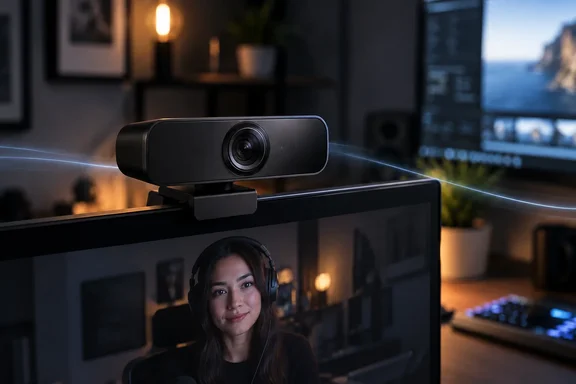
The Razer Kiyo V2 Pro doubles the 4K frame rate and keeps most of the Kiyo V2
Razer's press release, which TechPowerUp published, describes the camera as delivering 4K resolution at 60 FPS, combining smooth, high-quality video with versatile features. Engadget's launch coverage says the same thing more plainly: the $300 Kiyo V2 Pro's biggest upgrade is 60 fps capture, meaning less blur for your work calls, livestreams and everything else. Razer's US store lists the camera at US$299.99, and the product page is live with a buy button. You can order it now.
The Pro sits above the model Razer launched in October 2025. In that announcement, Razer said the Kiyo V2 combines stunning 4K 30FPS clarity with smart AI optimizations and stream-ready tools. TechRadar's review of the Kiyo V2 found it delivering either 4K recording at 30 frames per second or 1080p at 60. So on the older camera you had to pick between detail and smooth motion. The Pro's pitch is that you get both.
The sensor is where the story gets murkier. Razer markets the Pro as having Sony's 8.3-megapixel STARVIS 2 sensor, the same one that rival Elgato uses in its latest 4K webcam, according to Engadget. CGMagazine, which has already published a review, says the Kiyo V2 Pro also has the same image sensor, the 8.3MP Sony STARVIS 2 as the Kiyo V2. Razer's own Kiyo V2 materials say only "STARVIS" technology, while the Pro page says "next-gen STARVIS 2." Taking CGMagazine's account at face value, the move from 30 fps to 60 fps at 4K would come from processing and the lens, not a new sensor. That is our inference: Razer has not published a full spec sheet that settles it.
The lens and 86-degree field of view are the Kiyo V2 Pro's clearest hardware change
The optics show the clearest hardware difference. Engadget reports that Razer has paired it with a lens that can go as low as f/1.9 aperture, which should improve low-light performance and offer a stronger bokeh blur effect. A wider aperture lets in more light. That matters for a webcam in a dim bedroom or an office lit mostly by a monitor.
Razer also narrowed the field of view. The press release specifies an 86-degree wide-angle lens that captures more of the scene with minimal edge distortion, and Engadget notes that the company chose to reduce the field of view from 93 degrees on the V2 to 86 degrees to maintain image quality at 4K and reduce any fisheye lens effects at the outer edges of the frame. Seven degrees is a noticeable change if you currently rely on a wide shot to fit two people, a whole desk or a cramped room into frame. If you stream solo from a normal distance, it mostly means less stretching at the edges.
CGMagazine sees the tighter framing as part of the case for the Pro, noting that with a tighter focal length and 4K60 capture, there are definitely situations where it makes more sense than the V2. The body is largely unchanged. According to the review, it shares the fixed L-shaped mount with a ??" thread and a built-in privacy shutter, and a sturdy, wide body iconic to the Kiyo V2 design.
For mounting, Razer's blog says you can tilt and swivel the webcam on your monitor or attach it to a tripod through the built-in thread, and Engadget adds that the Pro webcam includes both a clamp for monitor and laptop edges and a universal mount for separate tripod use. The integrated privacy shutter is a twist-operated cover. Razer says you can cover the lens with a quick twist to ensure your privacy instantly.
Razer Kiyo line compared: where the V2 Pro fits
Here is how the current Kiyo models compare, using figures from Razer and published reviews. Razer has not published a full spec sheet for the Pro, so some cells are blank.
| Model | Top video modes | Field of view | Sensor (as reported) | Notes |
|---|---|---|---|---|
| Kiyo V2 Pro | 4K at 60 fps | 86 degrees | 8.3MP Sony STARVIS 2 | f/1.9 lens, UHDR, US$299.99 |
| Kiyo V2 | 4K at 30 fps, 1080p at 60 fps | 93 degrees | 8.3MP Sony STARVIS | HDR, Camo Studio integration |
| Kiyo V2 X | 1440p at 60 fps | Wide-angle (unspecified) | Not specified | Built-in microphone, privacy shutter |
Razer describes the V2 X as a 1440P 60FPS streaming webcam that makes you look good easily, and when it launched the company said it came with fast autofocus, a wide-angle lens, and a built-in microphone. The Kiyo V2 also has a built-in microphone, according to its retail listing. None of the Pro materials mention a microphone. If you plan to use the webcam's mic in place of a headset or USB microphone, check before you buy.
Much of the Kiyo V2 Pro's feature list depends on Synapse and Camo Studio
The features Razer leads with are AI-powered auto-framing, one-click image enhancement and Ultra-High Dynamic Range (UHDR). Per Razer's product page, with intelligent pan, tilt, and zoom effects, you'll always be center stage. In practice this is digital pan, tilt and zoom: Engadget and Razer both describe them as "effects." On a 4K sensor, that most likely means the camera crops into the frame and follows you. Razer hasn't documented how it works, so treat that as an inference.
One-click enhancement adjusts exposure, white balance and noise reduction automatically when your lighting changes. For manual control, Razer's blog says that through Razer Synapse, the Razer Kiyo V2 Pro gives you DSLR-level image customization with controls for ISO, shutter speed, white balance, exposure, gain, and other webcam settings. "DSLR-level" is marketing language. It tells you which settings you can change, not that the image will look like a DSLR's.
What the press release doesn't spell out is how much depends on third-party software. Its last line says that to unlock more features such as auto framing and advanced webcam controls, Razer has partnered with Camo Studio, an app from Reincubate. The Kiyo V2 worked the same way. At that launch, Razer said the Reincubate collaboration delivers Camo's AI-powered features, including intelligent auto-framing, background segmentation, and adaptive lighting correction, and it listed auto-framing as powered by Camo Studio. CGMagazine counts this against the Pro, saying the price along with its reliance on additional software to leverage its full potential, makes it a bit more niche than it otherwise could be.
Razer's own materials disagree about the Camo terms. The press release offers a "complimentary Camo Pro subscription," which sounds time-limited. The Razer product page says every Razer Kiyo V2 Pro comes with a free lifetime Pro license for Camo Studio, giving you access to smart features. The product page is the more specific and more recent statement, but Razer hasn't explained the difference or said whether the terms vary by region. If you plan to depend on Camo features for years, save your license confirmation when you activate it.
Razer's 4K60 and "lossless" claims mostly apply to local recording
Razer's product page advertises Uncompressed Video Encoding for lossless quality. It doesn't list the output formats, or which resolution and frame-rate combinations come out uncompressed. For the Kiyo V2, Razer did list them: support for lossless video encoding across MJPEG, YUY2, and NV12 formats. No matching list exists for the Pro, so don't assume every mode is uncompressed.
A camera that captures 4K60 won't necessarily deliver 4K60 to your viewers. Razer says the Pro works seamlessly with major platforms like OBS, Zoom, Microsoft Teams, and more, but it doesn't say which features or resolutions each app supports. Conferencing apps and streaming services generally downscale and compress video according to their own limits and your upload bandwidth. That is a general point about how these services work, not something Razer has documented for this camera. Where 4K60 capture clearly pays off is local recording, for example in OBS, where the footage stays in full detail for editing. Razer makes the same argument when it says the camera gives you raw footage that retains pixel for video editing and post-production.
The first independent test backs up the headline claim. CGMagazine reports that in testing, the Kiyo V2 Pro performs well, managing up to 4K60 FPS without breaking a sweat. Its verdict is that if you are looking for a professional-looking 4K capture without bumping up to a DSLR or an equivalent solution, the Kiyo V2 Pro delivers. The same reviewer also raises the question most buyers will face: whether there is enough here to warrant the price difference over the V2. So far that is one review. Low-light and UHDR comparisons against rivals using the same Sony sensor haven't been published yet.
What this means for you
Whether to buy comes down to whether you need 4K and 60 fps together in one stream or recording. If you record detailed demos, product close-ups or fast-moving gameplay-reaction video to edit later, the Pro gives you both, which the Kiyo V2 can't. If you mostly join Teams calls or stream at 1080p, the Kiyo V2 already does 1080p60, and the V2 X does 1440p60. Before buying, check that your room still fits in an 86-degree view, and plan on installing Synapse and Camo Studio. Without them, you lose the auto-framing and the fine manual controls.
- The Kiyo V2 Pro is on sale now at US$299.99 from Razer's US store. Razer's stated terms are up to one year of warranty and 14-day returns on direct RazerStore purchases.
- The headline upgrade is 4K at 60 fps. The Kiyo V2 tops out at 4K30 or 1080p60, and CGMagazine's testing confirmed the Pro sustains 4K60.
- The field of view shrinks from 93 degrees to 86 degrees, a trade-off that matters if you frame two people or a whole desk.
- Auto-framing and advanced controls rely on Razer Synapse and Camo Studio. Razer's product page promises a lifetime Camo Pro license, while its press release calls it a subscription.
- Razer has not listed a built-in microphone, the output formats or the operating-system requirements for the Pro. If any of these matter to you, confirm them with Razer or your retailer before buying.
- Viewers on Zoom, Teams or streaming platforms will only see 4K60 if those services support it, so local recording is where the upgrade clearly pays off.
The Kiyo V2 Pro is a focused upgrade: the same body and, by CGMagazine's account, the same 8.3MP sensor as the Kiyo V2, paired with a faster, brighter-lensed 4K60 pipeline and a longer software bundle. That is a real improvement for creators who edit their footage, and the first review suggests it works as advertised. The next useful information will be low-light and UHDR tests against Elgato's 4K webcam, which Engadget says uses the same Sony sensor, and clear terms from Razer on the Camo license that much of the feature list depends on.