

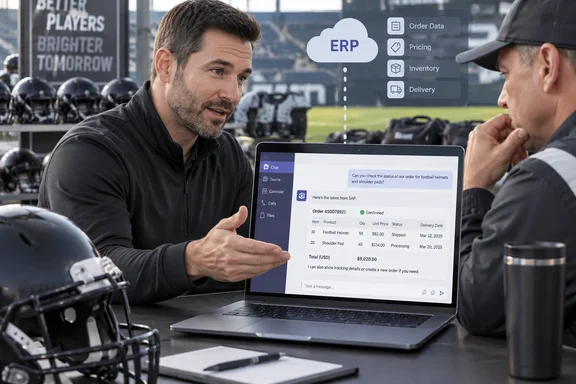
The enterprise IT interest is straightforward: Riddell put a conversational interface in front of an existing business system rather than asking field sellers to navigate that system themselves. The case also illustrates why the work behind an assistant—data preparation, governance and adoption—deserves as much attention as its chat window.
From ERP searches to conversations in Teams
According to Microsoft, Riddell’s sellers struggled with fragmented information and delays obtaining pricing, delivery dates and order status. RIA uses Azure Data Lake, Microsoft Fabric and Semantic Kernel. Project partner Saxon AI built the AI stack and Teams integration; Riddell handled data extraction and governance.
That division of responsibility is worth noticing. The conversational experience was a development project, but the information feeding it remained Riddell’s responsibility. For organizations considering something similar, the useful question is not simply, “Can we build a chatbot?” It is, “Which business answers can we reliably deliver, to which people, under which permissions?”
Microsoft describes the assistant’s SAP information as real-time, but does not publish refresh intervals, latency measurements or a detailed connection architecture. Consequently, the account should not be read as proof that every response queries SAP directly or reflects an immediately committed transaction.
The practical distinction: an accessible answer and a sufficiently current answer are separate requirements. A delivery estimate needs both.
What Semantic Kernel contributes—and what it does not prove
Microsoft Learn provides useful technical context beyond the customer account. Semantic Kernel plugins can expose existing APIs and application functions to an AI assistant. Through function calling, a model can request a function; Semantic Kernel routes that request to application code and returns the result for the model’s response.
This helps explain how an enterprise assistant can retrieve business information instead of relying on a model’s general knowledge. It does not establish which plugins, APIs or retrieval techniques Riddell implemented: those details are not disclosed in the customer story.
The same documentation distinguishes information-retrieval functions from task-automation functions and recommends human-in-the-loop approval for automation where appropriate. That distinction matters when an assistant moves from explaining an order to changing one. Reading a record and committing a transaction should not be treated as equivalent capabilities.
Microsoft Learn also explains that authentication or current-user context can be supplied by the hosting application rather than inferred by the model. For developers evaluating this pattern, that is an important design principle: conversational flexibility need not mean allowing the model to invent the identity under which a business operation runs. This is documented framework guidance, not confirmation of Riddell’s permission implementation.
Adoption figures need careful interpretation
Microsoft reports a seven-month development-to-rollout period and a phased introduction supported by training and feedback. Its published outcomes include:
- 73% of sales representatives using RIA at least once or twice weekly.
- An estimated 21,000-plus hours saved annually across the organization.
- 59% of representatives reporting faster answers to customer questions.
- Early indications that roughly 20% were making one to five additional customer calls daily.
These are customer-reported results published by a project vendor, not independently audited productivity findings. The account does not explain the annual savings calculation or provide enough survey and measurement detail to reproduce the results.
Nor does “59% report faster responses” mean responses became 59% faster. One is a share of respondents; the other would be a measured reduction in elapsed time. Keeping that distinction intact prevents a promising case study from acquiring a statistical turbocharger it never earned.
For an internal pilot, a more useful evaluation would combine adoption figures with defined operational measures: time to obtain an answer, answer correctness, support escalations and whether reclaimed time produces meaningful customer activity. Those are suggested evaluation criteria, not additional results attributed to Riddell.
Roadmap items are not deployed features
Microsoft’s page is dated March 10, 2026, so this is not evidence of a newly launched October deployment. Its roadmap includes Outlook meeting briefs, SAP Hybris quoting and custom-design workflows. The stated SAP S/4HANA-on-Azure migration was planned for later in 2026; the account does not establish completion.
That boundary matters. An assistant that retrieves selected ERP information is a different operational proposition from one that generates quotes or initiates design workflows.
For enterprise IT teams, the strongest takeaway is therefore a deployment pattern, not a guaranteed savings formula: identify recurring information bottlenecks, bring selected business data into the user’s workflow, and evaluate the result without confusing convenient conversation with verified execution. Riddell’s experience offers a concrete example of that approach. The unanswered questions—permissions, freshness, auditability and error handling—remain essential questions for anyone planning to reproduce it.
References
- Riddell unlocks SAP data for frontline sellers with an AI assistant on Azure - Microsoft Microsoft · Sat, 03 Oct 2026 07:00:00 GMT
- Plugins in Semantic Kernel | Microsoft Learn learn.microsoft.com