

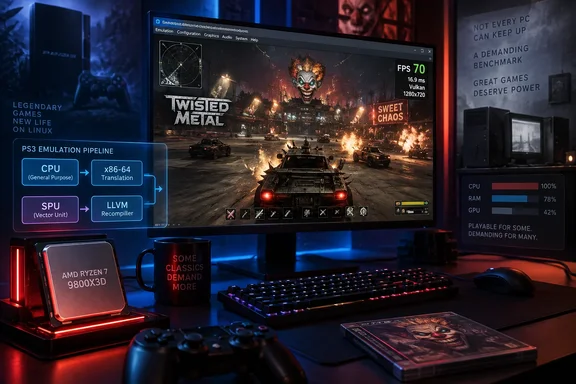
For Windows enthusiasts, the result is encouraging evidence of progress in PC emulation, but it is a Linux benchmark, not a Windows performance guarantee. Its immediate value is in showing how far RPCS3’s handling of a difficult PlayStation 3 workload has advanced, while exposing the considerable gap between a high-end demonstration system and more modest hardware.
RPCS3’s Twisted Metal milestone has a specific benchmark boundary
Notebookcheck reports that the RPCS3 team announced the 70-FPS result on X and described Twisted Metal as one of the most CPU-intensive games to emulate. Its reporting identifies the Ryzen 7 9800X3D and Linux as the platform used to reach that figure. The “first time” claim belongs to the developers; neither report establishes an independently audited performance record.
The additional detail in iXBT Games’ account makes the result easier to interpret. According to that report, the demonstration used a splash-screen sequence that the developers consider a stable in-game benchmark. A repeatable sequence is useful for comparing emulator performance because it gives successive tests a common workload. It does not establish how fast every combat encounter or other part of the game will run.
There is also a distinction between the actual test hardware and RPCS3’s broader “Max Performance” tier. iXBT describes that tier as a Linux system with a Ryzen 7 9800X3D, Radeon RX 7800 XT- or GeForce RTX 4070-class graphics, 16 GB of RAM, and an SSD. Those graphics specifications describe alternatives within a hardware tier; they do not identify which particular graphics card produced the reported result.
According to iXBT, some of the optimizations involved remained in development. That development-status detail is not independently confirmed in the other reporting available here, and neither account identifies a reproducible September build number and complete settings list. Consequently, this announcement cannot yet serve as a step-by-step recipe for reproducing 70 FPS on an otherwise similar PC.
Notebookcheck places the achievement against the original game’s reported target of 30 FPS at 720p when it launched in 2012. That is useful historical context, but the September accounts do not establish the demonstration’s rendering resolution or image-quality settings. The evidence supports a frame-rate milestone, not a controlled claim that RPCS3 delivered more than twice the original performance at identical visual settings.
Twisted Metal makes SPU translation the central CPU problem
The PlayStation 3’s unusual processor architecture helps explain why this particular result matters. Its Cell processor combined a main processing element with specialized Synergistic Processing Units, or SPUs. As Tom’s Hardware explained in its April reporting on RPCS3, those SPUs execute workloads that the emulator must translate into instructions a PC processor can run. The efficiency of that translation directly affects how much CPU time emulation consumes.
That creates a different performance problem from simply rendering a PC game at a higher resolution. A powerful graphics card cannot, by itself, establish that the host CPU will keep pace with the emulated processor workload. For Twisted Metal, the RPCS3 team’s explanation, quoted by Notebookcheck, specifically points to intensive SPU use.
There is documented context for continued improvement on this path. Tom’s Hardware reported in April that RPCS3 developer Elad had identified previously unrecognized SPU usage patterns and implemented more efficient native-code generation. The team’s Twisted Metal comparison showed a reported 5–7 percent average-FPS improvement between builds v0.0.40-19096 and v0.0.40-19151. Those were developer-provided results, rather than an independent test by Tom’s Hardware.
The mechanism is important: improving the translation allows the PC to perform the emulated work with less overhead. That helps explain why software changes can improve an emulator even when the user has not changed hardware. It also gives the September milestone a concrete precedent in the same game, rather than relying on unrelated titles to suggest progress.
However, the April comparison does not establish which changes produced September’s 70-FPS figure. It documents an earlier improvement, not a measured before-and-after for the latest demonstration. Assigning the new result entirely to that optimization—or calculating a cumulative performance increase from the two reports—would go beyond the evidence.
The Ryzen 5 5600 comparison limits the upgrade takeaway
The most useful counterweight to the headline is the developers’ response to an owner of a Ryzen 5 5600 system. According to Notebookcheck, the user asked about a PC with that processor, 32 GB of RAM, and a Radeon RX 5700. The RPCS3 team reportedly answered that Twisted Metal would run “well below” 30 FPS, citing the game’s heavy SPU workload.
That statement is a developer estimate for the specified configuration, not a published benchmark with frame-time measurements or a disclosed test route. Nevertheless, it directly contradicts any reading of the announcement as “60 FPS is now available on typical gaming PCs.” Even the original console’s reported 30-FPS target remains a demanding threshold for the configuration discussed.
The comparison also does not isolate why the Ryzen 7 9800X3D performs better. It supplies neither a controlled CPU comparison nor measurements separating processor architecture, core count, cache, operating system, and emulator settings. There is no basis here for assigning the result specifically to AMD’s extra cache, declaring a minimum core count, or extrapolating an exact frame rate for another processor.
Linux needs the same careful treatment. Its presence in the successful configuration is established by both accounts, but there is no matched Windows-versus-Linux test. The reported result does not justify changing operating systems solely to obtain 70 FPS, because the available evidence does not quantify the operating system’s contribution.
For the same reason, a purchase decision would be premature. Buying a Ryzen 7 9800X3D would reproduce one major component of the demonstration, but it would not reproduce an undisclosed emulator build, settings, rendering workload, and potentially unfinished optimizations.
Treat RPCS3’s 70 FPS as a development milestone before spending
Keep existing hardware decisions separate from this demonstration until a reproducible build and configuration are established. The report is useful for understanding RPCS3’s progress and setting expectations; it is insufficient as a hardware shopping guide or a guaranteed-performance setup procedure.
- The reported 70-FPS result concerns Twisted Metal on a Ryzen 7 9800X3D running Linux, rather than a verified Windows configuration.
- iXBT Games describes a repeatable in-game splash-screen benchmark, so the figure should not be treated as a sustained frame rate throughout the complete game.
- Notebookcheck reports that the developers expect a Ryzen 5 5600, 32 GB RAM, and Radeon RX 5700 system to remain well below 30 FPS in this title.
- The “Max Performance” tier describes a class of hardware, but the reports do not provide the exact graphics card, September emulator build, and settings needed to reproduce the demonstration.
- Some optimizations are reportedly still in development, making their availability in a particular downloadable build an important unresolved detail.
RPCS3’s achievement is meaningful on its supported terms: the developers report reaching a new performance level in a game whose SPU workload has repeatedly tested the emulator’s CPU translation. A reproducible release and configuration would turn that engineering milestone into something users can evaluate against their own PCs. Until then, the practical consequence is improved confidence in RPCS3’s progress—not a new promise that Twisted Metal will run at 60 FPS on the hardware already under your desk.