

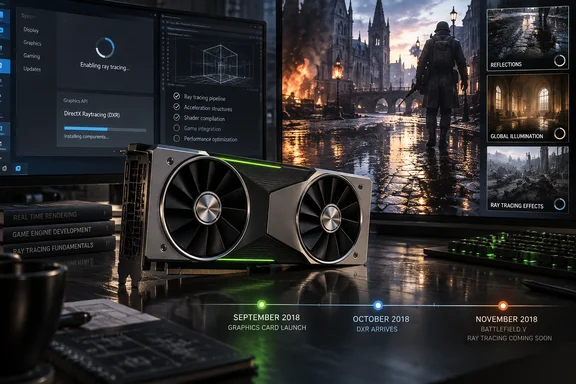
Tom’s Hardware’s retrospective is right to identify the RTX 20 series as the point at which ray tracing became a mainstream PC-gaming argument. Nvidia had spent the August 2018 reveal positioning Turing as a major architectural break, with dedicated RT cores for ray-tracing calculations and Tensor cores intended for AI workloads such as Deep Learning Super Sampling, or DLSS. The RTX name was therefore a promise about more than conventional frame-rate gains.
But the practical launch-day proposition was considerably narrower. Independent reviews from PC Gamer, PCWorld, TechSpot, and Ars Technica all reached the same basic conclusion: the RTX 2080 and 2080 Ti were exceptionally fast rasterized-gaming cards, yet their defining ray-tracing and DLSS capabilities had no playable software implementation available at retail. Buyers were being asked to pay for hardware whose flagship feature remained prospective.
The hardware arrived before the Windows platform did
Nvidia announced the GeForce RTX 2080 Ti at $999 and the RTX 2080 at $699, while setting Founders Edition prices at $1,199 and $799 respectively. Those were already sharp increases over the previous generation, particularly in the case of the 2080 Ti. Nvidia’s position was that the extra money bought entry into a “new era” of hybrid rendering: conventional rasterization for most of a scene, with selectively ray-traced reflections, shadows, or global illumination where it could make a visible difference.
The catch is that the DirectX API needed to make that work had not yet made its production debut in Windows. Microsoft released the Windows 10 October 2018 Update on October 2, 2018, and used it to take DirectX Raytracing, or DXR, out of its experimental phase. Microsoft’s DirectX team explicitly described Battlefield V, Metro Exodus, and Shadow of the Tomb Raider as the first wave of DXR games—games that were still coming rather than games an RTX buyer could run that September.
That chronology is the important correction to the memory of the launch. On September 20, an RTX 2080 or 2080 Ti owner could certainly use the card for traditional DirectX 11 or DirectX 12 gaming, CUDA work, or ordinary GPU compute. But the new hardware’s headline purpose depended on a Windows feature update that was still nearly two weeks away, followed by each developer’s own implementation and patch schedule.
For PC administrators and enthusiasts, this was an early example of a familiar modern graphics-stack reality: a hardware feature can require a GPU driver, a supported operating-system API, a game-engine implementation, and a game update before the advertised checkbox has meaning. A powerful GPU alone was not the product Nvidia had demonstrated.
Battlefield V became the first real test, nearly two months later
Battlefield V was the first shipping game to enable DXR ray tracing on PC, through its November 14, 2018 update. Electronic Arts’ release notes described the patch as enabling DXR on supported graphics hardware. That was 55 days after the first RTX 20-series cards became available.
The gap matters because Battlefield V was not merely an added benchmark. It was the first moment consumers could finally judge Nvidia’s consumer ray-tracing promise on a retail game rather than a controlled demo. Its implementation focused on ray-traced reflections, which could produce striking results in wet streets, windows, polished surfaces, and vehicle panels. It also carried a substantial performance cost, especially at the settings enthusiasts expected from a GPU priced between $699 and $1,199.
Early reviews had anticipated that problem. Ars Technica warned in September 2018 that there was no certainty about how quickly developers would adopt the new technology, while PC Gamer’s RTX 2080 review called out the absence of current ray-traced games outright. Their skepticism was not resistance to ray tracing as a rendering technique; it was an assessment of what a purchaser could actually do on day one.
Nvidia’s original pitch was also complicated by the incomplete state of DLSS. The company presented Tensor-core-assisted reconstruction as the performance companion to real-time ray tracing. Yet DLSS support was likewise unavailable in launch games. RTX’s two most marketable new functions—better lighting and a way to recover some of the lost frame rate—arrived as separate, delayed software milestones.
The RTX 20 launch sold an ecosystem before that ecosystem existed in usable form. Nvidia eventually built it, but buyers of the first cards financed the transition.
Metro Exodus and Tomb Raider show how long “launch titles” can take
The three games Microsoft named in October 2018 did not arrive on the same timetable.
Battlefield V received DXR support in November 2018. Metro Exodus launched on February 15, 2019 with ray-traced global illumination support for RTX cards. Its lighting implementation was more consequential than a reflection-only effect because global illumination changes how indirect light contributes to a scene’s overall look, particularly in the game’s dark interiors and outdoor environments.
Shadow of the Tomb Raider, despite being part of the initial promotional wave, did not receive its RTX ray-traced shadows update until March 20, 2019. In other words, one of the games routinely shown as part of the RTX 20 launch narrative gained the feature roughly six months after the RTX 2080 Ti and RTX 2080 went on sale.
That does not make Nvidia’s claims false. The company had developer commitments, engine partnerships, and working demonstrations. It does show why “supported” needs closer reading in GPU announcements. A title can be announced as supporting a capability while its release version lacks the code, drivers, API maturity, or performance tuning required to expose that capability to players.
The slow opening also explains why the RTX 2080 was a difficult upgrade recommendation for GTX 1080 Ti owners. In conventional games, the 2080 did improve performance, but it did not deliver a transformational uplift over Nvidia’s previous flagship. The 2080 Ti was plainly the fastest consumer gaming card available, but its price moved into territory that made it a luxury purchase even before the ray-tracing uncertainty was considered.
Turing changed the direction of PC graphics, not the overnight experience
The long-term significance of Turing is undeniable, though the launch conditions were awkward. Nvidia gave consumer graphics cards dedicated fixed-function hardware for portions of the ray-tracing workload, while Microsoft provided a Windows API that game developers could target. That combination turned ray tracing from an offline-rendering technique into a practical, if expensive, real-time option.
The first implementations were necessarily selective. Fully ray-traced scenes were beyond what 2018 consumer hardware could comfortably deliver at the resolutions and frame rates PC players expected. Developers therefore used a hybrid approach: rasterization handled geometry and much of the image, while ray tracing was reserved for individual effects such as reflections, shadows, ambient occlusion, or indirect lighting.
DLSS became increasingly central to making that tradeoff tolerable. Its first releases were uneven, but the broader direction was established: as rendering workloads became heavier, image reconstruction and upscaling would become part of the performance equation rather than optional extras. The later RTX generations benefited from faster ray-tracing hardware, more capable AI hardware, better denoisers, more mature game engines, and improved reconstruction techniques. None of those gains were available to the first RTX customers in September 2018.
Turing’s legacy is therefore more durable than the early reviews’ launch-day verdicts. The RTX 2080 and 2080 Ti did not make ray tracing a must-enable setting in 2018. They established the hardware and API baseline that made it normal for developers to consider the option, for engine makers to expose it, and for buyers to ask whether a GPU supports it.
The enduring lesson is about software promises attached to hardware prices
Eight years on, the RTX 20 series remains a useful reminder that a graphics-card launch is not the same thing as a feature launch. Nvidia delivered the silicon on September 20, 2018. Microsoft delivered final DXR support in Windows 10 on October 2. Battlefield V delivered the first playable use case in mid-November, while two other heavily promoted early titles arrived months later.
That staggered rollout did not prevent ray tracing from becoming a durable part of PC graphics. It did, however, mean that the first RTX buyers paid premium prices for a platform still being assembled around them.