

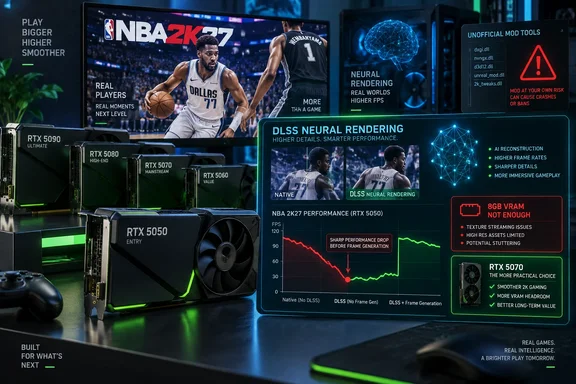
How-To Geek’s rundown of affordable DLSS 5-capable GPUs reaches the right broad conclusion—many recent RTX cards can at least demonstrate the technology—but it blurs the line between NVIDIA-supported DLSS 5 and community injection tools that attempt to put the neural-rendering pass into other games. For a PC buyer, those are very different propositions. One is a supported game setting; the other modifies rendering paths and game files, may trigger Windows security prompts, and should be kept far away from anti-cheat-protected multiplayer titles.
The practical answer is simpler than the headline suggests: existing RTX 50 owners can try DLSS 5 in its only official game today, while RTX 40 owners should wait for NVIDIA’s promised official expansion rather than buy or modify hardware solely for an experimental workaround.
NBA 2K27 remains the only official DLSS 5 test case
NVIDIA launched DLSS 5, which it calls 3D-Guided Neural Rendering, in NBA 2K27 on September 3. The feature appears inside the game as “DLSS Neural Rendering,” rather than as a plainly labelled “DLSS 5” switch. NVIDIA says the mode uses game-engine information—such as materials, lighting, geometry and motion—to improve the final image beyond conventional temporal upscaling.
There is an important limitation: NVIDIA’s official support applies to all RTX 50-series desktop and laptop GPUs, plus GeForce NOW systems running RTX 5080-class cloud hardware. The company specifies GeForce Game Ready Driver 616.64 WHQL or newer for the in-game option. NBA 2K Support separately states that the feature is exclusive to RTX 50-series GPUs.
That makes the RTX 5050 the lowest-cost supported GPU in a narrow technical sense. It does not make it the sensible DLSS 5 purchase. “Can enable the setting” and “has enough performance to use the setting comfortably” are not interchangeable, particularly for a rendering technology that adds substantial work to every frame.
NVIDIA’s own launch benchmarks advertised very high output-frame-rate figures, but they combined neural rendering with Super Resolution and Multi Frame Generation. Those figures are useful for showing the full feature stack, not for judging the native performance cost of DLSS 5 itself. TechSpot’s testing across the RTX 50 line and PC Gamer’s separate measurements both found a severe hit before generated frames are counted. PC Gamer reported NVIDIA had described a roughly 50–60 percent performance cost in briefing material, while its RTX 5080 test showed an even larger reduction in one 4K configuration.
That context changes the buying advice. DLSS 5 is currently a visual-quality feature that demands performance headroom; it is not a performance upgrade in the way most people learned to think about DLSS Super Resolution.
The RTX 5050 can run it, but that is a low bar
The RTX 5050 is the literal budget floor for official DLSS 5 access. In NBA 2K27 at 1080p, NVIDIA says virtually the entire RTX 50 family can use the game’s Ultra preset with ray tracing and DLSS 5. Independent testing broadly supports the claim that the card can run the game, but that should not be mistaken for a universal recommendation for DLSS 5 gaming.
Tom’s Hardware found that the RTX 5050, RTX 5060 and RTX 5060 Ti 8GB all display low-VRAM warnings in the relevant NBA 2K27 settings. The 8GB buffer is the more durable problem than a benchmark average. It leaves less room for high-resolution textures, ray tracing data, the neural rendering workload and generated-frame features at the same time. Reducing texture quality or rendering resolution can prevent stutter or warnings, but it cannot remove DLSS 5’s underlying compute cost.
For owners, the advice is uncomplicated: install the current driver and try the game feature if NBA 2K27 is already in the library. It is a legitimate way to see what NVIDIA’s first DLSS 5 implementation looks like. For buyers, it is difficult to justify a new RTX 5050 chiefly for one supported title and a feature whose frame-rate penalty is measurable even on much faster cards.
The RTX 5060 is a more credible 1080p starting point. NVIDIA’s launch chart put an RTX 5060 at up to 258 fps in a 1080p Ultra ray-traced configuration, but PC Gamer calculated that the underlying rate was closer to 43 fps once six-times Multi Frame Generation was removed from the marketing result. That does not make the experience unusable—generated frames can improve apparent motion smoothness—but it does mean buyers should not equate the advertised output with controller responsiveness or the game’s real render rate.
The RTX 5060 Ti offers more shader performance, but the 8GB version inherits the same memory constraint. Its 16GB sibling is the first card in this price tier that meaningfully addresses VRAM pressure, although GPU pricing can make it awkward value beside a discounted RTX 5070. A buyer considering either should compare actual street prices on the day, rather than assuming the product-stack gap reflects NVIDIA’s launch MSRP.
RTX 5070 is the practical lower limit for buying into DLSS 5
For someone specifically shopping for NVIDIA hardware and intending to use DLSS 5 now, the GeForce RTX 5070 is the first card that makes a broadly defensible case. Its 12GB of memory is not lavish at 1440p with ray tracing, but it gives the card more flexibility than the 8GB models and substantially more rendering performance than the RTX 5060 family.
NVIDIA’s NBA 2K27 figures put the RTX 5070 at up to 260 fps at 1440p with the full DLSS 5 feature stack enabled. Again, that number is output performance with generated frames and should be read accordingly. Still, the RTX 5070 has a better chance of retaining a viable pre-frame-generation rate when DLSS 5 is enabled, which is what determines whether frame generation is helping an already responsive game or covering an uncomfortably low base rate.
The larger issue is that no current budget GPU should be purchased on the assumption that DLSS 5 will soon be widespread. NVIDIA announced future support from major publishers, including Bethesda, Capcom, Ubisoft and Warner Bros., but NBA 2K27 remains the only official shipped implementation. A GPU purchase lasts longer than a launch window, so conventional performance, VRAM capacity, the games a buyer actually plays, and competing features such as AMD FSR should carry more weight than access to one early neural-rendering showcase.
RTX 40 support is coming, but mod support is not the same thing
How-To Geek notes that RTX 4060 and RTX 4060 Ti cards can be used with DLSS 5 through tools including OptiScaler and DLSS 5 Swapper. That claim needs a sharper warning label.
NVIDIA has said it plans to expand official DLSS 5 support to the RTX 40 series after it further tunes RTX 50 performance, but it has not provided a release date or committed to RTX 30- or RTX 20-series support. RTX 40 owners therefore have a reasonable reason to wait. They have hardware with Tensor cores and a stated path to official support, rather than a need to rely on third-party injection.
Community tools are doing something more complicated than merely replacing the familiar nvngx_dlss.dll Super Resolution library with a newer version. DLSS 5’s neural-rendering pass requires new inputs and a compatible rendering path. Modders have built OptiScaler forks and related packages that intercept or redirect data from games to attempt that pass. The results can be technically impressive, but they vary by API, game engine, graphics driver, GPU and mod version.
Tom’s Hardware reported that modders had patched incompatible CUDA instructions to bring DLSS 5 to RTX 40 hardware. That is evidence of rapid experimentation, not evidence of a supported feature set. A game that launches with an injected mod may still have image artifacts, instability, broken HUD elements, shader-compilation problems, unexpected VRAM use or different results after the game’s next update.
The RTX 4060 Ti may have enough raw performance for interesting 1080p experiments, while an RTX 4060 is best viewed as a curiosity platform rather than a DLSS 5 machine. Owners can test if they accept the risks. New buyers should not pay a premium for an older RTX 40 card on the theory that a modded DLSS 5 path is a substitute for official driver support.
Modding DLSS 5 carries Windows and account risks
The most consequential omission from affordability lists is security and account risk. DLSS 5 Swapper’s own release notes say its builds are not code-signed, so Windows SmartScreen can warn on first launch. That warning does not prove malicious behavior, but it means the normal publisher-identity assurance is absent and users must independently verify where they obtained the executable.
The project also warns that games with detected anti-cheat can crash, refuse to launch or result in an account ban after an installation attempt. Its software does not disable or bypass anti-cheat, but that is beside the point: modifying DLL loading and rendering hooks can still violate a game’s integrity checks. The safe rule is to treat DLSS 5 injection like other graphics modding: use it only in offline or explicitly mod-tolerant single-player software, back up original files, and keep the mod out of competitive games.
There is also a malware problem inherent to the way the current scene distributes components. A DLL is executable code, not a texture pack or a harmless preset. Tom’s Hardware recently reported warnings from the original DLSS Swapper project about untrusted, user-submitted DLL files. Downloading a “patched” neural-rendering library from a random file host or Discord repost is a far greater risk than being one driver version behind.
For Windows users, the prudent route is therefore clear. If you own an RTX 50 GPU, use NVIDIA’s official driver and NBA 2K27’s built-in setting. If you own RTX 40 hardware, wait for NVIDIA to deliver the support it has publicly indicated is planned. If you experiment with community tools on older cards, treat the exercise as mod testing—not as a stable DLSS 5 upgrade—and do it only where a bad DLL, a broken game installation or an anti-cheat response will not cost more than the experiment is worth.
References
- These are the cheapest GPUs that can run DLSS 5 (you probably own one already) How-To Geek · 2026-09-18T22:00:13+00:00