

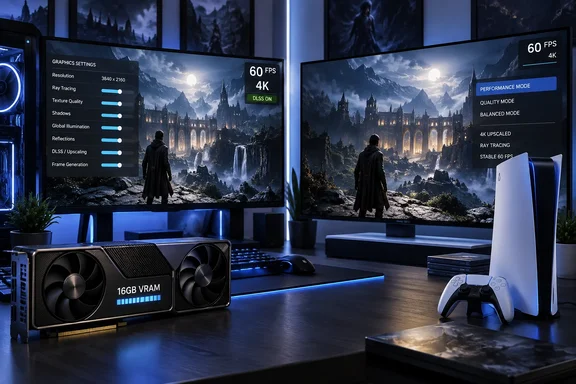
BGR’s September 20, 2026 comparison identifies the RTX 5060 Ti as the closest match. More concrete support comes from Notebookcheck’s July 8, 2025 account of Digital Foundry testing, which placed the PS5 Pro in broadly the same performance class as the RTX 5060 Ti 16GB and Radeon RX 9060 XT 16GB. That is an existing benchmark comparison, not a newly reported September 2026 test.
What the game comparisons establish
According to Notebookcheck, Digital Foundry compared Black Myth: Wukong, Forza Horizon 5, and Alan Wake 2, using console graphics modes as the starting point and adjusting PC settings to resemble them. The desktop graphics cards generally retained a small performance advantage.
Matching the graphics settings is central to interpreting the result. A PC running a game at its highest settings is a different workload from a console running its selected performance mode. The useful question is whether the PC can deliver a similar combination of visual quality, resolution and frame rate—not whether both platforms have a menu option called “Quality.”
Notebookcheck describes one comparison target as 4K output at 60 frames per second with upscaling. Upscaled 4K should not be treated as native 4K rendering: reconstructing an image for 4K output is a different workload from rendering every frame directly at that resolution. A claim that a card matches the console therefore needs to retain the upscaling qualification.
The ray-tracing results also resist a simple winner-and-loser ranking. Notebookcheck reports that the PS5 Pro maintained its 30fps target more consistently in Alan Wake 2’s ray-traced quality mode, while its ray-tracing quality was slightly lower than on PC. That supports two observations at once: the console could provide steadier delivery in that mode, and the PC was doing somewhat different visual work.
Those specific test conditions and stability observations are available through Notebookcheck’s account of Digital Foundry; they are not independently corroborated by a second test report in the available reporting. They support a performance-class comparison, not a guarantee for every game.
Why the 16GB model is the meaningful match
BGR names the RTX 5060 Ti without distinguishing memory capacities. Notebookcheck explicitly identifies the tested model as the RTX 5060 Ti 16GB and reports that the 8GB version underperforms in demanding games.
That makes the model distinction consequential for shopping. A less expensive listing bearing the same RTX 5060 Ti name is not necessarily the configuration behind the PS5 Pro comparison. The available reporting does not provide a complete game-by-game breakdown of the 8GB card’s limitations, so it cannot establish exactly where or by how much that version would fall behind.
For a buyer using these results as a reference, the supported starting point is the 16GB model. This is a narrower conclusion than saying every RTX 5060 Ti delivers PS5 Pro-level performance.
How to use the comparison when choosing a PC
Treat the RTX 5060 Ti 16GB as a shortlist candidate for a PC intended to deliver a PS5 Pro-like experience, with these boundaries:
- Compare similar visual settings and upscaling modes, rather than assuming a shared output resolution means an identical workload.
- Consider frame-rate stability alongside average performance; the reported Alan Wake 2 result shows why those can lead to different judgments.
- Keep the conclusion tied to the tested games rather than treating it as a promise about all future AAA releases.
- Compare a complete PC with the console when budgeting. A graphics card alone is not a functioning gaming system.
The evidence supports a useful answer without an exact hardware equivalence: the RTX 5060 Ti 16GB can deliver broadly comparable gaming performance at console-like settings, with some advantages for the PC and some game-specific strengths for the PS5 Pro. It does not establish that the card will reproduce every console mode—or that it is today’s best-value purchase at any asking price.