

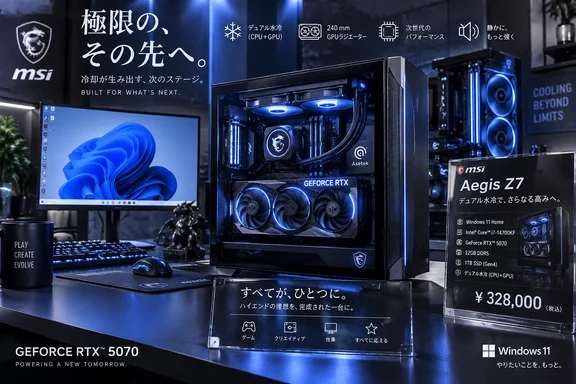
Asetek’s announcement frames the launch as a G TUNE flagship release. Mouse Computer’s own Tokyo Game Show 2026 materials and reporting from 4Gamer show the scope is wider: the same “GeForce RTX 5070 Liquid-Cooled Overclocked Edition” is offered in both G TUNE and NEXTGEAR desktops. That matters for prospective buyers because it places the cooling design in systems starting well below the flagship G TUNE pricing tier, while also confirming that there is no announced add-in-board version for DIY builders or North American system integrators.
The technical premise is straightforward. NVIDIA’s standard RTX 5070 specification is a 250 W card with a 2,512 MHz reference boost clock. Mouse Computer’s liquid-cooled version raises the advertised boost clock to 2,610 MHz, a modest 98 MHz increase, while Asetek rates its cooling assembly for up to 300 W of total graphics power. The extra thermal capacity is intended to preserve boost behavior under sustained load rather than turn the RTX 5070 into a substantially higher-tier GPU.
The 240 mm radiator is for the GPU, not the whole system
The launch materials created an avoidable point of confusion by referring to radiators of different sizes. PC Watch reported a 360 mm radiator in its coverage of the G TUNE systems, while Asetek’s release and Mouse Computer’s product information specify a 240 mm radiator for the liquid-cooled RTX 5070.
Both reports can be true. 4Gamer, which covered the Tokyo Game Show presentation in greater detail, reports that the graphics card uses the 240 mm Asetek loop, while some G TUNE configurations add a separate 360 mm liquid cooler for the CPU. In other words, the higher-end G TUNE machines can be dual-liquid-cooled: one radiator and loop for the processor, another for the graphics card.
That distinction is useful for anyone trying to assess the claimed thermals. A 360 mm CPU radiator does not make the RTX 5070’s own cooling loop larger. The GPU’s cooling hardware remains a 240 mm design, which is still substantial for a 250 W-class graphics card but does not change the card’s power category.
The card also is not passively cooled. 4Gamer observed that the GPU retains an air-cooling fan in addition to its liquid loop. Asetek’s claim that the radiator exhausts heat directly outside the chassis describes the radiator’s contribution, but buyers should not read that as meaning every watt associated with the GPU and surrounding board components is removed from the case exclusively through liquid cooling.
Mouse’s performance figures need the right comparison
Mouse Computer says its liquid-cooled RTX 5070 scored up to 7.89 percent higher in the 3DMark Fire Strike Graphics test than an air-cooled RTX 5070, while reducing full-load GPU temperature from 75.3°C to 56.2°C. That is a large reported temperature gap—about 19°C—and it is the strongest practical result disclosed at launch.
But it is still a vendor benchmark, not an independent review, and it is narrowly framed. Fire Strike is an older DirectX 11 synthetic benchmark; it does not establish that every modern game, ray-traced workload, creator application, or AI task will gain nearly 8 percent. Mouse has not published the complete test configuration, including the exact air-cooled card, fan profile, case airflow, room temperature for that comparison, or whether power limits differed between the two cards.
The clock specification gives a more grounded expectation. The 2,610 MHz advertised boost is roughly 3.9 percent above NVIDIA’s 2,512 MHz reference value. Performance gains can exceed the nominal clock increase when a conventional air-cooled card encounters temperature or power constraints, but the available evidence supports viewing the claimed 7.89 percent result as a best-case benchmark outcome, not a general performance guarantee.
The thermal result may still be meaningful for long gaming sessions, GPU rendering, or sustained encoding loads. Modern GeForce cards use opportunistic boost behavior, so lower core temperatures can help a card hold higher clocks for longer. What has not yet been independently established is whether the liquid model maintains that advantage in a closed retail chassis across a range of games—or how much extra power the overclocked model actually consumes while doing so.
The noise figures are promises, not system-level proof
Asetek says the pump reaches 20 dB(A) at one meter, or 27 dB(A) at 25 cm, and claims the complete system remains around 30 dB(A) while handling a 250 W load in a 35°C ambient environment. The company also says the loop uses corrosion-resistant metals, EPDM tubing with low permeability, and is designed for a 50,000-hour operational life without maintenance.
Those are manufacturer specifications, and neither Mouse Computer nor the independent event reports have published instrumented acoustics testing of a retail G TUNE or NEXTGEAR configuration. The distinction is not pedantic: a pump’s sound pressure measurement, a radiator’s fan noise, a graphics-card fan, CPU cooling, power supply noise, and case resonance all add up differently depending on enclosure and fan curves.
The claimed 35°C ambient condition is notable because it is warmer than the roughly 20°C to 23°C test rooms commonly used for component reviews. If the reported full-system noise level can be replicated at that temperature, it would be a respectable result. For now, however, it remains a claim that should be judged alongside independent testing rather than a reason to assume the systems will be near-silent in every room or workload.
The actual products are Windows 11 desktops sold in Japan
Mouse Computer lists the RTX 5070 liquid-cooled option in at least four newly announced desktop configurations: G TUNE FZ-I5G7L and FZ-I7G7L, plus NEXTGEAR JG-I5G7L and HD-A7G7L variants. The G TUNE FZ-I5G7L starts at ¥569,800, and the Core Ultra 7-equipped FZ-I7G7L starts at ¥589,800. The entry-level NEXTGEAR JG-I5G7L starts at ¥349,800.
The system differences matter more than the shared GPU label. The G TUNE FZ-I5G7L uses an Intel Core Ultra 5 250K Plus, 32 GB of DDR5 memory, a 1 TB PCIe 4.0 NVMe SSD, Windows 11 Home, and a 360 mm CPU liquid cooler. The lower-cost NEXTGEAR JG-I5G7L instead uses Intel’s mobile-oriented Core Ultra 5 245HX in a desktop, 16 GB of DDR5 memory, and an air-cooled CPU. That makes it the least expensive route to the water-cooled GPU, but it is not a like-for-like alternative to the larger G TUNE tower.
Mouse Computer’s official listings also make the regional limit clear. These machines are sold through its Japanese web store, direct stores, phone sales, and corporate channels, with Japanese yen pricing and Windows 11 Home configurations. Asetek and MSI have not announced a global launch, a U.S. distributor, standalone-card pricing, or an upgrade path for owners of existing RTX 5070 PCs.
Cooling is the product here, not a new RTX 5070 tier
Asetek’s 300 W thermal-capacity figure leaves about 50 W above the RTX 5070’s standard 250 W rating, but there is no announcement that Mouse has raised the card’s board power limit to 300 W. The evidence so far points to cooling headroom intended to stabilize an overclocked RTX 5070, not an unlocked 300 W RTX 5070 mode.
For Windows gamers in Japan, the practical appeal is a factory-integrated liquid loop with a reported 19°C full-load temperature reduction and the convenience of a complete, warrantied desktop. For everyone else, the announcement is a demonstration of an OEM-specific design rather than a new option at the graphics-card shelf. Until MSI, Asetek, or Mouse Computer publishes broader availability and independent reviewers test retail systems, the RTX 5070 liquid-cooled edition remains a tightly controlled Japanese prebuilt experiment—with impressive claimed thermals, but a relatively small advertised overclock.
References
- (PR) Asetek Brings Custom RTX 5070 Liquid-Cooled Desktop at TGS 2026 with Mouse Computer and MSI TechPowerUp · 2026-09-18T18:33:25+00:00