

The $16,000 listing
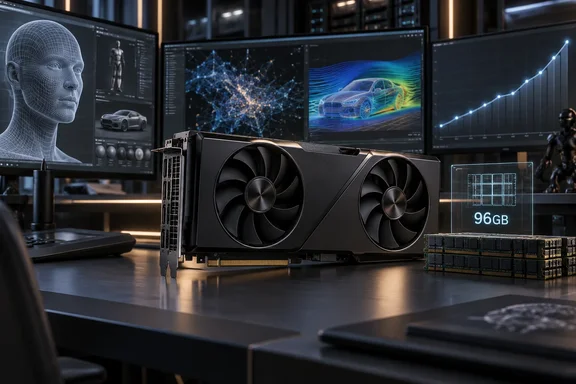
NVIDIA's US Marketplace now lists the 96GB workstation card at $16,000, up from $13,250 in June. That is another 20.8% increase in just two months. The June change was also large. According to VideoCardz, the June increase had already pushed the price up by about 55%, from $8,565 to $13,250.
The starting price needs a caveat. NVIDIA did not announce an official MSRP at the time, but early US retailer listings showed the boxed Workstation Edition at $8,565, while bulk pricing started at $8,435. Some buyers paid even less, since later preorder offers went as low as $7,673.
Here is the price history reported by VideoCardz, Tom's Hardware and others:
| Point in time | Reported price | Notes |
|---|---|---|
| March 2025 (preorders) | as low as $7,673 | Short-lived preorder offers |
| Spring 2025 (launch listings) | $8,565 single / $8,435 bulk | Retailer listings; no official MSRP announced |
| June 2026 | $13,250 | NVIDIA US Marketplace |
| August 2026 onward | $16,000 | NVIDIA US Marketplace |
That puts the card 87% higher than the $8,565 launch listing. Tech Insider Canada checked the math: going from $8,565 to $16,000 works out to a $7,435 increase, or about 86.8 percent, in under a year and a half. Thunder Compute also confirmed the $16,000 Marketplace price was still standing in September 2026.
Section summary: NVIDIA's own US store now lists the RTX PRO 6000 Workstation Edition at $16,000. That's about 87% above the early 2025 listings and more than double the lowest preorder offers.
Why NVIDIA raised the price: we don't know
NVIDIA hasn't given a reason. Tom's Hardware says these price hikes were not officially confirmed by Nvidia at any point during 2025 and 2026. NVIDIA just changed its store listing each time.
The usual suspect is memory. Tom's Hardware argued that with the ongoing component crisis continuing to worsen memory prices, these changes are not a surprise, especially when you consider the RTX Pro 6000 Blackwell has 96GB of GDDR7 VRAM. TweakTown went further and pointed to the board layout: the RTX PRO 6000 Blackwell GPU features 32 x 3GB GDDR7 modules, so the memory price increases seen in recent months are multiplied by 32. TweakTown also said plainly that this is an assumption on its part, not a statement from NVIDIA.
That explanation is plausible. It's still an explanation from outside the company, and "memory got more expensive" doesn't prove that every dollar of a $7,435 increase is component cost. Margin and demand from AI buyers may also play a part. Nobody outside NVIDIA knows how those factors split.
The increase also isn't limited to workstation cards. TechSpot reports that over the past few months, Nvidia has also increased prices for its consumer GPUs by as much as 150%, with high-end cards such as the RTX 5090 and RTX 5080 seeing the largest hikes. So the $1,999 RTX 5090 launch price is itself now mostly history.
Section summary: NVIDIA has explained none of the increases. Rising GDDR7 costs are the most commonly cited factor, but that is analysts' reasoning, not a confirmed cause.
What you get for the money
At its core, the RTX PRO 6000 is a larger version of the same chip family used in the RTX 50 series. Tech Insider Canada, drawing on NVIDIA's spec sheet and TechPowerUp's database, lists 24,064 CUDA cores, 752 fifth-generation Tensor cores, and 188 fourth-generation RT cores built on the Blackwell GB202 die.
Here's how it compares with the RTX 5090:
| Spec | RTX 5090 | RTX PRO 6000 Workstation Edition |
|---|---|---|
| CUDA cores | 21,760 | 24,064 |
| Memory | 32GB GDDR7 | 96GB GDDR7 with ECC |
| Memory interface / bandwidth | 512-bit / 1,792GB/s | 512-bit / 1,792GB/s |
| Power | 575W | 600W |
| Launch pricing | $1,999 | ~$8,565 (listings), now $16,000 |
TweakTown confirms an expanded CUDA Core count of 24,064 compared to the RTX 5090's 21,760, along with 96GB of GDDR7 memory, with a similar 512-bit interface as the RTX 5090 offering up a massive 1,792 GB/s of bandwidth.
NVIDIA's spec page adds that the Workstation Edition's memory uses error-correcting code (ECC), is rated at 600W, connects over PCIe Gen 5 x16, and is a dual-slot card measuring 5.4 by 12 inches with a double flow-through cooler. It has four DisplayPort 2.1 outputs.
The biggest difference is memory. The core count is only about 10% higher, while memory capacity is three times larger. Bandwidth is the same. For games, that means you shouldn't expect anything close to a proportional speedup. Games at 4K rarely fill 32GB, let alone 96GB. For AI and simulation work, the extra memory can decide whether a job runs at all. As Viperatech puts it, the 96GB pool allows professional users to work with large AI models, complex 3D environments, scientific workloads, simulations, and other datasets without being as constrained by GPU memory capacity.
Section summary: You're paying mostly for 96GB of ECC memory, not for a much faster chip. That's why it matters so much to AI developers and makes almost no difference in games.
Three cards share the name
"RTX PRO 6000 Blackwell" covers three products, so read listings carefully. NVIDIA's lineup includes:
- Workstation Edition: 600W with a double flow-through cooler. NVIDIA markets it for single-GPU desktops running 3D rendering, AI development and real-time simulation. This is the card listed at $16,000.
- Max-Q Workstation Edition: 300W with a blower-style active cooler. It's aimed at dense workstations with up to four GPUs.
- Server Edition: passively cooled and rated at 400–600W, for rack servers that handle their own airflow.
All three have 96GB of ECC GDDR7. A cheaper "RTX PRO 6000" listing may be a different edition, so check which one before comparing prices.
Store prices vary
NVIDIA's list price isn't the only price. In August, Tom's Hardware found the same SKU listed on Newegg for $13,998, so $2,000 less than Nvidia's official store, and B&H has the RTX Pro 6000 Blackwell up for $15,499. The outlet expected lower listings to rise once old stock ran out. By September, Thunder Compute was reporting Newegg and B&H at $15,999+, and used listings range from $14,980–$18,850.
For anyone buying one, especially for a department or small AI team:
- Check the edition. Confirm Workstation, Max-Q or Server before comparing prices.
- Compare several sellers. NVIDIA's Marketplace, authorized distributors and big retailers have differed by thousands of dollars.
- Price the whole system. A 600W card needs a power supply, case airflow and chassis that can handle it. Prebuilt workstations from OEM partners may be a better deal than building your own.
- Buy for your real workload. If your models or scenes fit in 32GB, a GeForce card may do the job. If they need more than that, the 96GB of memory is what you're paying for.
- Be careful with used cards. Used listings have sometimes been priced above new ones. Check the warranty and whether the seller is legitimate.
The bottom line
NVIDIA doesn't need to block consumers from buying this card. The price does that already. The RTX PRO 6000 Blackwell Workstation Edition is a professional product aimed at AI developers, engineers and 3D artists. It costs roughly eight times the RTX 5090's launch price, and most of that premium pays for memory that games don't use.
The bigger worry for Windows PC buyers is where prices go next. Memory costs are pushing up consumer and professional GPUs alike, and NVIDIA has raised its store price without explanation twice in about two months. A $16,000 listing may not be the last increase.