

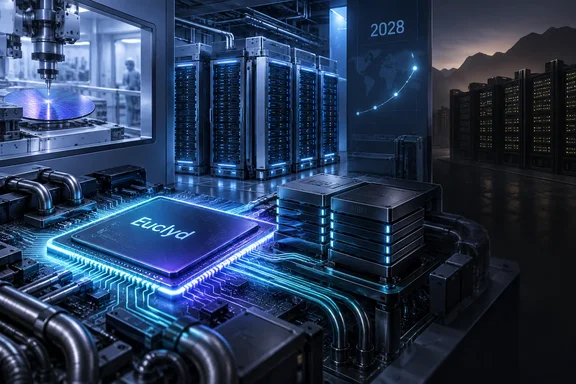
The funding was announced by Euclyd on September 15, with Samsung, Somerset Capital Partners, the Scaleup Europe Fund managed by EQT, and Innovation Industries named as co-leads. TechRadar described the round as $231 million, a reasonable conversion of the announced €200 million-plus total, but the company has not disclosed how much Samsung itself invested. More importantly, Euclyd’s own release describes a roadmap for silicon, memory architecture, and datacenter systems; it does not announce a shipping accelerator, a customer deployment, or independently measured performance.
For IT buyers accustomed to Nvidia’s mature hardware, CUDA stack, OEM server catalog, and enterprise support channels, the distinction is substantial. Euclyd has raised a very large Series A round, but it remains a company selling a future platform rather than currently deployable compute.
Samsung’s role reaches beyond a financial stake
Samsung’s participation matters because Euclyd’s central pitch is a processor-and-memory design intended to reduce the cost and power required to run AI inference. The company calls its silicon platform craftwerk and its rack-scale system craftwerk station CWS. Its thesis is that inference—serving responses from already-trained models—benefits from a less general-purpose architecture than the GPU systems that became standard for AI training.
Euclyd’s announcement says its approach combines programmable ASIC compute, processor-memory co-design, and datacenter-level optimization. EQT, one of the round’s co-leads, offers more detail: it says Euclyd is trying to reduce the distance data travels between compute and memory by pairing many smaller processing elements with local DRAM rather than relying on a relatively centralized memory pool. That is a recognizable answer to the memory wall: modern AI workloads can spend a large share of their time and energy moving model weights and context data rather than doing arithmetic.
Samsung is therefore potentially more useful to Euclyd than a conventional venture investor. The company is a major memory supplier and a semiconductor manufacturer with packaging, supply-chain, and systems expertise relevant to a design that makes memory placement a defining part of the product. Bernardo Kastrup, Euclyd’s chief executive, told CNBC that Samsung could offer engineering, systems knowledge, supply-chain experience, and a large network in addition to money.
There is one detail worth separating carefully. Euclyd’s own announcement names “Samsung” as a co-lead, while EQT identifies the investor as the Samsung Catalyst Fund. The public materials do not disclose the investment amount, manufacturing agreement, foundry node, packaging arrangement, or any commitment for Samsung to produce commercial Euclyd parts. Investors and suppliers can overlap in semiconductors, but a strategic investment is not automatically a volume-manufacturing contract.
A test chip is real progress, but it is not product validation
EQT says Euclyd’s first test chip was manufactured at Samsung and will validate the company’s compute architecture. That is the most concrete sign in the public record that the project has moved beyond diagrams and fundraising. It also underlines how early the program remains.
A test chip normally answers engineering questions: whether a design can be fabricated, whether its basic compute blocks function, whether memory interfaces behave as expected, and whether power, clocks, thermals, yield, and packaging assumptions hold up in silicon. Those are essential milestones, but they do not prove that an accelerator will run production foundation models reliably, match claimed cost-per-token targets, or scale across racks under enterprise workloads.
Euclyd had already publicized ambitious craftwerk specifications in 2025, including 16,384 SIMD processors, 1TB of custom “ultra-bandwidth memory,” 8PB/s of claimed bandwidth, and up to 32 petaflops at FP4 precision. TechRadar reported those figures when the company unveiled the design at the KISACO Infrastructure Summit in Santa Clara. The same report noted the absence of independent testing.
This week’s financing announcement notably does not repeat those numerical specifications. Instead, it uses broader descriptions such as “agentic AI silicon,” “innovative memory architecture,” and “the world’s lowest-power exascale AI factory.” That does not establish that the earlier targets were withdrawn; it does mean Euclyd is not yet putting updated, externally verifiable performance and efficiency figures behind its 2028 commercial target.
For administrators, the correct reading is straightforward: a fabricated test chip is an engineering milestone, while a deployable AI platform requires demonstrated hardware, a supported software stack, benchmark methodology, availability commitments, service terms, and clear compatibility documentation.
The missing software story is the hard part for enterprise adoption
Euclyd says it intends to sell complete hardware and rack systems to enterprises that want to run inference on premises, while also licensing its underlying intellectual property to companies that want to build chips around the design. SiliconANGLE, citing CNBC, independently reported the same two-part commercial plan and the 2028 launch target.
The split could give Euclyd two possible routes to market. Direct systems sales would put the company in the difficult business of supplying, installing, servicing, and supporting AI infrastructure. IP licensing could broaden adoption if an established silicon vendor takes the architecture into a shipping part. Neither route is explained in enough detail yet to tell buyers which one will arrive first, what form the system will take, or whether they will be buying from Euclyd, a server partner, or a licensee.
The announcement also leaves the most important practical question for Windows and enterprise AI teams unanswered: software. Euclyd has not publicly identified its compiler toolchain, runtime, supported model formats, framework integrations, operating-system support, cluster-management integration, observability tooling, or migration path for CUDA-dependent code. It has not named support for PyTorch, ONNX Runtime, TensorFlow, vLLM, Kubernetes device plugins, or Windows Server.
Those omissions are normal for a company still years from shipment. They are nevertheless the main reason Euclyd cannot yet be assessed as a substitute for Nvidia in an enterprise environment. AI accelerators compete on far more than peak precision throughput. A procurement team needs to know whether a model can be compiled without substantial rewriting, how quantization is handled, what happens when a workload falls outside the chip’s optimized execution model, and whether the vendor can support a fleet after deployment.
Specialized inference silicon can win on energy efficiency and predictable high-volume serving. It can also impose limits that general-purpose GPU platforms avoid. Nvidia’s advantage is not simply that it has fast chips; it is that its platform has accumulated years of libraries, frameworks, drivers, profiling tools, systems partners, and operational knowledge. Euclyd must demonstrate a credible answer to that software and operations gap before its hardware claims become a buying decision.
Nvidia remains the incumbent, not the immediate target
Calling Euclyd a company that will “dethrone” Nvidia is premature. Euclyd is targeting a narrower but consequential segment: inference for foundation models and AI agents, where memory bandwidth, power draw, rack density, and token-serving costs can matter more than the flexibility needed for research and training.
That segment has attracted multiple challengers because GPU architecture was not originally designed around today’s sustained, high-volume model serving. Groq, Cerebras, d-Matrix, hyperscaler-designed chips, and Nvidia’s own increasingly specialized systems all reflect the same pressure: reducing the cost of producing useful AI output at scale. Euclyd is entering that competition with a different memory-centric architecture and unusually deep funding for a European startup at this stage.
Its backers also provide a notable European semiconductor connection. Peter Wennink, ASML’s former chief executive, has joined Euclyd as board chair. Euclyd’s founders, Kastrup and Atul Sinha, previously co-founded Silicon Hive at Philips Research, a company later acquired by Intel. EQT says several of Euclyd’s other founders have worked with the pair across Philips, Silicon Hive, and Intel, lending the company more chip-design history than the typical newly formed AI startup.
Experience and capital reduce execution risk, but they do not erase it. The path from first test silicon to a manufacturable, supportable rack-scale platform includes validation, packaging, memory supply, thermal design, software enablement, systems integration, customer qualification, and production yield. A 2028 target leaves time for those steps, yet it also gives Nvidia and every established accelerator vendor multiple product cycles to advance.
Euclyd’s €200 million-plus raise is significant because it funds a European attempt to solve inference economics through new silicon rather than another layer of AI software. For enterprise buyers, the actionable conclusion is more modest: monitor its software disclosures and customer validation, but do not build a 2026 or 2027 infrastructure plan around hardware that is still headed for its first commercial delivery in 2028.
References
- Tiny Dutch startup enlists Samsung as backer as it seeks to dethrone Nvidia AI GPU — but Euclyd won't get its inference chip out till 2028 TechRadar · 2026-09-18T21:20:00+00:00