

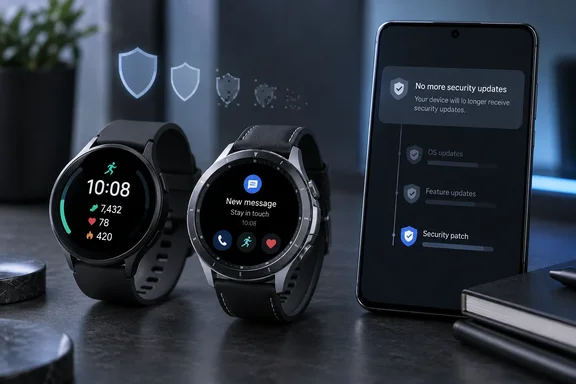
That distinction is where the submitted report gets the broader ownership question right but blurs an important practical line. Samsung’s own update records list the latest identified Watch4 and Watch4 Classic firmware as builds R870XXS2JZG3 and R880XXS2JZG3, released August 25, 2026, with the August 5, 2026 security patch. The report calls September 2026 the final update, but the available official changelogs point to August 25, while Samsung’s September security-support roster no longer includes either model.
Android Authority, Android Central, SamMobile, and Samsung’s own support material independently support the larger conclusion: Watch4 software support is over. The useful news for owners is less dramatic than “your watch has expired,” but more actionable. A working Watch4 is now an aging Android endpoint that may remain serviceable for years, while its risk rises as companion apps, cloud-backed services, and unpatched vulnerabilities accumulate.
Samsung kept the major-update promise, then stopped the clock
The Galaxy Watch4 line began shipping in August 2021 as Samsung’s first major move away from Tizen and onto the jointly developed Wear OS platform. Samsung later committed to four generations of One UI Watch and Wear OS upgrades for eligible Galaxy devices. By that measure, the Watch4 received a notably long run: its original Wear OS 3 platform was followed by Wear OS 3.5, Wear OS 4, Wear OS 5, and finally Wear OS 6 through One UI 8 Watch.
The final major upgrade arrived gradually rather than in one universal release. Samsung’s changelogs show One UI 8 Watch firmware for the Bluetooth Galaxy Watch4 and Watch4 Classic in late 2025, followed by 2026 maintenance releases. The August 25 builds were security-only updates, which means the last meaningful feature delivery had already happened.
Samsung has now removed the Galaxy Watch4 and Galaxy Watch4 Classic from the company’s Mobile Security update scope. That is a clearer end-of-life marker than vague language about a device reaching its “final update.” A product can receive a last patch without a formal date of retirement; removal from the security scope tells customers that subsequent vulnerabilities should not be expected to receive vendor fixes.
Samsung has not published a detailed end-of-support bulletin explaining whether every regional, LTE, and carrier variant received the August package, whether any exception patches are possible, or which future phone and Galaxy Wearable versions will remain compatible. Its changelogs explicitly warn that availability varies by country, model, and carrier. Owners should therefore check the watch’s installed build and patch level rather than assume that a notification, or lack of one, settles the question.
End of updates is a security issue, not an instant failure
For most people, a Galaxy Watch4 will keep telling time, tracking exercise, receiving Bluetooth notifications, and running installed apps after support ends. A software-support cutoff does not erase the operating system, turn off the display, or automatically sever Bluetooth. The article’s warning becomes misleading if it makes those outcomes sound inevitable or immediate.
But a smartwatch is more exposed than a simple digital watch. Galaxy Watch4 models use Wear OS, connect to Android phones through Galaxy Wearable, access Wi-Fi and Bluetooth, can install apps from Google Play, and on LTE models can make calls and exchange data over a carrier connection. Each of those interfaces can become a maintenance liability once security fixes stop.
The risk is especially relevant for people who use the watch to approve notifications, store payment credentials, receive work alerts, or pair it with a phone that carries corporate data. Samsung’s Knox material describes Wear OS-based Galaxy watches as part of its enterprise-security posture, but that positioning depends on maintained software. An unpatched wearable should not be treated as a durable second-factor device or a trustworthy endpoint for sensitive notifications merely because it still powers on.
There is also a subtler operational problem: support expiry moves the compatibility burden from Samsung to the owner. A future Android release, Galaxy Wearable update, Google Play services change, banking-app policy, or Samsung Health revision may be perfectly reasonable on its own yet leave an older watch with reduced functionality. Samsung continues to list the Watch4 among compatible Wear OS watches in current consumer-support pages, but that is a present-tense compatibility statement, not a promised horizon.
For now, the sensible response is proportionate:
- Install the latest available watch firmware and update Galaxy Wearable, Samsung Health, Google Play services, and watch apps while those updates remain available.
- Remove payment cards and reconsider notification mirroring if the watch is used for work messages, authentication prompts, or other sensitive information.
- Keep the paired Android phone current, because the phone becomes the practical security boundary for an unsupported watch that continues to rely on it.
- Avoid factory-resetting a functioning Watch4 without confirming that the current Galaxy Wearable application can still set it up again on the phone you intend to use.
The fourth point is easily overlooked. Long after a device is usable day to day, a replacement phone, reset, or account change can reveal that the real dependency was not the watch hardware but the companion-app and cloud setup path.
Spotify and Revolv show what a true remote cutoff looks like
The Galaxy Watch4’s retirement is not the same event as Spotify’s Car Thing shutdown. Spotify launched Car Thing widely in the United States in February 2022 for $89.99, stopped production in July of that year, and then announced in May 2024 that every unit would stop operating on December 9, 2024. TechCrunch and Ars Technica reported that the shutdown occurred on schedule.
Car Thing was not merely unsupported; Spotify controlled an essential service dependency and elected to disable the product. The company cited product-demand and supply-chain considerations when it halted production, while its later decision left existing owners unable to use the original device. Community projects and temporary workarounds emerged, but they were attempts to reclaim utility after Spotify’s service decision, not an official continuity plan.
Google’s Nest did something similar with the Revolv smart-home hub. Nest acquired Revolv in 2014, ceased sales, and announced that the hub and its app would stop working on May 15, 2016. Contemporary reporting from TechCrunch, VentureBeat, and Time confirmed that the server-backed device was being permanently disabled. Owners of what had been an expensive home-automation controller could not preserve its central purpose by declining updates or replacing a battery.
Those cases establish the part of the ownership argument that matters: a device can be physically intact but functionally contingent on a company’s servers, applications, accounts, certificates, or APIs. The purchaser owns the hardware object, but may not control the services required for it to perform its advertised role.
Samsung’s Watch4 is in a middle category. It is heavily dependent on software and services, but its essential local functions do not currently appear to be subject to an announced kill switch. Calling every end-of-support notice a “brick” hides the real hierarchy of risk. A discontinued product is inconvenient; a server-dependent product can be revocable.
“Buy” still does not settle ownership of digital media
The same distinction applies to ebooks, films, music, and digital games, where the object a customer receives is often a revocable license rather than a transferable copy. Amazon’s 2009 removal of unauthorized editions of George Orwell’s 1984 and Animal Farm from Kindle devices remains the classic illustration: downloaded files can be changed or removed when a retailer retains control of the delivery and rights system.
California’s Assembly Bill 2426 took effect on January 1, 2025. It requires clearer disclosure when stores offer revocable digital goods and restricts the use of ownership-suggesting terms such as “buy” and “purchase” unless the seller obtains an affirmative acknowledgment that the transaction is a license or presents a clear, conspicuous disclosure before checkout. The law improves the label, but it does not turn a license into a DRM-free, perpetual copy.
That also means physical media is not a universal escape hatch. A disc or cartridge is usually stronger evidence of possession and can work without a retailer library, but modern games may require downloads, accounts, online authentication, patches, or servers. The practical test is not whether a store button says “Buy.” It is whether the product remains useful when the seller, account system, or network disappears.
For Galaxy Watch4 owners, the immediate consequence is straightforward: the device has passed its supported life, not its usable life. Keep it if its current features meet your needs, update it to the newest available firmware, and treat it as a lower-trust accessory rather than a future-proof health, payment, or work device.
References
- Your smartwatch will stop working someday, and the company gets to decide when MakeUseOf · 2026-09-17T12:00:14+00:00