

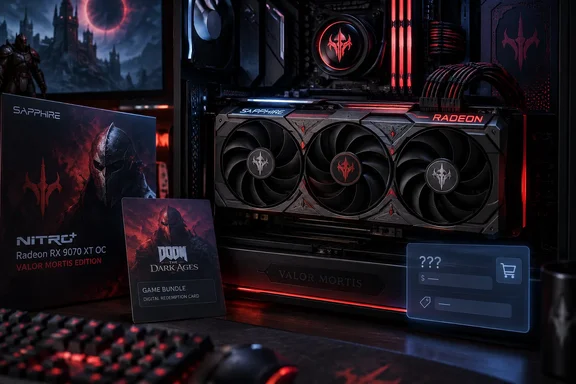
The product is real, not a render-only collaboration. Sapphire’s own product listing identifies it as SKU 11348-12-20G and confirms the key hardware configuration: an RDNA 4-based RX 9070 XT with 16GB of GDDR6 on a 256-bit bus, 4,096 stream processors, a 2,520MHz game clock, and a boost clock up to 3,060MHz. IT Home independently reported the announcement on September 18, describing the themed cooler accents and magnetic backplate. The card therefore appears to be the existing NITRO+ RX 9070 XT OC under a new exterior treatment, rather than a faster or otherwise reworked board.
That distinction sets the proper expectation for PC builders: this is a collector-oriented variant of an already premium Sapphire design. Its value will turn entirely on the eventual markup over the standard NITRO+ card and the mechanics of the game bundle.
A themed NITRO+ card, not a new RX 9070 XT tier
Sapphire’s Valor Mortis edition retains the headline characteristics of the company’s standard NITRO+ Radeon RX 9070 XT OC. The 3,060MHz boost figure matches the factory-overclocked NITRO+ specification, and the 16GB memory capacity, 64 compute units, and 256-bit memory interface are properties of AMD’s RX 9070 XT GPU rather than additions enabled by the collaboration.
The visible changes are concentrated around Sapphire’s MagniPlate backplate system and branding. Sapphire lists a Valor Mortis Edition quick-connect magnetic backplate, while IT Home reports themed fan-hub badges as well. The physical design is useful in one limited, practical sense: Sapphire’s NITRO+ cooler hides the 12V-2x6 power connection under the removable backplate, so the magnetic panel is part of access to the connector rather than merely cosmetic trim.
But buyers should not mistake that removable cover for a convenience feature with no planning requirement. A system using this card still needs room above and beside the GPU for the 12V-2x6 cable bend, especially in compact cases. Sapphire includes a three-eight-pin PCIe adapter for power supplies without a native 12V-2x6 lead, but an adapter does not solve clearance problems and creates more cable bulk in precisely the area the hidden-connector design is meant to clean up.
Sapphire rates the NITRO+ RX 9070 XT design at 330W, above AMD’s 304W total board power reference specification. The factory overclock and high-end cooler explain that difference, but they also mean this is not an entry-level board to pair casually with an aging or marginal power supply. Builders replacing a previous midrange GPU should check both their available PCIe power leads and their case dimensions before treating the themed backplate as a reason to buy.
The free game is confirmed, but its redemption rules are not
Sapphire’s product page says that Valor Mortis is included free in the box and that it will be redeemed through AMD Rewards. That establishes more than Wccftech’s initial report, which cited IT Home for the bundle: the promotion is directly described by Sapphire.
What Sapphire does not provide on the product page is the information that determines whether a buyer can actually receive the game. There is no start or end date for qualifying purchases, no participating-retailer list, no stated geographic coverage, and no redemption deadline. There is also no explanation of whether all Valor Mortis Edition cards will contain a code or whether the offer will depend on retailer participation, allocation, or remaining codes.
That omission matters because Sapphire’s current AMD-sponsored RX 9070-series offer is for a different title, Onimusha: Way of the Sword. Sapphire says that separate promotion runs from August 25 through September 26, 2026, and explicitly says retailers—not Sapphire—distribute the codes. The same notice directs customers to AMD’s participating-retailer list and warns that Sapphire itself does not hold keys for distribution.
The Valor Mortis Edition listing uses different wording, saying the game is included “in the box,” but it still points to AMD Rewards. Until Sapphire or AMD publishes formal terms, buyers should not assume the two promotions are interchangeable or that a general RX 9070 XT purchase qualifies. The safe reading is narrower: purchase the exact Valor Mortis Edition from a retailer whose listing explicitly includes the game, and preserve proof of purchase until the redemption succeeds.
Valor Mortis itself is scheduled for release on October 13, 2026. That date is supported by the game’s Steam page and developer One More Level’s recent Steam community updates. IT Home listed October 14, likely reflecting a regional storefront date or time-zone conversion, but the Steam listing and the developer’s stated schedule point to October 13 as the date U.S. PC buyers should use.
The price silence is the story
AMD launched the Radeon RX 9070 XT with a $599 suggested price in March 2025. That figure is now historical context rather than a realistic guide to the price of Sapphire’s premium board. The original NITRO+ Radeon RX 9070 XT OC already carried a premium for its cooler, factory overclock, hidden power arrangement, and build materials; the Valor Mortis version adds limited-edition art and a game whose standalone value has not been announced in Sapphire’s promotion terms.
PC Gamer’s current U.S. price watch puts readily available RX 9070 XT models around $759 to $800, with Amazon, Walmart, and Newegg listings near $800. That is roughly $160 to $200 above AMD’s original reference price before accounting for any special-edition premium. Earlier in 2026, Tom’s Hardware and VideoCardz documented temporary RX 9070 XT deals near $699, sometimes tied to free hardware or game offers, showing how sharply the market has moved since then.
The market comparison means Sapphire cannot make the bundle look compelling simply by saying it includes a free game. A $70 game, even if that proves to be its final price, does not make an $850 or $900 card equivalent to a $700 card—particularly when the base NITRO+ model and competing RX 9070 XT boards already use similar GPUs and offer comparable gaming performance.
Sapphire has given prospective buyers no MSRP or suggested price in any currency, and no retailer has yet surfaced in the material reviewed for this announcement. That makes any estimate speculative. Still, the product’s economic test is straightforward: the Valor Mortis Edition must land close enough to the standard NITRO+ RX 9070 XT OC that the themed hardware and game feel like a genuine limited-edition package rather than a way to normalize a larger markup during a period of elevated GPU pricing.
What does—and does not—change for Windows gaming PCs
For a Windows gaming system, the performance proposition remains the normal RX 9070 XT proposition. AMD’s RDNA 4 platform supports the company’s FidelityFX Super Resolution 4 upscaling on RX 9000-series hardware, along with DisplayPort 2.1a and HDMI 2.1b output support. Sapphire specifies four display outputs—two HDMI and two DisplayPort—plus support for up to four displays and resolutions up to 8K.
None of that appears exclusive to the Valor Mortis card. The same goes for Sapphire’s Tri-X cooling design, Honeywell PTM7950 thermal interface material, AeroCurve fans, steel frame, ARGB lighting, and TriXX utility controls. Buyers who want these thermal and cable-routing characteristics but do not care about the game art should compare the ordinary NITRO+ board first.
The themed edition’s appeal is therefore narrow but legitimate: it is for a builder who already intended to buy Sapphire’s high-end RX 9070 XT, has room for its oversized triple-fan form factor and power cabling, and wants the collaboration design enough to accept a modest premium. It is a poor fit for anyone shopping primarily by frames per dollar, since the GPU silicon and clocks are already available in the standard card.
Sapphire has supplied the identity and specification sheet; it has not supplied the terms that turn the product into a purchase decision. Until pricing, regions, participating retailers, card availability, and the Valor Mortis redemption window are published, the sensible move is to treat this as a confirmed special-edition model—not a deal.