

What SAS actually launched
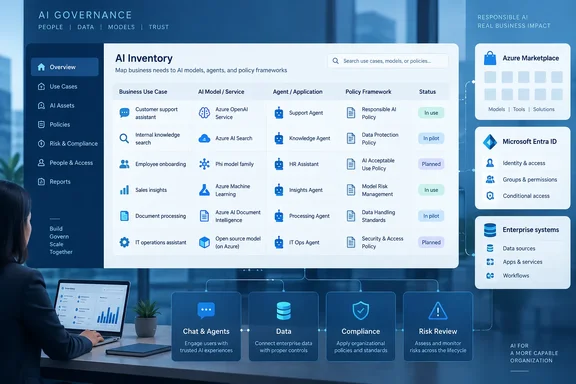
AI Navigator is a SaaS product. It inventories AI use cases and ties them to regulations and internal policies. SAS says it lets leaders compile a complete AI inventory and align AI use cases with government regulations and internal policies.
The product is not new news in the strict sense. SAS unveiled it on April 28, 2026, at SAS Innovate in Dallas, with availability on Microsoft Azure Marketplace promised for Q3 2026. A SAS community post says it was officially available on Microsoft Marketplace as of September 29, 2026. The press release followed on October 5. In short, October's news is that the Q3 promise has been delivered.
SAS says AI Navigator is organized around the business use case, which it calls the point of business impact. Governance extends to the models and agents that power each use case, and to the policies applied to them. SAS's example is a customer-service chatbot. The company could govern the underlying agent or model, such as Claude or Microsoft Copilot, and apply policies so the use case meets regulatory expectations.
The Techzine report adds that the tool covers the full lifecycle, from experimentation and rollout to phase-out. It covers both in-house AI and third-party tools.
The Microsoft angle for administrators
This is a third-party product sold through Microsoft's storefront. It is not a Microsoft service. The Marketplace listing doesn't say it is built into Microsoft 365, Azure, Copilot or Defender. The practical details from the listing are:
- Purchase and activation: Buyers purchase through Marketplace. SAS then emails them to activate the product.
- Identity prerequisite: The listing says organizations must use Microsoft Entra ID for identity management to implement the product. Confirm this early, because it could decide whether the product fits your tenant.
- Standalone operation: The listing says it needs no other SAS software. SAS's press release says it works for new or existing SAS customers.
- Pricing: The first six months are free. After that, pay-as-you-go pricing begins. Budget owners should treat this as a trial period, not free access.
- Azure context: SAS says it can help manage AI use cases across diverse environments, including those running on Microsoft Azure.
The reporting I reviewed doesn't give the post-trial rate, how usage is metered, data residency, retention terms or service-level commitments. It also doesn't say whether a Marketplace purchase can count toward an existing Azure spending commitment. Ask SAS or your Microsoft account team about all of these before you sign up.
Policy packs and frameworks
SAS says you don't have to write a corporate AI policy from scratch. The Marketplace listing says you can create your own policies or buy them from a partner. It names the EU AI Act, the NIST AI Risk Management Framework and an internal generative-AI policy as examples. The SAS release names Protiviti and Asenion as partners whose policy packs provide ready-to-use questions and risk classifications. No pricing or coverage details for those packs were published in what I reviewed.
A policy pack helps with documentation. It doesn't make a company compliant on its own. Someone still has to answer the questions accurately and keep the inventory current.
How to read the claims
The headline claim is that AI Navigator monitors what's already in use. That comes from SAS's own materials and Techzine's rewrite of them. The launch material does not explain how assets are discovered. It doesn't say whether discovery is automatic or what integrations exist.
One third-party listing (7wData) describes manual setup. It says users add connections to model repositories, agent platforms and LLM providers by entering API endpoints and credentials. That description is unverified and comes from a directory, not from SAS. Even so, it is a good reason to ask in a pilot how a shadow AI tool, like an employee's unsanctioned chatbot, ends up in the inventory.
Other points to weigh:
- The ROI statistic is not a product result. The "15 times more likely" figure comes from SAS's own report with IDC. SAS says organizations applying trustworthy-AI practices were 15 times more likely to report strong or high ROI, a comparison it puts at 62% versus 4%. The report surveyed 2,699 decision-makers in 28 countries across banking, insurance, life sciences and the public sector. It measures governance practices in general. It does not measure AI Navigator.
- The "employees override AI" finding is also survey-based. SAS says 97.2% of users override AI recommendations at least sometimes. The leading reason is that the AI can't explain its decision. That supports the case for transparency. It doesn't show that this product improves explainability.
- The healthcare reference is an early-tester view. Erasmus MC tested the product early. Dr. Michel van Genderen called it a tool with "real potential" for documenting and governing AI use in healthcare. He did not describe a finished deployment or measured results.
- The IDC quote is supportive. IDC's Kathy Lange said a centralized approach can help organizations understand what AI they have and whether it fits policy. The release is SAS's own, and nobody has independently tested the product.
A practical checklist before you start
- Confirm that your tenant uses Entra ID for identity management, since the listing requires it.
- Decide who owns the inventory: IT, security, legal or a data science team. The listing names all four kinds of stakeholder.
- List the AI you already know about, including Copilot deployments, internal LLM apps and agents, so you can test the inventory against it.
- Pick one framework, such as NIST AI RMF or the EU AI Act, and try it on one use case during the free period.
- Ask SAS about discovery, integrations, data handling and pricing before the six months end.
Bottom line
AI sprawl is a real problem for administrators who are already juggling Copilot rollouts, agent platforms and employees' own AI tools. AI Navigator is a credible-looking entry in a crowded governance market. It comes with a six-month free window and one clear dependency, Entra ID. Its discovery depth, pricing after the trial and real-world results are still unproven, so a small pilot makes more sense than a company-wide commitment.
References
- SAS AI Navigator now available: Gaining control over AI model sprawl - Techzine Global Techzine Global · 2026-10-06T07:55:11+00:00
- SAS® AI Navigator | Microsoft Marketplace marketplace.microsoft.com
- SAS AI Navigator now available to supercharge AI governance | SAS sas.com