

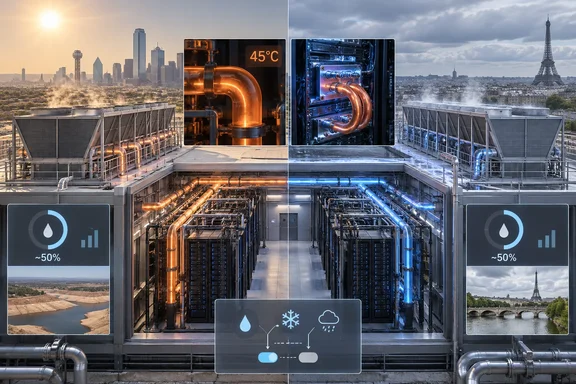
Schneider’s announcement of White Paper 220, Water Usage at AI Scale: Insights from a 100 MW Comparative Analysis, puts the modeled reduction at 48% in Dallas and 53% in Paris for an optimized liquid-cooled AI architecture compared with an air-cooled AI design. These are vendor-modeled results, not measurements from operating datacenters. The Register’s reporting describes how the comparison progresses from conventional air cooling to systems designed around coolant supplied at 45°C, or 113°F.
What Schneider modeled
According to The Register, Schneider compared four 100 MW designs using the annual weather profiles of Dallas and Paris:
| Design | Cooling arrangement | What the comparison examines |
|---|---|---|
| Conventional air cooling | Air removes heat from IT equipment. | Establishes the comparison baseline. |
| Liquid cooling at 32°C | Coolant is supplied at approximately 90°F. | Examines a lower-temperature liquid-cooling design. |
| Liquid cooling at 45°C | The cooling equipment remains the same, but the supply set point rises to 113°F. | Examines the effect of a higher operating temperature. |
| Optimized liquid cooling at 45°C | Equipment is sized specifically for the warmer operating point. | Examines the additional effect of right-sizing the cooling installation. |
The Register reports that Schneider describes the 32°C scenario as representative of early AI datacenters. It also reports that the fourth design reduces excess cooling capacity and capital expenditure. Schneider’s announcement confirms the broader comparison of architecture, heat-rejection technology and operating temperature, but the detailed four-stage breakdown rests on The Register’s account.
For the designs using adiabatic heat rejection, Schneider’s announcement gives these annual on-site cooling-water totals:
| Location | Air-cooled AI design | Optimized liquid-cooled AI design | Reported reduction |
|---|---|---|---|
| Dallas | Approximately 382,000 m³ | Approximately 197,000 m³ | 48% |
| Paris | Approximately 108,000 m³ | Approximately 51,000 m³ | 53% |
These numbers require one correction to the initial coverage: The Register describes the Dallas reduction as “at least 50 percent,” while Schneider’s announcement specifies 48% for its optimized, adiabatic comparison. The explicit figures support “roughly half,” rather than an across-the-board claim of at least half.
Climate also changes the absolute result substantially. Even after optimization, the Dallas design consumes considerably more cooling water than the Paris air-cooled baseline in Schneider’s model. A percentage improvement therefore cannot tell a site-selection team how much water a proposed facility will actually need.
Why warmer coolant can save water
Liquid cooling has two jobs to accomplish: collect heat from computing equipment, then transfer that heat out of the facility. A recirculating coolant loop addresses the first part; the equipment rejecting heat outdoors determines much of the continuing water demand.
In its technical explanation of AI cooling, Schneider says higher coolant supply temperatures can reduce both cooling energy and water consumption. The mechanism is a wider operating window in which outdoor air can accept the heat without mechanical refrigeration.
That does not mean the servers produce less heat simply because the coolant is warmer. It means a cooling system designed to operate at a higher temperature has more opportunities to dispose of that heat without chilling its working fluid to a lower temperature.
The external equipment matters:
- A dry cooler transfers heat to outdoor air without relying on evaporating cooling water.
- Evaporative cooling uses water to assist heat rejection.
- An adiabatic arrangement can use water assistance when outdoor conditions require it, while operating dry under suitable conditions.
In a sponsored DCD interview published earlier in September, Schneider cooling executive Tuan Hoang described this operating choice: use dry cooling when conditions permit, then introduce evaporative assistance or mechanical cooling when they do not. That explanation is useful technical context, but the sponsored interview is not independent validation of Schneider’s savings estimates.
A closed server-coolant loop can consequently coexist with water-consuming equipment elsewhere in the cooling chain. “Closed loop” alone does not establish zero facility cooling-water consumption.
The hardware must support the temperature
A 45°C supply temperature is a design condition, not a universal setting that administrators should apply to existing infrastructure.
NVIDIA’s June explanation of its liquid-cooled AI infrastructure describes systems designed for coolant entering at up to 45°C. NVIDIA says cold plates keep components within validated operating limits and that, in favorable climates, dry-cooler-based designs can reduce facility cooling-water consumption to near zero. It explicitly ties those possibilities to the architecture and geography.
That supports the engineering premise behind warmer coolant, but it does not reproduce Schneider’s Dallas or Paris results. Nor does it establish that every liquid-cooled server or mixed datacenter can operate at that temperature.
For an infrastructure team, the practical question is whether the proposed IT equipment and cooling installation support the same operating conditions. NVIDIA distinguishes its fully liquid-cooled design from earlier hybrid arrangements in which processors received liquid cooling while other components remained air cooled. Those remaining loads must be included when evaluating a facility’s cooling requirements.
What operators should take from the comparison
Schneider’s study supports evaluating cooling during site selection and facility design, before treating equipment quantities and operating temperatures as fixed. The Register reports that the paper also recommends considering alternative water sources to reduce demand on supplies used by local communities.
The useful procurement questions follow directly from the model:
- Ask for annual cooling-water estimates using the proposed site’s weather profile, rather than transferring a savings percentage from another city.
- Establish whether the proposal uses dry cooling, evaporative assistance, cooling towers or mechanical chilling—and under which conditions each operates.
- Confirm that the proposed coolant temperature is supported by the IT equipment and the complete cooling installation.
- Evaluate water demand alongside cooling electricity consumption and local utility costs.
- Keep on-site cooling-water figures separate from claims about the facility’s broader water footprint.
The final boundary is important. Schneider’s published totals concern on-site water consumption for cooling. They do not establish a complete water footprint that includes electricity generation or equipment manufacturing.
Schneider also has a direct commercial interest in the outcome through its cooling products and Motivair business, which NVIDIA identifies as Schneider’s advanced cooling division. The white paper should therefore inform a design comparison, rather than serve as an independent endorsement of a particular supplier.
For operators planning AI capacity, the supported conclusion is specific: warmer coolant can make lower-water heat rejection practical for more of the year, and equipment sized around that operating point can improve the design further. The decision belongs at the level of the complete facility—not in a standalone coolant-temperature change.
References
- Schneider says hotter coolant can make AI datacenters less thirsty The Register · 2026-09-21T14:29:00+00:00