

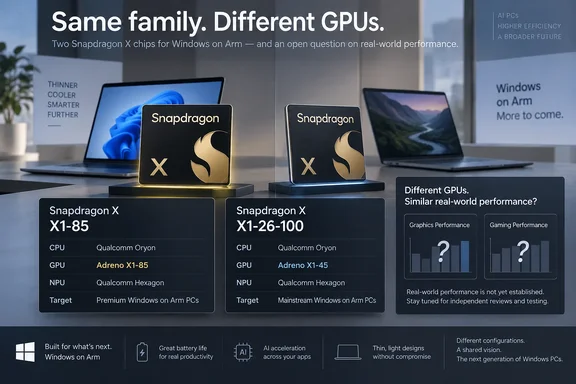
Notebookcheck’s processor entry describes the chip as an affordable Snapdragon X variant that first appeared in January 2026. However, the page mixes conflicting GPU descriptions with performance expectations that are not accompanied by identifiable X1-26-101 benchmark results. For Windows laptop buyers, the useful distinction is between confirmed specifications and conclusions still awaiting device-level testing.
Snapdragon X X1-26-101: confirmed specifications
Qualcomm’s official processor comparison establishes the following differences and similarities:
| Specification | Snapdragon X X1-26-101 | Snapdragon X X1-26-100 |
|---|---|---|
| Oryon CPU cores | 8 | 8 |
| Maximum advertised CPU frequency | 3.0 GHz | 3.0 GHz |
| Cache | 30 MB | 30 MB |
| Integrated GPU | Adreno X1-85 | Adreno X1-45 |
| Maximum GPU frequency | 0.63 GHz | 1.25 GHz |
| Hexagon NPU performance | Up to 45 TOPS | Up to 45 TOPS |
| Memory type | LPDDR5x | LPDDR5x |
| Maximum memory bandwidth | 135 GB/s | 135 GB/s |
These are Qualcomm’s listed specifications, rather than measurements from a reviewed laptop.
The CPU frequency also deserves a small clarification: Qualcomm’s footnote gives the actual maximum as 2.976 GHz. Consequently, listings showing 2.97 GHz, 2.98 GHz or an advertised 3.0 GHz need not describe different processors. Check the full processor identifier before treating rounding as a hardware change.
A different GPU does not settle the performance question
Notebookcheck’s introductory paragraph identifies an X1-45 GPU, while its graphics section and specification field identify an X1-85 at 630 MHz. Qualcomm’s official table supports the latter configuration. The page also associates a 3.8-TFLOPS label with the GPU, but Qualcomm’s comparison does not establish that throughput figure for this particular implementation.
The defensible conclusion is therefore narrower than “the 101 has faster graphics.” It has a different GPU model with a substantially lower listed clock.
As an analytical matter, neither the larger model number nor the lower frequency alone can establish the winner. A useful comparison would test actual X1-26-101 and X1-26-100 laptops in the same workloads, recording their configurations and settings. Processor names are labels, not frame-rate counters.
What the benchmark claims actually establish
Notebookcheck estimates that CPU performance should trail the Snapdragon X Plus X1P-42 by roughly 10%, and describes native performance as sitting below Intel’s Core Ultra 9 185H. Yet its X1-26-101 entry does not provide the benchmark names, scores and test systems needed to substantiate those comparisons for this chip.
Qualcomm does confirm that the eight-core X1P-42-100 has a higher CPU frequency ceiling of 3.4 GHz. That supports a specification-level distinction, not a universal percentage difference in application performance.
The same caution applies to power consumption. Notebookcheck’s 15–30 W sustained-load range is an estimate dependent on the system and power profile, not an established fixed rating for every X1-26-101 laptop.
Bottom line: the available evidence supports a specifications comparison, not a measured performance ranking.
What matters for Windows 11 users
Application architecture remains an important part of evaluating this processor. Microsoft documents support for both x86 and x64 application emulation on Windows 11 on Arm, while recommending native Arm builds for better performance, responsiveness and battery efficiency. Emulation carries overhead, but that does not establish a fixed penalty for every application.
Microsoft also confirms that Windows 11 version 24H2 includes the Prism emulator. Older emulated benchmark results should therefore not be treated as timeless predictions without identifying the Windows version and application build used.
Compatibility checks should cover more than applications:
- Peripherals: verify that required drivers are built into Windows or available as Arm64 versions.
- Business software: check products that depend on drivers, including security and virtualization tools.
- Games: confirm publisher support, particularly where anti-cheat drivers are involved.
Microsoft explicitly warns that incompatible drivers can prevent associated hardware or software from functioning properly. Kernel-mode drivers and user-mode print drivers require native Arm64 binaries; application emulation does not remove that requirement.
The X1-26-101 is thus best understood as a documented Snapdragon X configuration with a distinct GPU—not a proven performance leap. Before choosing a laptop around it, prioritize reviews of the exact machine and confirmation that your essential software and peripherals support Windows on Arm.
References
- Qualcomm Snapdragon X X1-26-101 Processor - Benchmarks and Specs - Notebookcheck Notebookcheck · 2026-10-01T14:06:12+00:00
- Qualcomm Snapdragon X1P-26-100 Processor - Benchmarks and Specs - Notebookcheck Tech notebookcheck.net
- Snapdragon X2 Plus qualcomm.com