

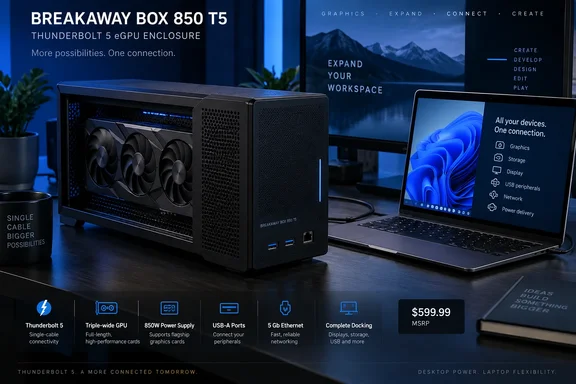
That timing discrepancy does not make the hardware less real. Sonnet’s official store currently lists the Breakaway Box 850 T5, model GPU-850T5, as available for $599.99, and the company’s product pages document the same hardware configuration described by TechPowerUp. It does mean shoppers should treat the story as a renewed retail availability notice or a fresh round of coverage, rather than evidence that Sonnet has just introduced a new Thunderbolt 5 enclosure.
For Windows laptop owners who have a Thunderbolt 5 port—or a compatible Thunderbolt 4 or USB4 implementation—the box is a substantial option. Its practical limitation is equally clear: the enclosure makes a desktop GPU portable between desks, but it does not turn that GPU into a direct PCIe slot inside the laptop.
A 2025 product presented as a 2026 launch
The documentation trail predates this week’s coverage by months. Sonnet’s Breakaway Box 850 T5 Quick Start Guide identifies Windows 11 2024H2 or later as the supported operating-system baseline and carries a December 22, 2025 support-post date. Sonnet also published an external-graphics setup guide on the same date that includes installation instructions specific to the 850 T5.
Sonnet’s product family page was already describing the enclosure as “NEW” months ago, and its store now calls it in stock. Neither record establishes the precise day when retail sales first began, so it would be overreach to assign a definitive launch date without a dated Sonnet announcement. They do establish that the Breakaway Box 850 T5 and its Windows support materials were public well before September 16, 2026.
This is a useful distinction because first-generation Thunderbolt 5 accessories are often bought to match a new laptop purchase. Buyers comparing options should not delay a purchase under the assumption that an untested newly announced model is imminent; the product has been documented long enough that its compatibility requirements and setup process are already available.
The enclosure’s limits are defined by the host connection
Sonnet describes the Breakaway Box 850 T5 as a Thunderbolt 5 system with 80 Gbps of bidirectional bandwidth and a PCIe 4.0 connection for a Thunderbolt 5 host. Intel’s Thunderbolt 5 documentation supports the broad technical premise: the standard doubles the external PCIe data capacity compared with Thunderbolt 4, with up to 64 Gbps allocated to a PCIe 4.0 external device.
That improvement is meaningful for an eGPU. Thunderbolt 4-class enclosures expose a 40 Gbps connection and, according to Sonnet, operate here through PCIe 3.0. A Thunderbolt 5 notebook can therefore provide the external card materially more host bandwidth, helping workloads that repeatedly move assets between system memory, storage and the GPU.
It is still an external PCIe link, not a full desktop graphics-card connection. A modern desktop GPU normally has access to a much wider local PCIe interface and a platform with fewer sharing constraints. Performance will vary with the game, rendering engine, AI runtime, external-display arrangement, laptop CPU and whether the workload sends a steady stream of data across Thunderbolt. Sonnet has published marketing language about near-desktop performance, but the company does not provide a standardized game, GPU-rendering or local-AI benchmark table for the 850 T5.
That absence is worth considering before pairing a top-tier graphics card with a $600 enclosure. The box makes particular sense where the GPU can retain a larger working set in its own VRAM, such as GPU rendering or local inference, and where a desktop replacement is more valuable than maximum frame-rate efficiency. It is a less straightforward proposition for someone whose only goal is extracting every last frame from a high-end GPU.
Triple-wide support has a precise physical boundary
The 850 T5 accepts graphics cards up to 345 mm long, 155 mm high and 70 mm wide. Those figures are more useful than the broad “triple-slot” description because oversized partner-board GPUs regularly exceed one of those dimensions through tall coolers, long shrouds or protruding power adapters.
Sonnet officially lists NVIDIA GeForce RTX 30-, 40- and 50-series cards, plus AMD Radeon RX 6000-, 7000- and 9000-series cards, as compatible families. That is a broad list, but it is not a guarantee that every card in those families will fit. A buyer needs to check the exact board’s published dimensions, including the depth required for the power cable bend, before ordering.
The supplied report says the power supply has three 8-pin connectors that can be adapted to the newer 12V-2x6 connector. Sonnet’s current technical specifications use slightly different language, listing support for “three 8-pin or one 16-pin (12VHPWR)” GPU power connection. The company’s specifications do not spell out which adapter, if any, is packed with every retail unit. For a high-power NVIDIA card, that is not a detail to assume: buyers should confirm the connector and included-cable arrangement with the seller before installing the card.
The integrated 850 W supply is generous on paper, but total power capacity alone does not resolve fit or cable-routing issues. The published 70 mm width ceiling means that some physically imposing cards marketed as three-slot designs may still be unsuitable once their actual measurements are checked.
The dock ports share one upstream cable
Unlike basic eGPU cases, the 850 T5 also functions as a dock. It includes one Thunderbolt peripheral port with 15 W available, three USB 3.2 Gen 2 Type-A ports rated at up to 10 Gbps, and a 5 GbE RJ45 port using Realtek’s RTL8157 controller. The host-facing Thunderbolt port can supply up to 100 W of laptop charging.
This makes the hardware attractive as a single-cable fixed-desk setup: connect the laptop, then attach displays to the GPU and leave network, storage and peripherals connected to the enclosure. The 5 GbE port also supports 2.5 GbE, 1 GbE and 100 Mbps links, and Sonnet says a 5 Gbps link can operate over Cat 5e cabling, assuming the rest of the network supports it.
There is a trade-off. The GPU, downstream Thunderbolt device, USB storage and Ethernet traffic all travel over the upstream Thunderbolt connection. A keyboard or mouse will be inconsequential, but a fast external SSD, sustained 5 GbE transfers and data-heavy GPU workloads can contend for the same connection. The dock capability adds convenience, not an independent high-speed pathway for each attached device.
For a workstation used for video editing, that suggests a sensible layout: place active media on internal storage or a carefully chosen external drive, reserve the enclosure’s network port for high-speed shared storage where needed, and avoid assuming every port will maintain peak speed simultaneously while the GPU is busy.
Windows compatibility needs closer checking than the headline suggests
Sonnet promises compatibility with Thunderbolt 5, Thunderbolt 4 and USB4 Windows computers, but its own support material gives the crucial qualification: a USB4 machine must support external PCIe graphics. The company instructs users to open Device Manager and look for “USB4(TM) Host Router (Microsoft)” under USB controllers; without that entry, Sonnet says the Breakaway Box cannot pass GPU or PCIe-card data.
That makes “USB4-compatible” an incomplete shopping criterion. Many PCs advertise USB4 for displays, charging and storage without providing the required PCIe tunneling behavior for an eGPU. Thunderbolt 4 systems should also be expected to run at the older connection class rather than inherit Thunderbolt 5 bandwidth merely because the enclosure supports both.
Sonnet’s OS guidance is also internally inconsistent. The product’s current technical-specification page and Quick Start Guide say Windows 11 2024H2 or newer, while a newer Sonnet Windows compatibility PDF lists the Breakaway Box 850 T5 as requiring Windows 11 25H2 or later. The safer course is to use the newer 25H2 baseline until Sonnet reconciles its public documentation, particularly for an IT department standardizing deployments.
The 850 T5 is a credible high-end eGPU dock for Windows users who have verified Thunderbolt or USB4 PCIe support and a card that truly fits its enclosure. The immediate takeaway from this week’s report is simpler: Sonnet is selling it now, but the record shows the product and its support materials have been in circulation since at least December 22, 2025—and buyers should validate the host port, Windows version, exact GPU dimensions and power connector before treating the $599.99 box as a plug-and-play upgrade.
References
- Sonnet Launches Thunderbolt 5 eGPU Box with 850 W PSU and Triple-Slot GPU Support TechPowerUp · 2026-09-16T04:38:44+00:00