

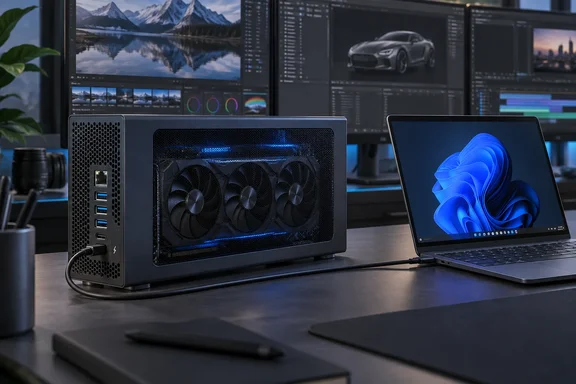
Sonnet's Breakaway Box 850 T5 has been on sale for months
Sonnet has promoted this enclosure for some time. Ahead of IBC2025, Broadcast Beat reported that Sonnet would show its new Breakaway Box 850 T5 Thunderbolt 5 eGPU for Windows computers. That report was dated August 2025. Creative COW's preview of the 2026 NAB Show called it "award-winning" and said Sonnet would exhibit it again. Retailers were selling it well before this month. B&H's listing, dated May 2026, describes it as compatible with Windows computers that have a Thunderbolt 5 or Thunderbolt 4 port, and Adorama already sells used units.
The September text is a refreshed announcement. Newsshooter ran essentially the same copy on September 16, describing a PCIe card expansion system for Windows 11 computers with Thunderbolt 5 or 4 ports, or USB4 ports with external graphics support. For readers, the practical point is that "available now" means real stock and existing owners, not a pre-order window.
The concept is simple. You fit a desktop graphics card into the enclosure, connect the enclosure to the computer, and the card then handles GPU work instead of the laptop's integrated or mobile discrete GPU. Sonnet pitches it at video editors, AI developers, medical imaging and gamers. The case it makes is that laptop GPUs are limited by power, heat and memory. Desktop cards generally run at higher sustained clocks with more VRAM and memory bandwidth, which helps with rendering, colour grading, visual effects and local AI models.
Sonnet's overview page names LM Studio, Ollama and GPT4ALL for local LLM work and Stable Diffusion and Flux.1 for images. It also says the setup can drive up to four monitors. You can output the enhanced graphics to four monitors. These are vendor workload claims. Sonnet's product pages include no benchmark figures, so any speed-up depends on the host, the card, the software and the task.
Thunderbolt 5 hosts get PCIe 4.0 bandwidth; Thunderbolt 4 and USB4 hosts get PCIe 3.0
The link between computer and enclosure sets the ceiling for this whole product category. Sonnet's specifications list two tiers:
| Host port | Link bandwidth (per Sonnet) | PCIe tunnel |
|---|---|---|
| Thunderbolt 5 | 80 Gbps bi-directional | PCIe 4.0 |
| Thunderbolt 4 or eGPU-compatible USB4 | 40 Gbps bi-directional | PCIe 3.0 |
Inside the enclosure is Intel's JHL9580 Thunderbolt 5 controller. The box is Thunderbolt-certified for Thunderbolt 5 and Thunderbolt 4 computers. Sonnet's launch material said the design offers double the PCIe bandwidth of any Thunderbolt 3 external GPU chassis. That comparison only holds on a Thunderbolt 5 host.
A Thunderbolt 4 laptop still works with the box and can be upgraded later. Sonnet markets that path as being "Accelerates Thunderbolt 4 and Most USB4 Windows 11 Computers, too." On a Thunderbolt 4 machine, though, the GPU runs over the older, narrower link. How much that costs depends on the workload, and Sonnet has published no figures for either tier.
"Most USB4" is the phrase buyers should read carefully. A USB-C connector or a USB4 logo does not guarantee external GPU support. Sonnet's spec sheet tells buyers to check with the computer's manufacturer whether a USB4 machine supports an eGPU. There is some outside evidence of the box working on a USB4 host that isn't Thunderbolt. A spattlabs video from January 2026 shows the enclosure connected to a Minisforum MS-02 Ultra mini PC using USB4 Version 2 (80 Gbps). That is one tester's setup, so treat it as a single data point rather than proof that USB4 hosts in general are compatible.
Windows 11 25H2 is now the minimum, and older listings don't say so
The requirement buyers are most likely to miss is the Windows version. Sonnet's current spec sheet lists Windows 11 25H2 or newer as the operating-system requirement. The announcement just says "Windows 11", which suggests any release will do.
The requirement has changed over time. Adorama's listing still carries an older spec block that says Windows 11 2024H2 or newer. Sonnet's own page now says 25H2. Sonnet hasn't explained the change. Either way, a PC that IT has held on Windows 11 24H2 may fall outside what Sonnet currently supports, even if the hardware is fine.
For managed fleets this should be settled before purchase. If a creative team's laptops are held on 24H2 by update policy, the eGPU becomes a reason to move those machines to 25H2 or to check the configuration with Sonnet support first. Sonnet's documentation also covers Apple Silicon Macs, but only as "experimental" GPU support for AI developers. This article is about the Windows 11 product.
RTX 50 and Radeon RX 9000 cards fit if they're under 345 mm and within the 850W supply
Sonnet lists support for NVIDIA GeForce RTX 50, 40 and 30 series cards and AMD Radeon RX 9000, 7000 and 6000 series cards. The physical limit is a triple-wide card no larger than 345 × 155 × 70 mm in any dimension. B&H describes this as room for a 13.5" long, triple slot graphics card. For power, the enclosure supplies either three 8-pin connectors or one 16-pin 12VHPWR connector.
These are limits on fit and wiring, not a guarantee for every card in those families. An oversized partner card, one with a different power-connector layout, or a driver problem can all stop a card from working. Measure the card you plan to use against the 345 × 155 × 70 mm envelope before ordering.
The power supply is the feature Sonnet leans on hardest. B&H notes that an 850W power supply is preinstalled inside the enclosure. Sonnet describes it as the highest-wattage supply in any eGPU currently sold, and says some competing enclosures ship without a power supply at all. That market-wide claim is Sonnet's own, and no independent survey has checked it. The narrower point is supported by the spec sheet. The supply is a universal 850W unit rated for 100–240V AC at 50–60 Hz, so it works on mains power worldwide. Sonnet says it has enough headroom for current top-end cards and for more power-hungry ones expected later.
Cooling comes from one large variable-speed fan controlled by temperature. B&H adds that the chassis has mesh side panels. Sonnet calls it "whisper-quiet", but no published noise measurements back that up. Sonnet's operating range is 0°C to 35°C. The enclosure measures 21 × 39.6 × 24.5 cm and weighs 6.4 kg (14.2 lb) before a card goes in, so it is a desk-bound box, not a travel accessory. Sonnet also says the chassis accepts other Thunderbolt-compatible PCIe cards, such as pro audio and video I/O cards, not only GPUs.
One cable also carries the dock's 5GbE, USB-A and 100W charging
The feature that sets it apart from a bare enclosure is the dock. Over the same host cable, the Breakaway Box 850 T5 provides:
- A Thunderbolt peripheral port that passes through whatever the host port supports, supplies up to 15W, and accepts Thunderbolt 5, 4 or 3 peripherals or USB-C devices.
- Three USB-A ports at USB 3.2 Gen 2 (10 Gbps), each delivering up to 7.5W for bus-powered drives and accessories.
- A 5GbE RJ45 port on a Realtek RTL8157 controller, supporting 5, 2.5 and 1 Gbps and 100 Mbps link speeds, with jumbo frames up to 16,352 bytes.
- Up to 100W of charging to the laptop through the Thunderbolt 5 computer port.
B&H says the downstream port allows you daisy chain devices. The Ethernet port matters for post-production users whose buildings are wired with Cat 5e. Breakaway Box 850 T5 supports a 5 Gbps link over even over Cat 5e cabling, potentially saving you the cost of pulling new cable. You still need a 5GbE-capable switch port at the other end to get more than gigabit speeds. That is a general networking requirement, not something from Sonnet's spec sheet.
In daily use this means one cable from the laptop carries GPU compute, network, peripherals and charging. Keep in mind that the dock traffic and the GPU traffic share that one host link. On a Thunderbolt 4 or USB4 machine, that link is the 40 Gbps tier.
The box comes with a region-specific power cable, a 0.8-metre Thunderbolt 5 cable and documentation, and carries a two-year warranty. Sonnet lists standby draw of 9.5W in sleep and 8W at idle, which adds up if the box stays switched on all day. No source we found gives a price. Check a reseller before budgeting, and remember to add the cost of the GPU.
What this means for you
The best fit is a Windows 11 25H2 laptop or mini PC with a Thunderbolt 5 port, whose owner does GPU-heavy creative or local-AI work at a desk and wants the card, the network and the peripherals on a single cable. Thunderbolt 4 owners can buy now and get the faster link when they replace the laptop. Owners of USB4 machines should confirm eGPU support with the PC maker before spending anything. Anyone who needs portable GPU power should look elsewhere: this is a 6.4 kg desktop chassis.
- Check the Windows build before ordering. Sonnet's current requirement is Windows 11 25H2 or newer, and some retailer listings still show the older 24H2 figure.
- Treat a USB4 port as unconfirmed until the computer's manufacturer says it supports an external GPU. Sonnet itself says USB4 alone is no guarantee.
- Measure your graphics card against the 345 × 155 × 70 mm limit and match its power connectors to three 8-pin or one 16-pin 12VHPWR.
- Expect PCIe 4.0 bandwidth only on Thunderbolt 5 hosts. Thunderbolt 4 and USB4 hosts get a 40 Gbps link and PCIe 3.0.
- Budget for the GPU separately, and plan for a 5GbE switch port if you want more than gigabit networking from the RJ45 port.
Sonnet's Breakaway Box 850 T5 is an established, shipping product, and this month's coverage is a new round of promotion rather than a launch. Its strengths are specific: the 850W supply, room for triple-slot cards and a real dock with charging. The limits for Windows buyers are just as specific. You need 25H2, a host that is actually eGPU-capable, and a Thunderbolt 5 port to get the bandwidth Sonnet advertises. Independent benchmarks of this box are still scarce, and those numbers will show how much of the "near-desktop" claim holds up on real Windows 11 machines.
References
- Sonnet Announces Thunderbolt 5 eGPU – Windows 11 - Content + Technology Content + Technology · 2026-09-25T05:11:27+00:00
- Breakaway Box 850 T5 - Tech Specs - SONNETTECH sonnettech.com