

Sony’s AI-assisted input patent puts interpretation between the player and the game
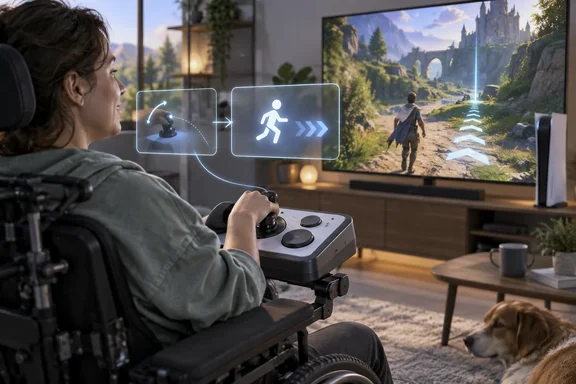
The published U.S. application, US 2026/0273392 A1, is titled “AI-Assisted User Input for Accessibility.” Its central proposal is to take information about a player’s control inputs, determine an accessibility limitation affecting those inputs, and use a trained model to generate an output that controls the game. It describes a system for handling controller signals, not a new controller that Sony has announced for sale.
Consider a player who can move a stick but cannot move it through its full range. Sony’s application describes generating a stronger digital output from reduced physical actuation. It also describes reducing an excessive input, or generating an input when the player cannot actuate a control at all. The patent’s abstract gives an example of a left-hand injury associated with less than 50 percent actuation of left-side controls; that figure illustrates one scenario, not a stated eligibility threshold for the proposed system.
The model would have more to work with than the position of a stick or the state of a button. The application describes using which controls were operated, how far, when and for how long. Accessibility information might come from a player profile, while controller details and the game’s current context could help the system determine what output is appropriate. In one example, signals from controls a player can operate normally help the system infer an intended action involving controls affected by a left-hand limitation.
That combination is the meaningful change Sony is exploring. A fixed remapping makes a chosen physical input perform a chosen command; the proposed model could vary its output according to the player, controller and situation in the game. The application describes possible behavior, however, rather than results from a released system. It provides no player-facing accuracy or responsiveness measurements on which to judge how reliably the model would infer someone’s intent.
Controller-agnostic language leaves PS5 and PC compatibility undecided
Sony describes the model as controller-agnostic: it could take account of different controller hardware and of differences between, for example, a joystick and a button. The application also contemplates running the model on a console, on a controller or through a remote service. Those are alternative designs in a patent application, not a compatibility list or deployment plan. In particular, the broad controller language does not establish support for a Windows PC, an Xbox controller or any specific third-party device.
The application goes beyond altering the signal delivered to a game. It distinguishes software-based “soft controls,” which can augment or replace an input, from proposed “hard controls” that would change a controller’s physical behavior, such as a control’s motion range. It also describes possible changes to game settings. These examples show how broadly Sony has framed the idea; they do not mean an existing PlayStation controller can acquire adjustable physical controls through a software update.
Personalization raises a separate implementation decision. Sony’s described approaches include accessibility information supplied through a profile and information inferred from controller use or gameplay history. A future product built this way would need to make clear what information it uses and where processing occurs, particularly if it uses a remote service. The application discusses user control of data, but there is no shipping service whose privacy settings or data handling can yet be assessed.
Multiplayer provisions acknowledge that assisted inputs affect other players
In multiplayer games, an input generated by software can affect more than the person using it. Sony’s application describes versions in which the AI assistance could turn off automatically during multiplayer play or be turned off by the player. It also describes visual or audio indicators that could tell other players when an accessibility agent is active.
These are possible safeguards, not a finalized rule for online matches. An automatic shutoff would have a different consequence for a player who relies on assistance than an indicator that allows the assistance to remain active. The application includes both possibilities without identifying a game, competitive mode or policy that would use either one. Readers should therefore avoid treating the disclosure as a promise that assisted input will work in every game—or be prohibited in multiplayer.
Sony’s Access controller offers a practical option while the AI remains a proposal
Sony already sells an Access controller for PS5, built around configurable physical controls rather than AI-generated actions. Its interchangeable button and stick caps, adjustable stick position and four 3.5 mm expansion ports let players arrange compatible inputs to suit their reach and movement. Sony says players can configure up to 30 profiles in PS5 settings, store three on the controller, remap or disable buttons, and adjust stick sensitivity and deadzone. They can also combine Access controllers with each other or with a DualSense or DualSense Edge controller.
Those settings offer a useful comparison with the application. Changing a layout or deadzone gives the player a defined configuration to use; Sony’s proposed AI would attempt to interpret and compensate for inputs as play unfolds. The approaches could address different needs, but the patent does not announce AI support for the Access controller or an upgrade to one already owned. Sony presents Access as a PS5 controller, so its documented configuration options should not be mistaken for a PC controller feature.
For someone using an Access controller now, Sony documents a concrete starting point for changing its profile: on PS5, go to Settings > Accessories > Access controller > Profile Library, then create a profile and configure its orientation and button assignments. Assigning it to one of the controller’s three slots makes it available from that slot; a profile saved without a slot remains on the console. This is an existing configuration procedure, independent of the AI proposal.
What this means for you
If you need an accessible setup now, make decisions using controllers and settings that exist today; the Sony application gives no basis for waiting for an AI release. If you are evaluating the idea for future console or PC use, its important unanswered product question is which devices and games Sony would actually support.
- Sony’s September 17 publication is a patent application, not an announcement that AI-assisted inputs are available on PS5 or Windows.
- The proposed model could amplify, reduce or supply an input using information about a player’s physical limitations and gameplay.
- “Controller-agnostic” describes the proposed model’s design; it confirms no particular PC or third-party controller compatibility.
- The multiplayer shutoff and player indicator are examples in the application, not rules announced for any game.
- PS5 owners can use the existing Access controller’s profiles, remapping and stick adjustments without waiting for this proposal to become a product.
The application identifies a real design direction: assistance that can respond to the difference between a player’s physical input and the action they intended. For now, its value is in making that approach concrete enough to examine. Any practical choice between it and today’s configurable controls must wait for Sony to announce a product, its supported games and hardware, and how players would control the assistance.
References
- Sony Patents AI-Assisted Controller Inputs For Accessibility - Insider Gaming insider-gaming.com
- US20260273392A1 – Ai-assisted user input for accessibility | Patsnap Eureka eureka.patsnap.com