

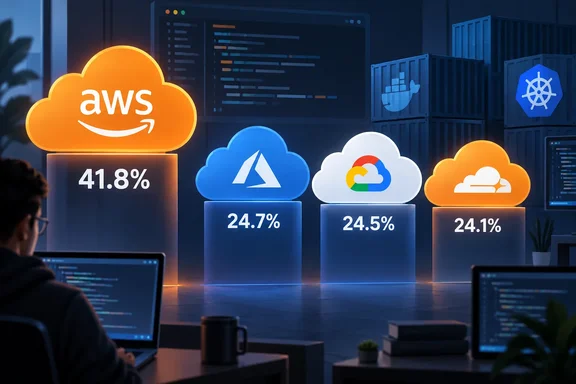
That is a useful snapshot of what developers say they build on. It is not a market-share report, and the difference matters for how you read it.
What the numbers measure
Respondents were asked which cloud platforms, container and orchestration tools, package managers, build tools and infrastructure-as-code products they had done extensive development work in over the past year. They were also asked which they want to use in the next year. The question was optional and allowed multiple selections.
So the figures show self-reported hands-on development. They do not show spending, deployed capacity, revenue or organizational standardization. A developer who ships on AWS for work and tinkers with Azure on the side can be counted in both.
The list is also a mixed bag. It combines cloud platforms with tools such as Docker, npm, pip, Terraform and Homebrew. Docker/Docker Compose topped the whole list at 59.1%, followed by npm at 54.6% and pip at 42.1%. AWS beat everything else in the cloud-provider group but placed fourth overall.
The Azure, Google and Cloudflare cluster
Azure's lead over Google Cloud is 0.6 percentage points, or 74 respondents. Cloudflare sits between them. With a sample of this size and a self-selected audience, calling that a tie is the honest reading. AWS leads Azure by 16.7 percentage points, which is not a tie.
For Microsoft-focused readers, a few details stand out:
- Azure is level with Google Cloud and Cloudflare in developer usage. It is not clearly ahead of either.
- On the "desired" measure, Google Cloud (13.9%) edges Azure (13.7%), reversing the usage order. Cloudflare's desired score is higher than both, at 16.7%.
- The "admired" scores, which cover people who used a tool and want to keep using it, were AWS 45.8%, Azure 43.2% and Google Cloud 42.6%. Hetzner Cloud scored 63.6% among its much smaller user base.
- Microsoft-adjacent tooling appears further down the list: NuGet at 18.6%, Winget at 11.9%, MSBuild at 11.8% and Chocolatey at 9.7%.
How this compares with earlier years
Year-over-year comparisons are imperfect because the survey changed, so treat the following as directional only. A DEV Community write-up of the 2025 survey listed AWS at 43.3%, Azure at 26.3%, Google Cloud at 24.6% and Cloudflare at 20.1%. That makes Azure's 2026 figure slightly lower and AWS's slightly lower as well.
Stack Overflow's own analysis for 2026 notes that Cloudflare is up from 20% to 25%. It speculates that bot activity may be a factor, which is a guess and not a finding. Earlier, InfoWorld cited the 2024 survey, where AWS was at 48%, Azure at 27.8% and Google Cloud at 25.1%.
The 2025 survey was much larger, with roughly 49,000 respondents according to one summary. This year's survey has 30,903 responses, and the cloud question drew 10,889. Different sample sizes and a different recruitment window mean small shifts are within what you'd expect from noise.
Containers and infrastructure as code
Kubernetes was selected by 26.0% (2,836 respondents). That puts it just above Azure, Cloudflare and Google Cloud. Other container and infrastructure tools:
- Podman: 13.0%
- Helm: 12.4%
- Rancher: 4.4%
- OpenShift: 3.2%
- Terraform: 18.3%
- Ansible: 12.0%
- OpenTofu: 3.6%
- Pulumi: 2.0%
OpenTofu's admired score (61.1%) is well above Terraform's (45.7%), even though Terraform has about five times as many selections. Podman's admired score (54.9%) is also close to Kubernetes (53.5%). Because admired scores only count each tool's own users, smaller communities of enthusiasts can easily score higher than a widely used default.
For admins, the practical takeaway is that the infrastructure-as-code and container tooling conversation is broader than one vendor's stack. If your shop runs Azure, the people you hire or work alongside are likely to arrive with Docker, Kubernetes and Terraform experience as much as Azure-specific skills. That is general industry reasoning, not something the survey states.
AI in production operations lags
The survey's AI workflow question had 12,547 respondents, a different group from the cloud question. For deploying, operating or troubleshooting production systems, 19.9% (2,264 respondents) said they currently use AI or AI agents.
Other answers for that activity:
- 23.3% expect to use AI more for it.
- 7.4% expect to use it less.
- 36.0% neither use it nor plan to.
- 22.0% said it isn't part of their workflow.
Other operational tasks showed higher use. Analyzing data, logs, metrics or query results was at 41.9%. Creating or configuring development and test environments was at 28.1%.
Stack Overflow's announcement from Ryan Donovan sums up the gap: AI gets to muck about with familiar code, but once that code reaches prod server, it gets shown the door. The numeric results are the stronger evidence. The wording covers production systems generally, not cloud workloads specifically. It also doesn't separate AI assistance from autonomous operation.
For IT teams evaluating Copilot-style tooling in Azure or Microsoft 365 operations, the signal is cautious. Developers are comfortable letting AI read logs and metrics, and much less comfortable letting it act on production. A sizable minority says it will not use it there at all.
How much weight to give the survey
Several cautions apply before you quote these numbers in a planning meeting:
- Self-selected sample. Stack Overflow promoted the survey through its own website, blog and community channels, according to Virtualization Review. The results do not represent all developers or all cloud administrators.
- Developers, not buyers. The question tracks hands-on development work. It says nothing about who signs the cloud contract.
- Mixed categories. The combined list blends clouds, package managers and build tools, so cross-category rankings are not meaningful.
- Different cohorts. The cloud and AI questions have different respondent bases, so don't read them as one group.
- Small gaps. Differences of under a point, such as Azure versus Google Cloud, are not decisive.
The bottom line
AWS remains the cloud developers most often report building on, by a wide margin. Azure, Google Cloud and Cloudflare are effectively indistinguishable in this sample. Docker is the most commonly used tool in the category. AI use drops off sharply as work moves from analysis and development toward production operations. As a read on developer habits it is useful. As a measure of the cloud market it isn't one.
References
- Stack Overflow Survey: AWS Leads Cloud Providers, Azure and Google Nearly Tied - Virtualization Review Virtualization Review · Tue, 06 Oct 2026 19:25:33 GMT
- Cloud development — Technology data 2026 | Stack Overflow Developer Survey survey.stackoverflow.co
- Stack Overflow Developer Survey 2026 survey.stackoverflow.co