

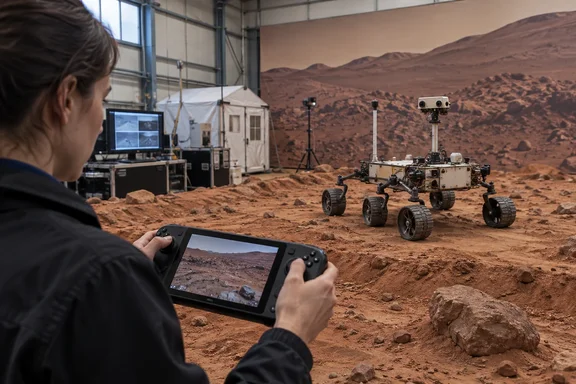
Airbus Hands Tom Scott a Steam Deck to Drive an ExoMars Prototype
The footage comes from Tom Scott's visit to Airbus's UK rover facility. An Airbus senior engineer first demonstrates a laptop-based system, instructing a prototype to move forwards, before Scott is handed the Steam Deck to operate a separate rover locally. TechSpot describes the arrangement in plain terms: Scott later operates another rover with a Steam Deck running custom software. The handheld's sticks, buttons and triggers give him real-time control of the machine.
TechSpot and IGN, whose account Dork summarized, both saw the same video. Dork notes that IGN, which reported on Scott's video, notes that the precise software running on the Deck has not been detailed. Techtroduce reports that Scott's video was filmed at Airbus' Mars Yard, a purpose-built area containing terrain designed to replicate some of the conditions a rover could encounter on Mars.
The laptop comes first and the Deck second, and that order shows what each tool is for. The laptop sends discrete commands such as "move forward." The Steam Deck gives an operator continuous, analog steering. Both are ways for people on the ground to exercise a prototype. Neither is part of the rover's own onboard computing, and nothing in the footage suggests otherwise.
Rosalind Franklin's Autonomy Keeps the Steam Deck on Earth
The rover being developed is ESA's Rosalind Franklin, the surface element of the ExoMars programme. ESA's mission page says its job is to search for signs of past and present life and to study the shallow subsurface with a drill that reaches a maximum of 2 metres. The same page says launch is scheduled for late 2028 and the cruise will take about two years, longer than the usual nine months, so that touchdown falls in northern-hemisphere spring and the solar panels get plenty of light. On ESA's numbers, arrival would come around 2030. That date is an inference from ESA's figures, not a published landing date.
Distance is the reason a joystick cannot drive it on Mars. As Dork summarizes, because of the distance between Earth and Mars, the finished machine is intended to navigate autonomously using mounted 3D cameras instead of waiting for direct instructions from an operator. ESA's description is more detailed. Scientists on Earth pick target destinations from compressed stereo images taken by cameras on the rover's mast. The rover then builds digital maps from its navigation stereo cameras, works out a safe path, and uses close-up collision-avoidance cameras while it drives. ESA puts the result at roughly 100 metres per sol, a sol being one Martian day.
Autonomy does not mean the rover is cut off. ESA says Rosalind Franklin talks to Earth through the ExoMars Trace Gas Orbiter, which provides at least two good communication windows per sol. The usual cycle is an activity plan sent up on a morning orbiter pass and results sent back on the evening pass. The Rover Operations Control Centre in Turin, Italy, monitors and commands surface operations, and its traffic goes through ESA's Estrack ground network.
So the working model on Mars is planned instructions twice a day plus onboard decisions in between. The immediate, hands-on control Scott had in the Mars Yard is something only a test site on Earth can offer. TechSpot puts it this way: the Steam Deck is not a substitute for the ExoMars rover's autonomous systems. The final rover will have to navigate without live steering from Earth.
Why Manual Control Matters in the Stevenage Mars Yard
The Mars Yard at Airbus's Stevenage site was built to train exactly the autonomy described above. When the UK Space Agency and Airbus opened the expanded facility in March 2014, the government's announcement described a 30-by-13-metre test area filled with 300 tonnes of specially selected sand. It was built so the rover's Guidance, Navigation and Control team could finish the autonomous navigation system. The walls, doors and interior surfaces were painted reddish-brown, and a large Martian landscape mural was added so the navigation cameras would see as realistic a scene as possible.
The 2014 announcement also shows how far the schedule has moved. At the time, the plan was launch in 2018 and landing in 2019, with a claimed ability to navigate autonomously up to 70 metres a day. ESA now lists late 2028 for launch and roughly 100 metres per sol for traverse. Those older dates are the original plan and have been superseded.
The facility explains why engineers still want direct control. Prototypes have to be moved into position, repositioned between runs and driven through manoeuvres while engineers watch how the chassis behaves. Techtroduce notes that the analog sticks, triggers, buttons, trackpads and touchscreen can provide the physical inputs needed to operate a robotic vehicle without requiring a separate laptop and controller. TechSpot adds that a physical controller can be quicker and easier to use than a keyboard.
ESA's description of the drivetrain suggests why an analog controller suits it, though this is our inference rather than something the video shows. Rosalind Franklin has six flexible wheels, each driven and steered on its own, mounted on independently pivoting bogies. The wheels can also be pivoted to change the rover's height and angle, which allows a "wheel-walking" gait for soft soil such as dunes. Proportional stick input is a natural fit for a vehicle with that many degrees of freedom. The video does not show how the custom software maps controls to motion.
An Open Linux PC Is Why the Steam Deck Fits
The Steam Deck works as a lab tool because it is a general-purpose computer shaped like a gamepad. TechSpot calls it essentially a small Linux PC with a built-in display and a full set of physical controls. That makes it more adaptable than a conventional game console and more portable than a laptop-and-controller setup.
Openness is the deciding factor. Dork notes that Valve's hardware runs Linux and permits users to install other programmes or operating systems, making it a plausible fit for bespoke technical applications. A locked console would make an engineering team go through a vendor's developer programme just to run an in-house control app. On the Deck, a team can install its own software and use the built-in gamepad as ordinary input hardware.
Valve's engineers have described this openness as deliberate. In IGN's interview about the Steam Machine, Valve engineer Yazan Aldehayyat said, "I don't think it's a coincidence that a good PC is also a good gaming device. At the end of the day, good hardware is good hardware." The same interview says Valve's newer devices follow the same approach, since they all run Linux and make no effort to stop users from installing different programs or even operating systems.
Airbus is not the only example. Disney operators have also been seen using Steam Decks to control BDX droids at Galaxy's Edge. In both cases, the device appears to be serving as a flexible control interface rather than as part of the robot's main computing system. The two cases are separate and say nothing about each other's technical setup. They do show that the handheld tends to end up as the operator's console rather than the robot's brain.
What the Steam Deck Footage Does Not Show
The video leaves out the details an engineer copying the idea would most want. Techtroduce notes that it does not identify the software running on Valve's handheld or explain the communication method used between the Deck and the vehicle. There is no public information on whether the link is wired or wireless, what the latency is, what control protocol is used, what safety interlocks exist, which Deck model it is, or whether it runs SteamOS or another Linux distribution.
It is also unclear whether the Deck is a standard part of Airbus's test toolkit or a convenient setup brought out on the day Scott visited. The footage shows one prototype driven by one Deck during one filmed session. It supports calling the Steam Deck a practical local controller for a ground-test rover. It does not support calling it mission hardware, space-qualified equipment, or a replacement for purpose-built rover ground-support equipment.
What this means for teams building PC-based robot controllers
If you run a lab, a maker space or an industrial test bench, the lesson is that off-the-shelf handheld PCs are a real option for operator consoles. They belong on the local side of the system, and the safety-critical logic should stay on the robot. The Airbus demonstration fits that split: the Deck sends commands, and the rover keeps its own sensing and navigation. Teams already using a laptop plus a USB gamepad for bench control can consider a handheld Linux PC as a single device with an integrated display. Teams whose systems need certified or hardened control hardware should treat this as an example of convenience during development, not a model for production.
- A Steam Deck with custom software was used to drive an ExoMars prototype in real time during Earth-based testing at Airbus in the UK, as shown in Tom Scott's video.
- The flight rover, Rosalind Franklin, plans its own paths from stereo camera maps and receives activity plans on scheduled Trace Gas Orbiter passes, so live joystick control applies only on Earth.
- ESA currently schedules launch for late 2028 with a cruise of about two years. The 2018 launch and 2019 landing dates from the 2014 Mars Yard opening are obsolete.
- The Deck's usefulness comes from being an open Linux PC that accepts custom software, not from anything specific to Steam games.
- The software, connection method and latency of Airbus's setup are not public, so anyone copying the idea will have to build and validate their own control stack.
Airbus's Steam Deck demonstration is a small story with a clear point. Cheap, open PC hardware has earned a place at the operator's end of serious robotics, while the machine it controls stays in charge of its own decisions. The Stevenage Mars Yard will keep training Rosalind Franklin's autonomous navigation ahead of the late-2028 launch. Handheld controllers will keep moving prototypes around the sand until then, and they will be left behind when the flight rover leaves Earth.