

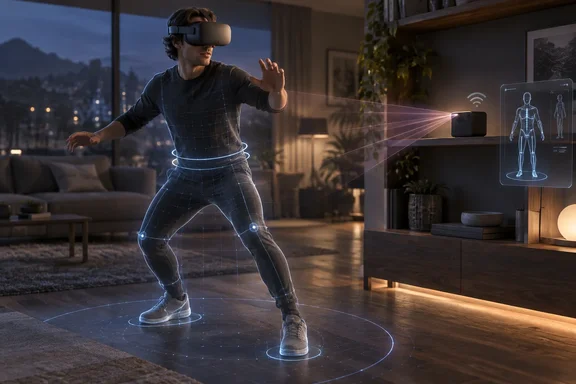
Notebookcheck first flagged Soulart’s September 15 statement, while PC Gamer independently reported that the company is working on “standalone support” for Steam Frame. Soulart’s own product material confirms that Station is intended to deliver local motion processing for SteamVR and other platforms. It does not yet list Steam Frame among its established shipping targets, and neither Soulart nor Valve has published a release date, compatibility matrix, public driver, or demonstration of the proposed integration operating on the headset.
That distinction changes the story from “Steam Frame gets full-body tracking” to something more conditional: a third party is attempting to fill a feature gap created by Valve’s move away from external Lighthouse base stations. For the small but demanding audience that treats VRChat as a primary VR application, that could be a meaningful accessory category. For everyone else, it remains an unpriced, unreviewed promise.
Station Is a Depth-Sensing Tracker, Not a Lighthouse Replacement
Station resembles a Valve or HTC base station in the broad sense that it sits in a room and observes a player, but its tracking approach is fundamentally different. Lighthouse units sweep infrared light across a play space; compatible headsets, controllers, and pucks use sensors to determine their position. Soulart instead says Station uses time-of-flight infrared depth sensing, RGB sensors, and local neural processing to infer a person’s body pose from 3D data.
That means the device is markerless: the user is not expected to strap trackers to their feet, waist, chest, or elbows. Soulart says a Station can operate independently, connect to its app over Wi-Fi or USB-C, and pass motion data into platforms including Windows, Meta Quest, Android XR, and SteamVR. Its product page also claims that sensitive motion data is processed locally rather than sent to an external service.
The appeal is obvious for people who have used conventional full-body tracking. Vive Tracker-style setups require hardware on the body, charging routines, straps, pairing, and in many cases a room equipped with Lighthouse base stations. In VRChat, full-body mode then still needs calibration so the reported tracker positions align with an avatar’s skeleton. Station cannot remove the need for avatar calibration, but it could remove the most visible hardware burden: the pucks themselves.
Soulart’s architecture also explains what “doesn’t need a PC” should and should not mean. The company is saying the Station’s sensor interpretation runs in the appliance rather than consuming CPU or GPU resources on a Windows PC. That is different from proving that every VR game, every social platform, and every headset can accept those tracking data streams without a PC. SteamVR compatibility is not automatically the same thing as standalone Steam Frame compatibility.
Steam Frame’s Tracking Gap Is Real
Valve’s Steam Frame uses onboard cameras for inside-out tracking of the headset and controllers. The design reduces setup friction compared with the Valve Index: users do not need wall-mounted base stations, and they can move the headset between rooms more easily. Valve has also positioned Frame around both wireless PC streaming and local execution on its Arm-based Qualcomm platform.
The trade-off is that the headset’s own tracking system is built around the head and hands. It does not provide the dedicated body sensors needed for reliable full-body avatar motion by itself. Software can estimate legs or posture from head and controller movement, but estimation is not equivalent to independently tracked hips and feet.
For VRChat users, that difference is visible. The platform recognizes additional trackers through SteamVR, then offers full-body calibration and maps the positions to an avatar. Properly implemented full-body tracking affects how an avatar sits, dances, crouches, kicks, and turns—not merely cosmetic hand animation. It is one reason some Index and Vive owners have retained Lighthouse hardware long after standalone headsets made room-scale VR simpler.
Soulart’s pitch is therefore aimed at a genuine hole in the Steam Frame experience. But it is not a Valve-announced expansion of Frame’s tracking system. There is no indication that Valve is adding native full-body APIs, endorsing Station, packaging it with Frame, or accepting support responsibility if the accessory creates tracking conflicts.
The Published Numbers Leave Out the Measurement That Matters
Soulart says Station can operate at up to 120 Hz and that a multi-Station installation can cover up to 50 square meters. Those claims sound promising, but neither number establishes how the system will feel in a fast VR session.
A 120 Hz capture rate means the system can sample movement up to 120 times per second. It does not disclose the full motion-to-photon path: sensor capture, pose estimation, communication to the headset or app, SteamVR translation, game processing, rendering, and display. A tracker can sample quickly yet still feel delayed if those stages add enough latency.
Soulart itself acknowledges that its machine-learning approach can introduce “slightly higher latency and error” than traditional marker or suit-based tracking. That is a more candid admission than many pre-launch hardware pitches make, but the company has not attached public end-to-end latency figures, jitter measurements, repeatability tests, or independent side-by-side comparisons with Vive Trackers, Tundra Trackers, SlimeVR, or camera-based competitors.
Occlusion is the other unanswered question. A room-mounted depth sensor may lose a foot, hip, or arm when furniture, another person, the player’s own body, or a sitting position blocks its view. Soulart says additional Stations improve accuracy and coverage, which strongly suggests one device is a minimum configuration rather than a recommendation for every room layout. The quoted 50-square-meter coverage figure also applies to multiple Stations, not a single unit.
For a social VR user, these are not laboratory concerns. Lower-body drift, delayed squats, intermittent foot loss, and body rotations that fail during a turn are immediately noticeable to the user and everyone viewing the avatar. Until reviewers can test a completed unit in cluttered rooms, seated poses, fast dance movement, and multi-hour sessions, Soulart’s claims should be treated as specifications rather than performance results.
“Under $400” Could Become a Multi-Device Purchase
PC Gamer reported that Soulart has described Station as costing under $400 per unit ahead of its planned Kickstarter campaign. The phrasing leaves a wide range of unanswered questions: whether that is an early-backer price, whether it includes shipping, what accessories are required, how long the offer lasts, and what the eventual retail price will be.
The more consequential unknown is how many Stations a buyer will need. A single unit may be enough to establish a basic tracker feed, but Soulart’s own messaging says multiple devices deliver better results. At two units, an under-$400 price becomes close to $800 before taxes or shipping; three units would push the accessory cost toward or beyond the price of many complete consumer VR headsets.
That calculation matters especially beside Steam Frame’s current pricing. Valve’s 256GB Frame kit starts at $1,059 in the United States, while the 1TB model is $1,299. The product’s high entry price has already made its standalone capability a central part of the purchase case. Adding two or three unproven body-tracking sensors would place a wireless full-body setup well above $1,800, without accounting for any remaining game purchases, charging equipment, or a separate PC for titles that cannot run directly on Frame.
The cost may still be worthwhile for dedicated VRChat users who value a cleaner room and fewer worn devices. It is not yet the inexpensive alternative implied by a single-unit headline price.
Standalone Steam Frame Support Still Has Two Separate Tests
Soulart’s planned support has to clear two technical hurdles. First, Station must reliably provide tracking data to Steam Frame’s software environment. Second, the target application must run on the headset—or the user must instead stream it from a PC—and accept the full-body data correctly.
Valve has made Steam Frame capable of both standalone and PC-streamed use, but the company has also been clear that its mobile-class processor will not run every demanding desktop game well. The headset’s dedicated wireless PC link remains central to its design. A Station working while Frame is streaming a Windows PCVR game would be useful, but it would not be the PC-free arrangement Soulart’s announcement suggests.
There is currently no published evidence that VRChat on Steam Frame will support native, standalone full-body play through Station. Soulart has not detailed whether its Frame work depends on a SteamOS driver, an Android-compatible app layer, a specific SteamVR runtime change, or a direct integration with VRChat. Those implementation details decide whether the accessory becomes a straightforward setup or another experimental bridge between incompatible tracking systems.
Soulart has identified a valuable target: full-body tracking without body-mounted hardware is precisely the kind of add-on that could make Steam Frame more compelling to social VR regulars. But the near-term buyer guidance is simple: do not budget Station as part of a Steam Frame purchase until the Kickstarter terms, per-unit requirements, latency data, and working standalone software are public.