

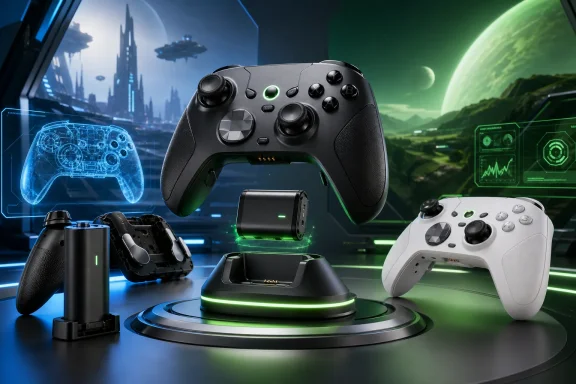
For Windows players, the central appeal is clear. SteelSeries advertises a 1,000 Hz PC mode, rear paddles, configurable controls, modular stick caps, and a battery arrangement that could avoid the usual choice between stopping to charge and playing wired. Yet that PC polling-rate headline comes with a headset-related limitation, and the controller’s high price makes clarity on day-to-day behavior more important than it would be for an ordinary gamepad.
What SteelSeries documents
SteelSeries documents the Aeon Pro as having Hall Effect thumbsticks and analogue triggers, hair-trigger switches, four rear paddles, 18 mechanical switches, an OLED display, and swappable thumbstick components. The company lists long concave and short convex caps among the supplied stick options.
That places the Aeon Pro squarely in the high-end controller category. Four rear inputs can be useful in games where players want to keep their thumbs on the sticks while activating actions normally assigned to face buttons. Hair-trigger switches may also suit games that benefit from a shorter, more immediate trigger response. Neither feature is automatically beneficial in every genre: driving games and other titles that depend on fine analogue trigger control may call for a different trigger setup than a competitive shooter.
The OLED display could make profile selection and basic status checks less dependent on a PC utility. SteelSeries’ documentation says the display can handle device selection, profiles, button mapping, battery information, and several controller settings. The same documentation indicates that deeper dead-zone and shift-key customization requires SteelSeries GG on PC. Profiles are stored in the controller’s onboard memory and later edits in GG update when the controller reconnects to a PC.
That division is sensible in principle: common changes can happen on the controller, while more detailed tuning happens in software. Still, prospective buyers should consider whether the available on-device options match their intended use. A player who frequently changes response settings, dead zones, or shifted mappings will remain tied to a Windows PC for those adjustments.
Hall Effect is a design choice, not a proven longevity result
SteelSeries documents contactless Hall Effect thumbsticks and markets them as drift-free or “zero drift.” The technology is relevant because it uses magnetic sensing rather than the contact-based arrangement associated with many conventional stick-wear concerns.
However, the wording matters. “Zero drift” is SteelSeries’ marketing claim, not an independently established lifetime result for this controller. No independent long-duration drift test was found in the supplied research. That does not prove that the sticks will develop drift, nor does it invalidate the potential advantages of Hall Effect sensing. It means purchasers should not treat the presence of Hall Effect sticks as proof of how an Aeon Pro will behave after months or years of use.
The same caution applies to the controller’s mechanical controls. SteelSeries’ documented switches, paddles, triggers, and caps describe the intended hardware, but they do not establish the durability of those parts under sustained play. At this price, the distinction between an encouraging component choice and demonstrated durability is especially important.
The 1,000 Hz PC mode has a headset trade-off
SteelSeries specifies a 1,000 Hz polling rate on PC in both wired and wireless operation. In broad terms, polling rate describes how often the controller reports input to the host. A higher stated rate can be attractive to players who place a premium on low-latency input, though its practical effect varies with the game, the broader PC and display setup, wireless conditions, and individual sensitivity to timing differences.
The limitation is more consequential than the headline figure. SteelSeries specifies 250 Hz on Xbox. It also specifies 250 Hz on PC when a headset is connected to the controller.
For a Windows player who expects to use a wired headset through the gamepad, the Aeon Pro’s highest listed PC polling mode is therefore not available in that configuration. This is not necessarily a problem for every player; many people will reasonably prioritize controller-based audio over the potential benefit of a higher report rate. But it is a meaningful trade-off for buyers drawn to a premium controller specifically for 1,000 Hz wireless or wired PC play.
Xbox buyers should similarly read the specification as a 250 Hz console proposition, not as a controller that carries its 1,000 Hz PC mode to the console. The Aeon Pro may still offer other premium controls on Xbox, but SteelSeries’ stated polling figures make the performance-oriented distinction clear.
The battery system is promising, with specific limits
The removable-battery system is the Aeon Pro’s most distinctive idea. Rather than waiting for an internal battery to recharge or attaching a cable mid-session, a user can exchange a depleted battery for a charged spare. SteelSeries also says the batteries are compatible with Arctis Nova Pro, Nova Pro Omni, and Nova Elite batteries.
SteelSeries provides per-charge battery estimates that differ by mode:
- 11.5 hours on PC without a headset attached
- 12.5 hours on Xbox
- 12.5 hours with a headset attached
- 14 hours over Bluetooth
SteelSeries attributes the shorter 11.5-hour PC/no-headset estimate to the controller’s 1,000 Hz polling-rate mode. That explanation makes the trade-off concrete: the setting that differentiates the controller on PC is also, by SteelSeries’ estimate, its lowest per-charge runtime condition.
These figures are useful for planning, but they remain manufacturer estimates rather than controlled independent measurements. Actual endurance can vary with connection mode, headset use, vibration, OLED behavior, firmware, wireless conditions, and play patterns. No controlled independent battery-life benchmark was found in the supplied research, and no independent assessment establishes whether the physical battery swap is seamless in use or how reliably the dock maintains a ready spare.
There is a separate, unresolved 25-hour claim in one report’s specification table. It conflicts with SteelSeries’ 11.5-to-14-hour per-charge estimates, and the available material does not explain whether that number refers to two batteries combined or another measurement. It is not established as a per-charge battery result and should not be treated as one.
For prospective owners, the important practical question is not whether the system can be described as “infinite power.” It is whether an 11.5-, 12.5-, or 14-hour estimated run suits their typical sessions, whether they will keep the spare battery charged, and whether a quick swap is more valuable to them than a larger fixed internal battery. If the dock works consistently, the system could be more convenient than a conventional controller even without leading on single-charge runtime.
SteelSeries’ Xbox documentation conflicts
The clearest buying risk is an inconsistency in SteelSeries’ first-party Xbox guidance.
SteelSeries’ compatibility FAQ says that Xbox must use the base station. But SteelSeries’ Product Information Guide explicitly lists wired USB-C Xbox compatibility and instructs users to connect the controller directly to an Xbox or PC using a USB-C-to-USB-A connection.
The documentation does not explain this contradiction. It also does not expressly say that the FAQ’s base-station requirement applies only to wireless Xbox operation. That may be a plausible interpretation, but it remains an inference rather than a stated resolution from SteelSeries.
The distinction has real consequences. A customer who wants wireless Xbox use may need to accommodate the dock in their console setup. A customer who wants to travel, play at a different TV, or use the controller during a dock-related problem may care deeply about whether direct USB-C operation is supported. Until SteelSeries reconciles the two positions, buyers should verify the exact wired and wireless Xbox arrangement they need before purchasing.
This is also relevant to Windows households that share a controller between a desktop PC and an Xbox. The dock may be an attractive part of a fixed desk-and-console setup, but it becomes less optional if a desired Xbox mode depends on it.
Early hands-on feedback is encouraging but not decisive
PC Gamer’s early hands-on is a useful first signal, rather than a final assessment of the controller. The publication said its time with the Aeon Pro was brief, but reported that the controller felt premium, with solid build quality, grips, and generally comfortable button presses.
Its most notable reservation concerned the ABXY buttons. The reviewer found noticeable pre-travel and described the buttons as somewhat mushy. That is subjective feedback, but face-button feel is central to menu navigation, platformers, action games, and many Xbox-style layouts. An otherwise capable controller can feel less satisfying if those primary inputs do not match a buyer’s preference for a crisp response.
Brief hands-on impressions are well suited to comments on initial ergonomics, materials, and button feel. They do not settle long-term stick performance, battery endurance, dock reliability, wireless stability, or how comfortable the paddles remain during repeated multi-hour sessions. The available early feedback makes the Aeon Pro sound promising as a physical product, but it should not be mistaken for evidence of longevity or measured endurance.
A targeted proposition for PC players
The Aeon Pro appears most compelling for a Windows player who values its stated 1,000 Hz PC mode, wants rear paddles and modular stick hardware, and sees removable batteries as a meaningful daily-use advantage. It may be especially appealing in a desk setup where the dock can remain permanently installed and the player is willing to use SteelSeries GG for deeper customization.
The case is less straightforward for people who regularly use a headset through the controller, primarily play on Xbox, or want the simplest possible premium gamepad experience. For those buyers, the 250 Hz headset and Xbox conditions, along with the unresolved Xbox connectivity wording, are central considerations rather than minor technical footnotes.
SteelSeries has documented an ambitious controller system, not merely a collection of premium parts. Hall Effect sticks, rear paddles, an OLED, configurable settings, and swappable batteries give the Aeon Pro a credible foundation. But the $259.99 price asks buyers to evaluate the whole ownership experience: how the dock fits their setup, which polling mode they will actually use, how often they use controller-based audio, and whether SteelSeries clarifies Xbox operation. For now, the best-supported conclusion is that the Aeon Pro is a feature-rich option with a potentially valuable battery concept, not yet a proven default choice for every PC and Xbox player.