

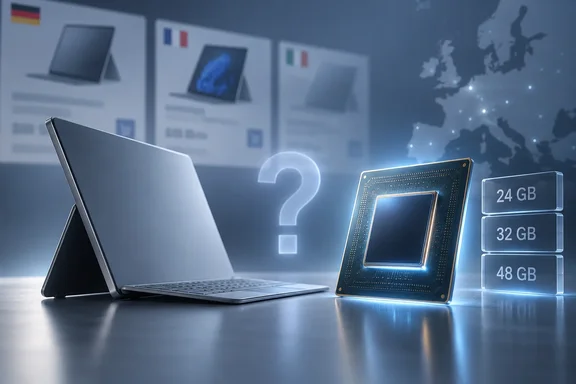
Surface "Minos" and the jump from 32 GB to 48 GB
The story has moved quickly over two days. On September 22, Quandt posted on Bluesky about a Surface codenamed Minos. Notebookcheck summarized the post as a device that "is said to combine an Nvidia RTX Spark chipset with up to 32 GB of RAM and 'insane pricing'." In that first version, Minos paired an RTX Spark chipset with 24 GB or 32 GB of RAM and 512 GB or 1 TB of storage. Quandt hedged from the start. He wrote that he thought it "might be based on RTX Spark as well bc reasons", then followed up with "maybe retailers listing BS?"
His fuller WinFuture write-up on September 23 added detail. Several European retailers have recently listed a Surface under the codenames "Minos" and "Project BP". The entries now include a 48 GB memory tier alongside 24 and 32 GB, with the same 512 GB and 1 TB storage choices. They also describe two CPU configurations that the listings clearly identify as Nvidia chips, and colour options of Platinum or Black. WinFuture points out that this colour pair matches older Surface models. The Surface Laptop Ultra is reportedly planned in Platinum and "Dark Steel" instead.
Notebookcheck's September 23 follow-up says the two Nvidia configurations are likely the 18-core and 20-core variants that have shown up on benchmarking sites in recent weeks. That is an inference. It links the retail data to unrelated benchmark sightings, and the WinFuture report itself does not give core counts.
So the new information is a third memory tier plus retailer corroboration of an Nvidia processor. That is more than Quandt's original "bc reasons" hunch, but the device's existence and form factor still rest on retail database entries.
Why the 12-inch claim is the shakiest part of the leak
WinFuture flags the weakness itself. The listings are not clean, so they may be wrong or contain errors. The 12-inch detail in particular could be a mistake, with the entries really describing the Surface Laptop Ultra and its 15-inch screen. Readers should hold on to that caveat, because every attractive part of the story depends on the size claim.
The codename itself is also a weak anchor. Quandt noted that "Minos" "usually is just one of several codenames used for various purposes and doesn't mean much at all." WinFuture says the same: Microsoft often uses a whole series of internal names for one Surface device during a launch. Two codenames for one product in the listings (Minos and Project BP) fit that pattern. They don't prove Minos is a separate product from the Laptop Ultra.
Nothing in the reporting describes the design. A 12-inch Surface could be a tablet, a detachable or a clamshell, and WinFuture says it has no design information. Assuming Minos is an Nvidia-powered Surface Pro goes beyond the evidence.
Guru3D, reporting independently on the 32 GB version of the leak, reached a similar view: the processor claim is "the most consequential and the least certain." Until Microsoft or Nvidia publishes documentation, RTX Spark support, memory configurations and even the final form factor remain unconfirmed.
What RTX Spark is, and why it would be hard to fit into a 12-inch Surface
RTX Spark is a full system-on-chip for Windows on Arm, not a discrete graphics card. Microsoft and Nvidia promoted it heavily around Computex and Build 2026, with Nvidia becoming the second Arm chip vendor for Windows 11. WinFuture describes it as an Arm platform from Nvidia and MediaTek with a Blackwell GPU aimed at local AI work. Microsoft says RTX Spark combines up to 6,144 Blackwell RTX CUDA cores and up to 20 Arm CPU cores, is rated for up to 1 PFLOP of AI performance, and is designed for Windows PCs running local AI, creator and developer workloads.
That "up to 20 Arm CPU cores" figure is the top of the platform. It fits the report that Minos listings name two Nvidia configurations, with a 20-core part as the higher option and something smaller below it. The link is plausible, but it is still the benchmark-sighting inference and not a confirmed spec.
Power is where a 12-inch device gets difficult. The Surface RTX Spark Dev Box reportedly has a 100W thermal envelope, above the 45W to 80W range listed for RTX Spark laptops. Microsoft's own product page for the Dev Box confirms "a 100W thermal envelope inside an aluminum chassis that doubles as a cooling system." Even the laptop range's 45W floor is a lot to cool in a 12-inch chassis. Guru3D notes that power consumption and cooling would be central to any 12-inch device, especially if Microsoft wants it thin and light. Guru3D also raises an open question: the reports don't establish whether "RTX Spark" here means the same configuration used in compact desktops, a lower-power derivative, or an internal evaluation platform.
Why 48 GB matters on a unified-memory RTX Spark design
On a traditional PC, RAM capacity mostly decides how many apps and browser tabs you can keep open. RTX Spark works differently. Microsoft describes the Dev Box as having "up to one petaflop of AI compute and 128GB of unified memory", and its Build 2026 developer blog says that memory is shared across the CPU and GPU. Nvidia says the RTX Spark can run models with up to 120 billion parameters locally with 128 GB of unified memory.
Our inference: if Minos uses the same unified architecture, its RAM figure is also the ceiling on graphics memory and on the size of local AI models it can load. That would make the difference between 32 GB and 48 GB more meaningful than on an Intel or Qualcomm laptop, and it would explain why a 48 GB tier would show up at all. It also means Minos could not match the Dev Box's local-model capacity. At most it would offer well under half the Dev Box's memory. Microsoft has not said whether memory in any RTX Spark Surface can be upgraded. Buyers should assume the capacity they order is the capacity they keep until Microsoft states otherwise.
The October 7 Surface event is the obvious place for an answer
The event is confirmed. Microsoft has scheduled an in-person event for October 7 in San Francisco about the Surface brand, and since Nvidia CEO Jensen Huang is confirmed to attend, the consensus is that it will focus on RTX Spark devices rather than Intel or Qualcomm hardware. Windows Central reports that Satya Nadella and Windows chief Pavan Davuluri are expected as well, and that the invitation names Windows, RTX Spark and Surface. WinFuture describes the event as officially centred on the Surface Laptop Ultra, Microsoft's first PC on the Nvidia–MediaTek platform. That makes it the natural venue to confirm or rule out a smaller sibling, but nothing guarantees Minos will be shown.
Here is where the known RTX Spark Surface hardware stands:
| Device | Status | Form factor | Memory |
|---|---|---|---|
| Surface Laptop Ultra | Announced, pre-release | 15-inch laptop | Not detailed in this reporting |
| Surface RTX Spark Dev Box | Announced, pre-release | Mini PC, 100W envelope | 128 GB unified |
| Surface "Minos" | Retailer listings only | Reportedly 12-inch | Listed at 24, 32 or 48 GB |
The Dev Box is still a pre-release product. Microsoft's own page labels it "Pre-release product. Features are subject to change prior to launch." It is due later this year in the US through Microsoft's online store. The Surface Laptop Ultra was introduced during Nvidia's Computex keynote. Even the officially announced RTX Spark hardware is not shipping yet, so a rumoured third device would be further behind again.
Minos is not the only thing in the same retail data. WinFuture also reports Snapdragon X2 refreshes of the 12-inch Surface Pro (codename "Cabo") and the 13-inch Surface Laptop ("Navarro"), with French retailer pricing:
- Surface Pro 12-inch with 16 GB and 256 GB: €1,259. With 512 GB: €1,379.
- Surface Laptop 13-inch with 16 GB and 256 GB: €1,319. With 512 GB: €1,439.
The same listings include a Bluetooth mouse codenamed "Coolidge" at about €90. These are listings too, not official prices. They do show a pattern: the reported prices for Microsoft's cheaper Surfaces are rising. That context is relevant to Quandt's "insane pricing" remark about Minos, which he never tied to a figure.
What this means for you
If you're weighing a small Surface purchase this autumn, wait until after October 7. Buying now means paying for current hardware just before Microsoft either confirms or quietly skips an Nvidia-based compact option. IT buyers should also plan for platform differences. A Surface built on RTX Spark would differ fundamentally from Microsoft's recent Qualcomm- and Intel-based models. Organisations running x86-only drivers, VPN clients or security agents should treat any RTX Spark device as a separate validation project from their Snapdragon or Intel fleet.
- Don't treat the 24/32/48 GB tiers, 512 GB/1 TB storage options or 12-inch display as final specs. They come from retailer entries that WinFuture itself says may contain errors.
- The 18-core and 20-core CPU variants are an inference from benchmark sightings. Nobody has confirmed them for Minos.
- If Minos keeps RTX Spark's unified memory, the RAM tier you pick also caps GPU and local-AI capacity. That would make 48 GB the meaningful option for on-device model work.
- Budget cautiously. The same retail data shows higher prices for the Snapdragon X2 Surface Pro and Surface Laptop 13, and Quandt called Minos pricing "insane" without giving a number.
- Plan to validate apps and drivers for Windows on Arm on Nvidia silicon separately from existing Qualcomm Snapdragon deployments before committing to any RTX Spark Surface.
For now, Surface Minos is a set of European retail database entries interpreted by a leaker with a good track record. Those entries now include a 48 GB tier and two Nvidia processor configurations that the first leak lacked. The October 7 San Francisco event will settle it one way or the other. Either Microsoft adds a 12-inch RTX Spark machine alongside the Surface Laptop Ultra and the Dev Box, or the listings turn out to be a mislabeled Laptop Ultra. Until then, the only confirmed options for anyone wanting a Surface with Nvidia's Arm chip are a 15-inch laptop and a mini PC, and neither ships yet.