

What Microsoft is pitching
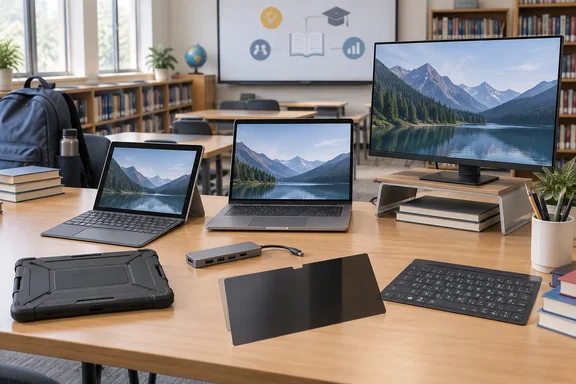
The post makes one argument. A school device moves between a backpack, a classroom display, a library table and a desk at home, so the setup around it should be configurable. Microsoft points to the Designed for Surface (DfS) ecosystem, which it directs readers to at DesignedforSurface.com. It groups its examples into four situations.
- When it moves: The post names the STM Dux Rugged Case for Surface Laptop 13-inch and the UAG Scout Series case for Surface Pro 12-inch. Microsoft says they add protection against everyday bumps and drops.
- When it arrives: The Cable Matters Foldable USB-C Multiport Adapter is offered as a way to add connections at a library table or a classroom presenting station.
- When the task changes: The Kensington MagPro Elite Magnetic Privacy Screen narrows the viewing angle during individual assessments. JCPal VerSkin Language Keyboard Covers come in French (EU), Spanish (EU) and German layouts.
- When it needs more room: A ViewSonic 27-inch ColorPro 4K UHD monitor with USB-C is paired with a Kensington SmartView Organizing Laptop Riser. Microsoft says the monitor offers Pantone Validation and power delivery over a single cable.
The timing: these devices aren't on sale yet
The accessory post describes the "new" devices, which Microsoft calls the second editions. Microsoft announced second-edition versions of the Surface Pro 12-inch and Surface Laptop 13-inch on September 23, 2026. Surface Laptop 13-inch starts at $1,199 MSRP, available starting October 13th in select markets. The Surface Pro 12-inch is priced from $1,149.99 and has the same October 13 date. As of today, October 2, that is still about eleven days away.
Microsoft also says the Pro 12-inch, Laptop 13-inch and Surface Mouse will reach commercial customers through Surface for Business beginning October 13. That is the window for education IT teams to line up accessory trials and procurement before devices arrive.
What actually changed in the hardware
This is a chip refresh, not a redesign. Both devices swap the eight-core Snapdragon X Plus from the first edition for a six-core Snapdragon X2 Plus. ITdaily also reports that the NPU is rated at 80 TOPS instead of 45 TOPS. NewsBytes says the new models bring no design or hardware changes from last year's versions. That matters for accessories. A first-edition-sized case or cover may look like it fits, but fit and compatibility with the second editions should be confirmed with each vendor.
Microsoft's own performance claims are comparisons with the first editions. In the announcement, Microsoft lists up to 17% faster Office productivity workloads, up to 18% more efficient battery performance, more than 60% faster graphics, and up to 95% faster local AI inferencing on the NPU. The accessory post's "upgraded performance" footnote gives no numbers. Microsoft's footnotes say the figures come from its own benchmarks, including UL Procyon and 3DMark Steel Nomad Lite, and that performance varies by configuration.
Practical reading for education IT
Microsoft's examples work better as a checklist of questions than as a shopping list.
- Protection: The post offers no drop-test standard, rating or warranty for the cases. Ask vendors for the test method before you assume a case suits younger students or shared carts.
- Ports: Microsoft's product listings, as relayed in the research notes, give both models two USB-C ports. The Laptop adds USB-A and a headphone jack. The post doesn't say what the Cable Matters adapter offers, which display modes it supports or how much power it passes. Check the adapter's own documentation against the displays and peripherals in your rooms.
- Privacy: A privacy filter narrows the viewing angle. It does not on its own guarantee assessment integrity. It is one layer next to proctoring policy and lockdown settings.
- Languages: The JCPal covers change the physical keyboard labelling. Nothing in the post says they alter Windows input settings. Configure input languages in Windows separately, through your normal deployment and policy tools.
- Workstations: The monitor and riser are generic desk examples. The post gives no model numbers, wattage or riser adjustability. Test a single-cable docking setup on one unit before standardizing.
Where to be skeptical
Every product here comes from a partner, and the post gives no independent evaluations, prices or education outcomes. Microsoft doesn't claim that accessories improve learning, and readers shouldn't infer it. The DfS framing does help in one way. Adding accessories to the endpoint specification, instead of leaving them to individual buyers, can make school deployments more consistent and easier to support. Whether these particular products are the right ones is something a pilot should settle.
Bottom line
- The Surface Pro 12-inch and Surface Laptop 13-inch second editions go on sale October 13 in select markets, and Microsoft is already promoting accessories for them.
- The refresh is a Snapdragon X2 Plus chip swap. The hardware design is unchanged.
- The post names concrete accessory categories, but it gives no compatibility, durability or performance data for them. Confirm those details with each vendor before you buy in volume.
References
- From Classroom to Anywhere: Extending Surface for Learning Surface IT Pro · 2026-10-02T19:28:56+00:00
- Microsoft Surface Pro 12 and Surface Laptop 13 feature Snapdragon X2 Plus and 16 GB RAM, but cost significantly more - ITdaily itdaily.com
- Introducing the next Surface Pro 12-inch and Surface Laptop 13-inch with Snapdragon X2 Plus: Greater performance that travels light | Microsoft Devices Blog blogs.windows.com