

What Take-Two disclosed
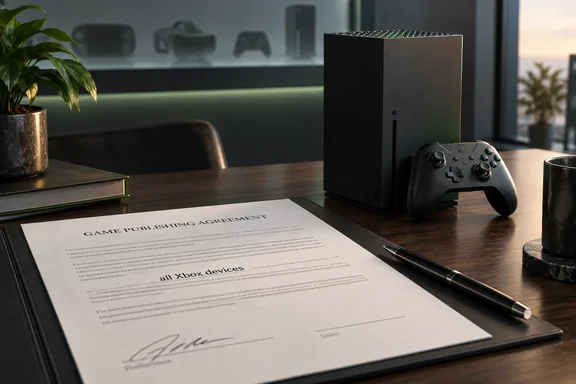
According to Take-Two's Form 8-K, the new deal gives the company the right to develop, publish, have manufactured, market, advertise, distribute and sell XBOX compatible products for all XBOX devices. GuruFocus reports that the agreement was entered into a new long-term Xbox Publisher License Agreement with Microsoft Corporation, effective as of September 17, 2026, and was signed on September 28.
The filing also says the Agreement supersedes and replaces all of the Company's existing XBOX publisher license agreements with Microsoft. Take-Two's relationship with Xbox now runs under one contract instead of several older ones.
The other disclosed terms are standard for a platform licence:
- Digital sales: Microsoft will pay the Company the applicable wholesale price and/or agreed revenue share for any of the Company's digitally delivered products and content sold by Microsoft.
- Approval rights: Microsoft has the right to review, evaluate, and approve each game concept and the final version of the game, including the game's packaging and marketing materials featuring Microsoft's marks.
- Physical media: Microsoft charges the Company fees and royalties under the Agreement for each physical media product manufactured on behalf of the Company.
- Termination: The Agreement may be terminated by either party in the event of a material breach or insolvency. Take-Two keeps certain rights to sell off existing inventory if the deal expires or ends.
The 8-K summary does not give royalty rates, revenue-share percentages or an end date. "Long-term" is as specific as it gets.
Section summary: Take-Two has one new Xbox licence covering every Xbox device. Microsoft still approves concepts and final builds, and the money terms are not public.
How the wording changed from 2020
The 2020 contract it replaces was much more specific. Take-Two's July 2020 8-K said that agreement covered Xbox compatible products for the Xbox One and the Xbox Series X platforms, until May 31, 2023 (the "Initial Term"), in the territories as specified in the Agreement. After that, the Agreement will automatically renew for successive one-year periods absent written notice from either party. That deal had itself replaced the company's existing Xbox One Publisher License Agreement, dated October 31, 2013, which expired on June 30, 2020.
The two filings are close to identical in their business terms. The 2020 filing also included Microsoft's concept and final-build approval, physical-media royalties, and the "wholesale price and/or agreed revenue share" wording for digital sales. TweakTown made the same point: apart from the device language, the terms look like the 2020 "Xbox Next Gen" deal.
| Term | 2020 agreement | 2026 agreement |
|---|---|---|
| Hardware scope | Xbox One and Xbox Series X, named | "All XBOX devices" |
| Duration disclosed | Initial term to May 31, 2023, then automatic one-year renewals | "Long-term," no end date disclosed |
| Microsoft approval of concepts and final builds | Yes | Yes |
| Digital payment basis | Wholesale price and/or revenue share | Wholesale price and/or revenue share |
| Physical-media fees and royalties | Yes | Yes |
| Replaces | 2013 Xbox One agreement | All existing Xbox publisher agreements |
Section summary: Most of the contract carries over. What changed is that the console list became a general phrase, and the fixed renewal cycle was replaced by a "long-term" deal with no published end date.
Does "all Xbox devices" point to Project Helix?
TweakTown argues that the broad wording supports the idea that Project Helix will be a family of hardware rather than a single box. It cites Xbox CEO Asha Sharma, who it says spoke in August about building "a great family of devices for Helix." I could not find a primary source for that quote in this research, so treat it as TweakTown's reporting.
The theory is reasonable. A licence for a multi-device platform would need wording like this. But the wording does not prove there is a multi-device platform. The 8-K summary does not name Project Helix, a console generation, a handheld, cloud hardware or any device at all.
Precedent also cuts against reading too much into it. Device-neutral wording is common in platform licences:
- Sony used it years ago. Take-Two's fiscal 2019 annual report said its 2017 Sony agreement covered PlayStation compatible products for all PlayStation systems, including the PS4. Sony was not hinting at a family of hidden consoles. Lawyers just prefer contracts that don't need rewriting every time new hardware arrives.
- Microsoft has written for future hardware before. An amendment to the old Xbox One licence defined the platform to include Xbox One, Xbox One S, Xbox One X and their successors and variants (collectively, "Xbox One"). Covering later revisions is a normal drafting choice.
My view, based on general industry practice rather than anything in the filing: this looks more like future-proofing than a product announcement. Under the old setup, new Xbox hardware or a renewal date meant paperwork. "All Xbox devices" removes that, whether Helix turns out to be one console, five, or a PC-style ecosystem. It is consistent with the family-of-devices theory, and it is equally consistent with a lawyer doing the obvious thing.
Section summary: The wording fits a multi-device Helix but does not confirm one. Sony's "all PlayStation systems" clause and Microsoft's own "successors and variants" definition show this is ordinary contract drafting.
What about current consoles and GTA 6?
The phrase "all Xbox devices" does not exclude current hardware, and Take-Two's earlier licence covered the Xbox One and Series generations. So the new contract almost certainly still lets Take-Two publish on today's Xbox Series X|S consoles. TweakTown also suggests the wording could mean current-generation consoles will stay in use longer. That is speculation. A publishing licence gives Take-Two the right to ship games on Xbox. It does not require Take-Two or Microsoft to support any particular console for any particular length of time.
The same goes for GTA 6. In its fiscal 2026 annual report, Take-Two said Grand Theft Auto VI is planned for release on November 19, 2026. The new Xbox agreement does not name GTA 6 and does not promise versions for future hardware. Anyone reading it as a guarantee of a Helix edition is going beyond what it says.
TweakTown also covers accounting. It says storefronts act as the principal in digital sales and that big publishers negotiate their own rates rather than paying a flat 30%. The filing supports the second point only indirectly: it refers to an "agreed revenue share" and gives no figure. Any specific percentage is a guess.
Section summary: Current Xbox consoles are very likely still covered, but nothing here promises how long they will be supported, and there is no GTA 6 detail.
What it means for Xbox and PC players
For players, the practical effect is continuity:
- Take-Two games keep coming to Xbox. The rights that cover NBA 2K, Borderlands, Civilization and Rockstar's games on Xbox are now under one long-term contract.
- Microsoft keeps its approval role. Each new concept and final build still goes through Xbox certification, as it did under the 2020 deal.
- Future hardware is already covered. If Microsoft releases new Xbox devices, Take-Two will not need a new licence to publish on them, assuming the contract's undisclosed definitions agree with the plain reading.
- PC is a separate question. Take-Two's 2019 annual report noted that We are not required to obtain any licenses from hardware manufacturers to develop titles for the PC. Whether a Helix-era device that runs PC games falls under this licence is not answered by the public summary.
The fourth point is the one to watch. If Project Helix does run PC storefronts, an "all Xbox devices" licence and the long-standing rule that PC needs no platform licence will meet somewhere. How Microsoft and publishers handle that overlap will matter more than the wording of one 8-K.
Bottom line
Take-Two has tidied up its Xbox paperwork. Under a single long-term licence it can publish on every Xbox device, under nearly the same terms as before. The shift from naming consoles to "all Xbox devices" is real and worth noting. It is also a phrase Sony was using in 2017. Project Helix may well be a family of devices, but this filing alone doesn't show it.
References
- Take-Two enters agreement to publish new games on 'all Xbox devices' - TweakTown TweakTown · 2026-10-01T01:13:07+00:00
- Take-Two Interactive (TTWO) Signs New Long-Term Xbox Publisher License Agreement with Microsoft gurufocus.com
- Amendment No. 6 to Xbox One Publisher License Agreement between contracts.justia.com