

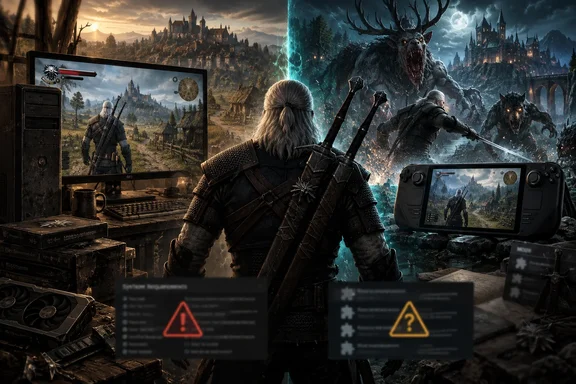
The new detail comes from PC Gamer’s September 15 interview with CD Projekt Red executive producer Jakub Kutrzuba. He described the project as a larger undertaking than the 2022 next-gen update, saying the team has altered animation, camera work, combat behavior, pathfinding, and quality-of-life friction points that had remained largely intact since the original launch.
CD Projekt Red’s August announcement independently confirms the headline features: enhanced combat, movement and traversal changes, revised mount handling, new Witcher Sign effects, monster-behavior upgrades, a revamped skill tree, transmogrification, expanded Photo Mode, and new finishers. In other words, “remastered” is being used here to describe a mechanical revision of a live game build, not simply a higher-resolution texture package.
For existing PC owners, that distinction matters more than the marketing language. A visual update can be toggled down or sidestepped; changes to animations, enemy logic, pathfinding and movement can change the feel of a long-running save, invalidate muscle memory, and complicate expectations around mods. CD Projekt Red has confirmed that saves, achievements and trophies will carry over, but the studio has not yet published a detailed technical migration guide for PC mod users or a final compatibility list for existing mods.
The 2022 update was the technical baseline
Kutrzuba drew a clear line between this release and The Witcher 3’s December 2022 next-gen update. That earlier update added ray tracing, DLSS and FSR support, higher-quality assets, camera options, quality-of-life changes and the Netflix-inspired quest and gear content. It also gave PC players an early lesson in the risks of sweeping upgrades to a mature game: its initial launch brought widespread complaints about performance, stuttering, mod breakage, and instability before subsequent patches improved the situation.
The 2026 remaster’s stated ambition is different. According to PC Gamer, CD Projekt Red concluded that another technology-only pass would not be sufficient. The team is targeting places where the original game could feel dated in daily play — the camera, the responsiveness and presentation of animation, enemy behavior, road navigation, and assorted annoyances encountered during quests and exploration.
That is a far more consequential set of edits than improved lighting. Combat systems and movement determine how every encounter, horse ride and exploration session reads to returning players. A change that makes Geralt more responsive or enemies less predictable may be welcome, but it also means this is not a preservation-oriented update of the 2015 experience.
CD Projekt Red’s own language supports that reading. The company says it wants the game to compete with contemporary releases, and Kutrzuba told PC Gamer that the internal test is whether developers find it difficult to return to the prior version. That is an unusually blunt admission that the old version is being treated as a starting point to improve on rather than a fixed work to leave alone.
A free upgrade does not mean a low-impact update
The upgrade will be free on PC for current owners through GOG, Steam and the Epic Games Store. CD Projekt Red has also said all owners of the base game received the two original expansions, Hearts of Stone and Blood and Wine, at no extra charge when the remaster was announced in August. The benefit is broader than the submitted report suggests: it is not restricted to owners of the previous Complete Edition.
The remaster will replace the current Complete Edition on storefronts when it launches, according to PC Gamer’s guide to the release. That makes September 29 an important date for anyone who deliberately keeps older builds for a modded playthrough, benchmark comparison, speedrunning route, or a particular version’s behavior. A storefront replacement is not the same thing as an optional separate remaster SKU, and CD Projekt Red has not publicly explained whether PC launchers will preserve a readily selectable legacy branch.
Steam’s current store page is explicit on one point: the listed requirements are temporary, with a notice that they “will change” on September 29. The presently visible minimum specification remains the original Windows 7/8-era baseline of a Core i5-2500K or AMD A10-5800K, 6 GB of RAM, a GeForce GTX 660 or Radeon HD 7870, DirectX 11, and 50 GB of storage. Those figures are plainly not a useful guide to the remaster.
That makes claims that the remaster has already “considerably” raised the minimum PC requirement premature. CD Projekt Red has not published final replacement requirements on the official Steam listing, nor has it published recommended specifications, resolution targets, frame-rate targets, storage needs, or a feature-by-feature matrix for ray tracing, path tracing, HDR and upscaling. Those omissions are more useful to a PC buyer than a generic promise of a heavy technical overhaul.
Steam Deck assurance is not a PC specification sheet
There is one encouraging performance statement, but it has a narrow evidentiary basis. In a separate PC Gamer interview published September 1, Kutrzuba said the remaster should run on Steam Deck “the same way” as the current game while looking substantially better, crediting optimization work in the newer rendering technology. He made a similar claim about the Nintendo Switch 2 version.
That should be read as a developer expectation, not independently tested performance guidance. Neither CD Projekt Red nor Valve has published a Steam Deck performance target, a Steam Deck Verified status, recommended preset, battery-life estimate, or comparison against the current build. “Works the same way” leaves open critical questions: the target frame rate, whether upscaling is required, which visual settings are assumed, and how difficult locations such as Novigrad compare.
The same uncertainty applies to desktop PCs. A remaster that upgrades textures, lighting, animation, combat behavior and rendering systems can impose different pressure on CPU performance, system memory, VRAM and storage bandwidth. A GTX 660-era system that could run the original game’s low settings tells players almost nothing about whether it will be supported by the September 29 build.
The responsible move for PC players is to treat the existing Steam requirements as obsolete until CD Projekt Red updates them, rather than relying on reposted figures or speculative requirement tables. Players near the old minimum should wait for the final listing and early independent benchmarks before allowing an automatic update to become their only installed version.
Saves are confirmed; mods remain the unresolved risk
CD Projekt Red has said existing saves will work with the remaster and that unlocked achievements will carry over. GamesRadar reported the confirmation after the developer posted the clarification on September 1. For a game with many players carrying years-old campaign and New Game Plus saves, that removes the most immediate risk of losing progression.
Save compatibility does not establish mod compatibility. The remaster is expected to bring cross-platform mod support and CD Projekt Red’s official material identifies co-developer Yigsoft as a team that has worked on The Witcher 3 and the REDkit tool. But the company has not published a promise that existing Nexus Mods installations, script-heavy builds, visual overhauls, gameplay rebalance packages, save-game edits, or mod managers will work unchanged on September 29.
That gap is especially significant because CD Projekt Red is altering systems mods commonly touch: combat, movement, UI-adjacent quality-of-life features, skills, visuals, and likely underlying data structures. Experienced mod users should back up local saves and the complete game directory, record their installed mod list and load order, and avoid assuming that a save created with a heavily modified build is a safe first test for the new client. A clean, unmodded save provides a much better migration check.
CD Projekt Red’s promise is compelling precisely because it is more invasive than a routine patch. The September 29 release is positioned as the new default way to play The Witcher 3, while a paid third expansion, Songs of the Past, is scheduled for 2027. For PC players, the immediate decision is not whether the remaster sounds modern; it is whether their hardware and mod setup are ready for a game update whose final technical requirements still have not been disclosed.
Update: Xbox Play Anywhere will add a Microsoft Store PC entitlement (September 21, 2026)
CD Projekt Red has confirmed that The Witcher 3: Wild Hunt Remastered will support Xbox Play Anywhere when the September 29 update launches. Players who own the game on Xbox will be entitled to the corresponding Windows PC version through the Microsoft Store without buying it again.
For Windows users who switch between an Xbox console and a PC, this adds a new upgrade path beyond the previously confirmed Steam, GOG, and Epic Games Store versions. Play Anywhere support should also provide the usual benefit of carrying eligible digital ownership between Xbox and the Microsoft Store PC ecosystem, although CD Projekt Red has not yet detailed the exact save-sync behavior or whether all editions qualify.
The company also said that the Microsoft Store PC release in Japan will carry a CERO Z rating. CD Projekt Red describes this as its first PC title to receive a CERO rating; the change does not affect existing PC storefront versions such as Steam.
References
- The Witcher 3 Remastered Owners on Xbox Will Get a Free PC Version, Play Anywhere Support Also Confirmed at Launch Windows Report · 2026-09-21T06:45:27+00:00
- CDPR Wants The Witcher 3 Remastered to Feel Like a Modern Release TechPowerUp · 2026-09-16T00:14:23+00:00