

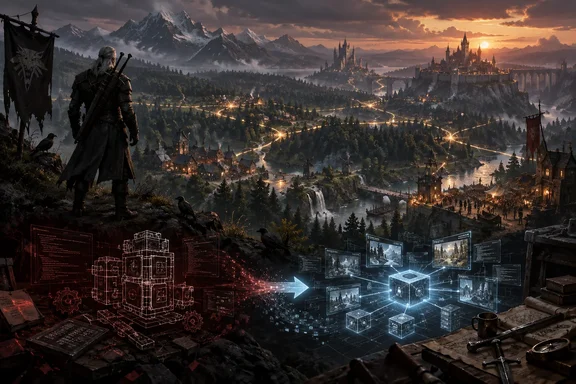
That clarification matters for PC players expecting Unreal Engine 5 to automatically solve the technical problems associated with Cyberpunk 2077’s 2020 launch—or, conversely, fearing that a switch to Epic’s engine will condemn The Witcher 4 to the shader-compilation stutter that has affected several UE5 releases. CD Projekt Red is changing the division of labor behind its games. It is not outsourcing responsibility for how they run.
Wccftech first highlighted Nowakowski’s remarks from the podcast, while The Game Business separately reported that CD Projekt Red had questioned during its research-and-development phase whether Unreal Engine 5 could meet the studio’s requirements at all. Epic’s own announcements confirm the unusual depth of the collaboration: CD Projekt Red has been working with Epic since 2022 on tools and engine features intended for large, dense open worlds.
The practical message is more restrained than the headline version. The Witcher 4 will be built on UE5, but the game’s performance, streaming behavior, traversal smoothness and visual character will depend substantially on the custom work CD Projekt Red and Epic are making together.
REDengine Was a Cost of Making Each New World
REDengine powered The Witcher 3: Wild Hunt and Cyberpunk 2077, and it was capable of things that were technically demanding even by current open-world standards: a detailed city, long-range streaming, day-night systems, dense quest logic and a heavily customized rendering pipeline. The engine’s existence is not evidence that CD Projekt Red lacked technology expertise. The company built and maintained a sophisticated proprietary stack for more than a decade.
But proprietary engines impose a recurring cost that is easy to overlook when judging a finished game. Every new platform generation, rendering feature, animation workflow, world-streaming requirement, editor improvement and production tool may require work from an internal technology group before designers and artists can safely rely on it. As projects become larger and multiple teams work in parallel, that work is no longer a background expense.
Nowakowski’s central point is that CD Projekt Red does not want its identity—and its development capacity—defined by owning that stack. The studio wants to focus its staff on the technology that is distinctive to its games rather than duplicating every engine-level function Epic already develops and supports.
That is a sensible calculation for a company now trying to operate several major projects at once. REDengine served a studio that largely made one flagship RPG at a time. CD Projekt Red’s current plans require parallel work across the new Witcher saga, a Cyberpunk sequel, The Witcher remake and related projects. A shared external engine gives those teams a more common technical language, a broader hiring pool and a route to reuse workflows rather than beginning another engine cycle for each game.
The Matrix Demo Was a Test, Not a Sales Pitch
The pivotal moment, according to Nowakowski, was CD Projekt Red’s early look at The Matrix Awakens, Epic’s 2021 Unreal Engine 5 technology demonstration. The demo showed a highly detailed city designed to demonstrate UE5 systems including large-scale world rendering, virtualized geometry and real-time lighting. It did not convince CD Projekt Red that Unreal was immediately ready for a Witcher-scale commercial RPG.
It prompted the opposite question: could it become ready?
Epic had presented The Matrix Awakens as a technical showcase rather than a shipped open-world game with years of content, broad PC hardware support, save-game edge cases, mod interactions and an open-ended quest structure. CD Projekt Red’s concern was therefore justified. A visually striking demonstration can establish a direction for engine technology; it cannot prove that a production pipeline is mature enough for a multi-year RPG made by hundreds of developers.
The studio decided the answer could be yes only through a close relationship with Epic. That distinction is important. CD Projekt Red did not select Unreal Engine 5 off the shelf and hand its games to a conventional engine-integration team. It committed to improving the parts of UE5 that did not yet fit its needs.
Epic has publicly backed that account. At its 2025 State of Unreal presentation, the company said the two firms had worked on expanding UE5’s open-world development capabilities and on tooling aligned with CD Projekt Red’s design approach. The demonstration shown there, which Epic stressed was a technology demo rather than The Witcher 4 itself, ran on PlayStation 5 at 60 frames per second with ray tracing and showcased fast world loading, dense crowds and high-detail foliage.
Those are useful signs of technical direction. They are not PC performance benchmarks. CD Projekt Red has not published the target frame rates, system requirements, upscaling modes, shader-compilation policy, storage requirements or supported graphics cards for The Witcher 4. Until it does, no one can responsibly turn the 2025 demo into a promise about how the retail PC version will behave.
A Shared Engine Does Not Mean a Generic Witcher Game
One understandable worry among fans is that Unreal Engine will make the next Witcher game look or feel like every other UE5 production. Engines supply capabilities and constraints, but they do not dictate a game’s art direction, combat design, narrative systems or world construction. CD Projekt Red’s work with Epic is specifically meant to avoid a generic implementation.
The studio has already demonstrated why that matters. REDengine games did not merely use a renderer; they carried distinctive solutions to weather, material response, landscapes, urban density, cinematic dialogue and environmental storytelling. Retaining that authored identity inside UE5 requires more than importing assets or enabling Nanite and Lumen. It requires custom tooling that lets a large RPG team build content at scale without flattening it into engine defaults.
For developers, the larger significance is that CD Projekt Red is treating Unreal as a platform to extend rather than a sealed product to license. Nowakowski described a relationship in which the studio works inside the engine’s black box with Epic. The practical value of that access is not prestige. It is the ability to influence systems that would otherwise be opaque or slow to change when they become blockers for a huge open-world production.
If successful, the changes may have value beyond The Witcher 4. Epic has an incentive to make its engine better at the categories CD Projekt Red cares about: large worlds, rapid streaming, stable content authoring, foliage-heavy environments and dense population scenes. That does not mean every UE5 game will inherit CD Projekt Red’s improvements, or that every performance problem will vanish. It does mean the work is aimed at core engine capabilities rather than a one-off game patch.
The Cyberpunk Lesson Was Organizational
Nowakowski’s comments should not be read as an attempt to erase Cyberpunk 2077’s launch failures. The game’s December 2020 release was marred by severe bugs and unacceptable performance on PlayStation 4 and Xbox One, prompting Sony to remove it from the PlayStation Store for months. CD Projekt Red spent years rebuilding the game through patches and then the Phantom Liberty expansion.
The record supports a more precise conclusion than “REDengine caused it.” An engine can contribute to development difficulty, but it cannot by itself explain decisions about scope, release timing, platform support, quality assurance or what the company was prepared to ship. Nowakowski says the REDengine-to-UE5 decision was not triggered by the launch. That is credible on its face because the studio’s stated justification is broader: it wants to increase output while reducing the ongoing burden of maintaining a full proprietary platform.
The risk is that readers interpret this as a technical reset button. It is not. Unreal Engine 5 has its own widely observed challenges on PC, especially traversal hitches and shader-related stutter in some games. Epic has continued to improve its tools and rendering systems, and CD Projekt Red’s partnership targets difficult open-world requirements, but neither company has announced a specific solution to every UE5 stutter scenario.
A smooth Witcher 4 will require early testing across the real range of PC configurations, disciplined shader-pipeline work, asset-streaming budgets that hold up outside a controlled demo, and a release plan that does not repeat the mismatch between ambition and supported hardware seen in 2020. Engine selection can reduce one category of risk; it cannot make those decisions for a studio.
What PC Players Can Actually Take From This
CD Projekt Red has now put dates around the Witcher pipeline. The Witcher 3: Wild Hunt — Remastered is scheduled for September 29, 2026, followed by the paid Songs of the Past expansion in 2027. The company has set a planned 2028 release window for The Witcher 4.
Those nearer projects will not answer whether The Witcher 4 runs well on UE5. The Witcher 3 remains a REDengine title, and its remaster’s path-tracing improvements say more about the studio’s continued support for its older technology than about the new game’s engine. The relevant evidence will arrive later, when CD Projekt Red shows actual PC footage, publishes system requirements and explains its graphics settings and performance targets.
For now, the engine switch should be understood as a bet on production scalability and shared technology, not a marketing claim that Unreal Engine 5 is inherently superior to REDengine. CD Projekt Red is trading exclusive control of an engine for deeper access to a widely used one—and betting that the saved engineering effort can become better tools, more parallel projects and, eventually, more reliably delivered games.
That wager will be tested when The Witcher 4 reaches PC in 2028, not by the name on its engine splash screen, but by whether players can cross its world without the technical compromises CD Projekt Red says the partnership was designed to prevent.
References
- Unreal Engine 5 Switch For The Witcher 4 Wasn’t About Engine Limitations, But A Bigger Studio Identity Shift Wccftech · 2026-09-17T10:31:09+00:00