

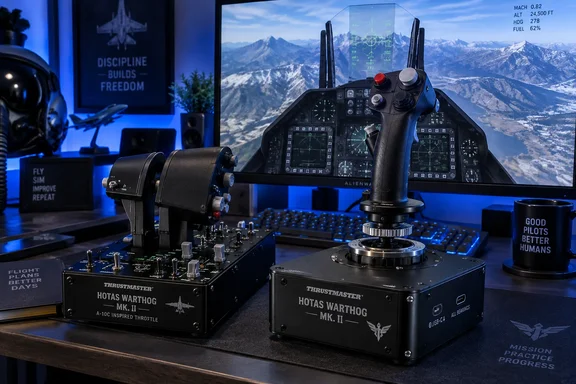
Windows Central first reported the September 16 launch and listed the U.S. MSRP at $599.99. Thrustmaster’s own product page confirms the core change: a redesigned Warthog base with anti-stiction ball bearings, a new 6-pin grip connector, an optimized metal structure, and a detachable USB-C cable. The company still describes the product simply as a PC device, with Windows 10 and Windows 11 support.
For existing Warthog owners, that makes this a hardware refresh with a narrower purpose than the name suggests. It is primarily an answer to the aging original base’s mechanical limitations and restricted grip compatibility, rather than a ground-up replacement for every control in the original HOTAS bundle.
The base is the actual Mk. II upgrade
The original HOTAS Warthog earned a long service life partly because its throttle unit is dense, functional, and covered in controls that map naturally to combat aircraft. Its joystick base, however, remained tied to an older design even as Thrustmaster introduced newer AVA modular bases and interchangeable grips across its range.
The Mk. II bundle replaces that base with a revised mechanism built around ball bearings intended to reduce the resistance around center. Thrustmaster also says its redesigned electronics and 6-pin connector can support every generation of Thrustmaster grips, with up to 128 buttons and eight axes recognized through the connection.
That is the substantive change. The full-size Viper grip is still the stick grip in the box, and the dual-engine throttle assembly is still the A-10C-inspired unit that has been sold in the original Warthog package for years. Both are proven pieces of hardware, but neither is newly engineered for this release.
Thrustmaster’s product page calls the package an A-10C replica while separately identifying the stick as a Viper replica. That wording deserves precision: the throttle is modeled on the A-10C Warthog’s dual throttles, while the grip is modeled after the F-16 Viper control stick. This is a deliberate hybrid bundle, not a faithful reproduction of one aircraft’s complete control set.
For DCS World users, that mixture is hardly a deal-breaker. The abundance of physical switches and hats is useful across aircraft modules, and the Viper grip remains particularly apt for DCS’s F-16C Viper. But a prospective buyer looking specifically for an all-A-10C arrangement should understand that the stick grip is not the A-10’s.
Compatibility is the practical reason to buy the new version
The Mk. II’s promise of compatibility with all Thrustmaster grips is more valuable than a cosmetic refresh because it gives Warthog owners a route into the company’s modular flight-control lineup without discarding the included throttle.
Thrustmaster says the new base supports its current and prior grip generations, including add-on grips that turn a joystick setup toward specific aircraft. The mechanical polarizing system is designed to ensure correct installation and protect the connector, which matters when a product is explicitly built around swapping heavy metal grips.
The older Warthog base also supported some add-on hardware, but compatibility required firmware updates and could be more constrained. Thrustmaster’s support documentation for the existing HOTAS Warthog still warns that owners using the F/A-18C Hornet Add-On Grip must update the base firmware or risk incorrect recognition in the company’s T.A.R.G.E.T configuration software.
The Mk. II therefore reduces a purchasing dilemma that has existed in Thrustmaster’s catalog: enthusiasts who wanted a Warthog throttle plus newer grip flexibility previously had to combine separately purchased components or move to the more expensive Warthog AVA Edition. The new bundle puts a modernized mounting and electronics platform below the familiar grip and throttle at the same $599.99 list price Windows Central reported for the Mk. II.
That does not mean owners of a working original Warthog need to replace it. The new base solves a real limitation for people who want modular grips and smoother center movement. It does not add new throttle axes, new button clusters, force feedback, or a new flight-sim platform beyond PC.
Hall-effect sensors are not the whole story
Thrustmaster is again leading with H.E.A.R.T., its Hall-effect sensor branding, and specifies 16-bit resolution. Hall-effect sensors measure position magnetically rather than through a physical potentiometer contact, a design generally valued for reducing wear-related drift.
But the marketing emphasis risks obscuring the more important mechanical change. The original Warthog was already associated with Hall-effect sensing; the Mk. II is not introducing magnetic sensing to a previously potentiometer-based joystick. The upgrade is the revised base structure and bearing system surrounding those sensors.
That distinction matters in daily use. A high-resolution sensor can report movement precisely, but it cannot on its own make the hand feel smoother crossing the center point or change the load created by a stick’s gimbal and spring arrangement. Thrustmaster’s claim is that the revised base does both: retain long-term sensor precision while improving the physical motion that the player actually feels.
Independent hands-on testing has not yet established how large that improvement is. Windows Central said it had received a sample and expected a review before the end of September, while major U.S. retailers were still showing the hardware as a pre-order or imminent shipment item. B&H Photo listed an estimated September 17 shipment date, and MyPilotStore listed expected availability on September 17.
So the launch-day language needs one qualification: the product is announced and orderable, but broad retail availability appears to be following immediately after rather than being uniformly in stock on September 16. Thrustmaster’s U.S. storefront itself was still labeling the Mk. II as a pre-order when checked.
Windows users should expect setup work, especially in combat sims
Thrustmaster rates the Warthog Mk. II for expert-level military aviation simulation, and the hardware’s control count explains why. The Viper grip has 19 action buttons including a dual trigger and an eight-way point-of-view hat. The throttle adds dual levers, a large control panel, additional buttons, hats, toggles, and a friction adjustment control.
That density is an advantage in Digital Combat Simulator, Falcon BMS, IL-2 Sturmovik, Elite Dangerous, and other software where taking a hand off the controls can break immersion or cost a maneuver. It can also create a setup burden. A player moving between aircraft will need to create or import bindings, account for modifier layers, and decide which controls should remain universal across simulators.
Thrustmaster’s T.A.R.G.E.T software can merge supported Thrustmaster USB controllers into a single virtual controller profile and load per-game configurations. That can simplify complex setups, but it also introduces another software layer between a game and its input devices. Many PC sim users instead bind the stick and throttle directly in each simulator, particularly when games have solid native multi-controller support.
The company advertises preset profiles for selected games, but neither Thrustmaster nor Windows Central has published a full Mk. II-specific list of tested titles, configuration files, or firmware requirements at launch. Buyers should therefore treat compatibility as hardware-level Windows support first and game-specific plug-and-play mapping second.
Microsoft Flight Simulator players should also keep expectations in line with the hardware’s purpose. The Mk. II will work as a Windows controller, and its switches can be mapped extensively, but its A-10C throttle, fighter-style grip, and heavy centering behavior suit military and space-combat simulation more naturally than casual general-aviation flying. A yoke, rudder pedals, and a dedicated civilian throttle quadrant remain more natural choices for airliners and light aircraft.
The price makes this an enthusiast purchase
At $599.99, the Mk. II is firmly priced for buyers who already know why they want a metal HOTAS. Its 6.56 kg combined weight is substantial enough to help keep it planted on a desk, but it also makes a proper cockpit mount or secure desk arrangement more than an aesthetic upgrade. The supplied desktop plate helps, yet the product’s size and cable routing should be considered before purchase.
The bigger issue is value relative to Thrustmaster’s own range. Its U.S. store continues to list the older HOTAS Warthog stick-and-throttle combination at the same $599.99 bundle price, while the newer Warthog AVA Edition sits above it. Unless the older bundle receives a meaningful discount, the Mk. II is the sensible new purchase for someone committed to the Warthog layout because the newer base removes the original package’s clearest limitation.
For owners of the original bundle, the calculation is different. The throttle appears unchanged, the included Viper grip is unchanged in purpose, and the control layout is unchanged. Replacing a functioning setup makes sense chiefly for people who want the newer base’s smoother mechanics, USB-C connection, and broader grip support—not for anyone expecting an entirely new combat-sim cockpit.
The immediate consequence is straightforward: new Windows flight-sim buyers who want Thrustmaster’s metal Warthog controls should buy the Mk. II rather than pay full price for the older bundle. Everyone else should wait for independent testing to determine whether the redesigned base delivers enough improvement in center feel and durability to justify replacing hardware they already own.