

Thunderobot Station moves from Ryzen AI Max+ 395 to PRO 495
The Station name has been used before. In late 2025, TechRadar reported a Thunderobot teaser on the company's Weibo account for a cube-shaped Station built on the older Ryzen AI Max+ 395. Thunderobot described that station as an AI-focused mini PC built for sustained workloads and long-term stability rather than peak burst performance. Its cube-like enclosure measured approximately 3L in volume.
That earlier machine was shown at CES 2026. Liliputing reported that Thunderobot hadn't announced pricing or availability for the cube-shaped computer, but the company showed it off at CES. On the front it had a full-sized SD card reader, a power button, two USB Type-A ports, a USB Type-C port, and a 3.5mm audio jack. On the back were four more USB Type-A ports, two LAN ports, a DC power input, and three video outputs: two HDMI and one DisplayPort.
The September teaser describes something bigger: a series rather than one machine. According to Technetbook, it is a new lineup of mini AI workstations for heavy compute tasks, with processor configurations reaching the AMD Ryzen AI Max+ PRO 495 and support for multi-unit cluster networking. The word "reaching" suggests lower-tier chips will also be offered, but those tiers have not been named.
Don't mix up the two generations. The January port list and 3-liter chassis belong to the 395 model. Nobody has published a chassis, port list, or power target for the PRO 495 Station. No other outlet has reported the September teaser, and we could not find an official Thunderobot post confirming the PRO 495 configuration or the cluster feature. Treat those details as Technetbook's reporting.
What the Ryzen AI Max+ PRO 495 brings to a mini workstation
The chip itself is well documented. It tops AMD's Ryzen AI Max PRO 400 series, the part previously code-named Gorgon Halo. It is 16 Zen 5 cores, 32 threads, Radeon 8065S, 256-bit LPDDR5x memory, up to 192 GB of RAM, and an NPU with up to 55 TOPS. Boost clocks go up to 5.2GHz, and AMD rates total AI throughput at up to 131 TOPS. Those TOPS figures are AMD's peak ratings. They don't tell you how a particular model or application will run on a particular Thunderobot box.
The graphics are what separate the 495 from its siblings. The Ryzen AI Max PRO 485 and 490 use the Radeon 8050S with 32 compute units, while the 495 has the Radeon 8065S with 40 CUs running at up to 3000 MHz. If the Station lineup includes lower chips, the gap between the cheapest and most expensive models will show up mostly in the GPU.
For local AI, memory matters more than anything else on the spec sheet. The CPU and GPU share one pool of LPDDR5x, and a large part of it can be assigned to the GPU. Minisforum, which already ships a PRO 495 machine, says its system supports up to 192GB of LPDDR5x unified memory, with up to 160GB allocatable as VRAM. That shared pool lets a mini PC load models far larger than most discrete consumer graphics cards can hold. But 192GB is the processor's ceiling, not a promise. Lenovo's PRO 495 machine, covered below, tops out at 128GB. Thunderobot hasn't said how much memory the Station will carry.
Power and cooling are also unknown. The same chip behaves very differently depending on how much sustained power the chassis allows. For comparison, Minisforum lists 160W peak power, 120W sustained load for its PRO 495 workstation. Thunderobot has published no equivalent figure for Station.
Elastic cluster networking is still unexplained
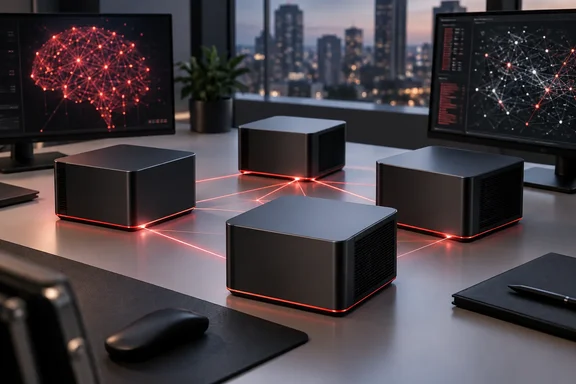
Clustering is the headline claim. Technetbook says the standout feature of the Station series is elastic cluster networking, which lets users link multiple mini workstations together to expand processing power on demand. The target buyers are software developers, visual creators, and enterprise teams that need flexible local compute power without buying large server racks.
Thunderobot hasn't said how it works. Nothing published covers the physical link, the software that splits a job across boxes, the maximum number of units, whether a cluster behaves like one large memory pool for AI inference, or whether it can also spread rendering or build jobs. Each of these decides whether "elastic" means something useful to you or just describes a spec sheet.
Other vendors show what clustering usually looks like at this class. In July, VideoCardz reported that Framework demonstrated two 50GbE network adapters with RDMA over Ethernet, in a proof-of-concept cluster that connects two 192GB systems and uses tensor parallelism to access 384GB of memory across both computers. Tensor parallelism splits a model's layers across machines, so each box holds part of the weights and they exchange intermediate results over the network. The approach depends on a fast, low-latency link, and adding a second node doesn't double performance.
This gives a reasonable framework for judging Thunderobot's claim once details appear. It isn't a description of Station. The CES-era 395 model had two LAN ports on the back, but nothing links those ports to the clustering feature in the PRO 495 series.
Lenovo and Minisforum already sell PRO 495 clusters
Thunderobot is late to this. Several vendors have already announced PRO 495 machines, and at least two advertise multi-unit clustering with firmer numbers than Thunderobot has offered.
Lenovo's ThinkCentre X Ultra is the most concrete enterprise option. VideoCardz reports that Lenovo confirms the Ryzen AI Max+ PRO 495, Radeon 8065S with up to 96GB allocated graphics memory, 128GB LPDDR5X-8533 and the full I/O configuration in its specification table. The four-system clustering feature is part of Lenovo's announcement. The ThinkCentre X Ultra is scheduled to become available in November 2026, with European pricing expected to start at €3,100. Tom's Hardware notes the rear I/O includes a pair of Thunderbolt 4 ports and a 10Gb Ethernet jack, and that Lenovo is offering both Linux and Windows options.
Minisforum announced its MS-S1 MAX-P495 at IFA 2026 on September 4, alongside an AI Agent NAS built on the same chip. Its store listing claims specific cluster results: two 192GB MS-S1 MAX units form a compact AI cluster capable of running Qwen3.5-397B locally at 16 tok/s, and in real-world testing, a four-unit cluster ran the DeepSeek-R1 671B Q4 large model (380GB, Q4_0 quantization). These are Minisforum's own results, not independent benchmarks. Still, they name a model, a quantization level, and a node count, which is the kind of claim a buyer can check.
VideoCardz has also reported a COLORFIRE mini PC with the PRO 495 and up to 192GB of memory. When Station ships, it will be at least the fourth PRO 495 compact system, facing competitors that already have prices, dates, or published cluster results.
| System | Status (as reported) | Memory ceiling | Clustering claim | Price / timing |
|---|---|---|---|---|
| Thunderobot Station series | Teased | Not disclosed | "Elastic" multi-unit, no details | Not announced |
| Lenovo ThinkCentre X Ultra | Announced | 128GB LPDDR5X-8533 | Up to four systems | From €3,100, November 2026 |
| Minisforum MS-S1 MAX-P495 | Listed for sale | 192GB (up to 160GB as VRAM) | Two- and four-unit, with vendor-tested models | Store listing live |
| Framework Desktop (PRO 495) | Previewed | 192GB | Two-node RDMA proof of concept | Not established here |
Thunderobot's AI Master line explains the Station bet
Station extends Thunderobot's workstation push. Technetbook places it alongside the AI Master M7000 laptop and roadmap mentions of Gorgon Halo AI Master M laptops and AI Master D mini PCs. The M7000 has independent confirmation. VideoCardz reports it is a 16-inch mobile workstation based on AMD's Ryzen AI Max+ 395, with 64GB of LPDDR5X-8000 memory and Radeon 8060S graphics in the retail configuration, listed in China for 24,999 yuan, around $3,733.
The M7000 also pairs 768GB of conventional storage with an 85GB AI cache using Phison's aiDAPTIV+ technology. That middleware can retain data such as KV cache, less-active MoE experts and model data when faster system or unified memory is constrained. Thunderobot has already shipped one workaround for memory limits on a Halo-class machine, so it's fair to ask whether Station will use a similar storage-cache trick alongside clustering. That is only a guess; the teaser doesn't mention it.
The roadmap claims about future AI Master M and AI Master D models come from Technetbook alone, with no dates or specifications. The M7000 launch in China also raises a question for readers outside that market: Thunderobot hasn't said where Station will be sold.
What this means for you
Nobody can buy or evaluate Station yet. If you need a PRO 495 cluster in 2026, the products with published details are what you can actually plan around. Station is worth watching if Thunderobot's pricing ends up well below Lenovo's, and that's something only a firm announcement will settle.
- Station is a teaser. Thunderobot has announced no price, launch date, memory configuration, or sales regions for the PRO 495 models.
- The PRO 495 offers 16 Zen 5 cores, Radeon 8065S graphics with 40 CUs, and up to 192GB of unified memory, but each vendor sets its own memory and power limits.
- Before buying any "elastic cluster" system, check the interconnect speed, the supported inference software, the maximum node count, and whether the vendor names models it has actually run across nodes.
- Lenovo's ThinkCentre X Ultra is the dated enterprise alternative, with four-system clustering, Windows or Linux options, and a November 2026 target from €3,100 in Europe.
- Minisforum's MS-S1 MAX-P495 already publishes two- and four-unit cluster results, though those are its own tests.
- The January CES Station, with its roughly 3-liter chassis and front SD reader, used the older Ryzen AI Max+ 395, so its specs don't necessarily apply to the new series.
Thunderobot has put its name in a crowded field of PRO 495 mini workstations. The company that already makes Halo-class laptops and a cube desktop clearly intends to compete. What moves Station from teaser to shortlist is a spec sheet that explains elastic clustering in the same concrete terms Lenovo and Minisforum already use: node count, interconnect, memory per unit, and a price. Until then, IT buyers timing a late-2026 local-AI purchase already have firmer options.