

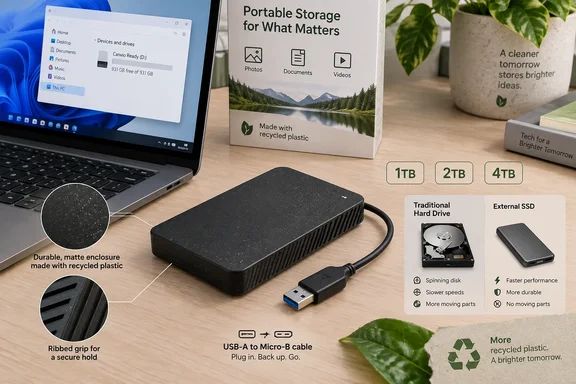
NotebookCheck first reported the refresh on September 16, while Toshiba Electronics Europe formally announced it on September 15. Toshiba says the revised Canvio Ready will reach the market in the fourth quarter of 2026, but it has not published pricing, a specific on-sale date, or a U.S. availability announcement. That makes this a regional product refresh for now, rather than a new portable-storage option that American buyers can confidently order.
For Windows users who need inexpensive offline capacity for file copies, image archives, and a second backup target, the Canvio Ready remains a simple option. Buyers looking for a fast external working drive should treat the recycled-plastic change as exactly what it is: an enclosure revision, not a storage-performance upgrade.
The new model replaces more than the top panel
Toshiba’s EMEA product page identifies new part numbers: HDTP410EK3AA for 1TB, HDTP420EK3AA for 2TB, and HDTP440EK3CA for 4TB. Those identifiers differ from the prior Canvio Ready line, which used HDTP310EK3AA, HDTP320EK3AA, and HDTP340EK3CA respectively.
That is useful when comparing retailer listings. A listing that only says “Canvio Ready 4TB” does not establish that it is the recycled-material revision; the model number is the reliable check. Toshiba describes the new shell as having a matte, speckled finish and ribbed detailing intended to improve grip, replacing the prior two-tone matte-and-gloss presentation.
The environmental claim is also carefully bounded. Toshiba says the top cover contains recycled plastic; it does not claim that 65% of the complete drive, its internal mechanism, packaging, cable, or total product mass is recycled material. The company has not published a lifecycle assessment, carbon-footprint comparison, or material breakdown beyond the top cover. Readers should not infer a quantified reduction in the drive’s overall environmental impact from that one component claim.
Toshiba’s announcement calls the change a product refinement, and the published specifications back that up. There is no increase in maximum capacity beyond 4TB, no faster interface, no USB-C connection, no stated change to the mechanical disk inside, and no expanded warranty.
USB 3.2 Gen 1 still means a Micro-B cable
The Canvio Ready uses USB 3.2 Gen 1, the current name for the 5Gbit/s USB standard also widely labeled USB 3.0. Toshiba includes a Type-A-to-Micro-B cable, and the drive is backward-compatible with USB 2.0 ports.
That connector choice is increasingly important in a laptop market that has moved heavily toward USB-C. The included cable will connect directly to many desktops, older notebooks, docks, and monitors with Type-A downstream ports. It will not connect directly to a USB-C-only Windows laptop without an adapter, a USB-C-to-Micro-B cable, or a dock that provides USB-A.
The 5Gbit/s figure is the interface’s theoretical signaling rate, not a promise that the spinning hard disk will sustain transfers at that speed. Toshiba’s own specifications say real read and write performance varies with the host, files, and conditions. Mechanical portable drives generally become the limiting component long before a 5Gbit/s USB link does, especially when transferring many small files or writing to a nearly full disk.
That does not make the interface obsolete for this product category. For periodic backups, moving media libraries, archiving virtual-machine images, or taking a second copy of data off-site, a 2.5-inch hard drive can still be useful because it offers multi-terabyte capacity without a separate power adapter. But IT staff and power users should not confuse it with an external SSD. A portable SSD remains the better choice for active project files, Windows-to-Go-style workloads, frequent virtual-machine use, or fast recovery from an external image.
Windows setup is easy, but the backup plan is still yours
The EMEA Canvio Ready ships formatted as NTFS for Microsoft Windows and is designed for plug-and-play use. Connect it to a Windows 11 PC, assign no additional software, and it should appear in File Explorer ready for file storage.
That convenience has a limitation: Toshiba does not bundle the Windows backup and security tools offered with some of its higher-tier Canvio products. Its current U.S. lineup comparison lists no automatic backup software and no password-protection software for Canvio Ready, while certain Canvio Advance models include both Windows-oriented features.
The practical implication is straightforward. A Canvio Ready is storage hardware, not a backup system. Windows users who purchase one should decide before copying data whether it will hold a disposable file archive, a manually maintained duplicate, or a backup governed by a schedule and retention policy. Simply dragging files to an external disk once is useful as an extra copy, but it does not protect the data that changes afterward.
For a personal Windows PC, File History, Windows Backup, or another backup application can manage recurring copies, depending on what needs protection. For business systems, the drive is more appropriately a transport or emergency-copy device unless it is folded into a controlled backup process with encryption, access controls, and verification. The drive itself does not add those protections.
Toshiba says its ramp-load mechanism helps protect the disk heads while the drive is moved, and its shock sensor can cut power when it detects physical stress. Those are sensible safeguards for a portable hard drive, but neither feature substitutes for a second copy. A drop can still damage an enclosure, cable, or disk; corruption, theft, ransomware, accidental deletion, and electrical failures have different failure modes entirely.
The 4TB model needs closer comparison shopping
The refresh also exposes a detail that can confuse buyers comparing international listings. Toshiba’s updated EMEA Canvio Ready page lists a 78mm by 109mm by 14mm enclosure for the range, with approximate weights of 124g for 1TB, 147g for 2TB, and 206g for 4TB.
Toshiba’s current U.S. Canvio Ready page still describes the earlier two-tone product. It lists the 4TB edition as 19.5mm thick and approximately 217.5g, while its 1TB and 2TB models are 14mm thick. The U.S. page also retains the older part numbers and does not yet claim a recycled-plastic top cover.
That is more than a cosmetic web-page mismatch. It means specifications from a U.S. retailer may describe an older 4TB Canvio Ready even after the revised EMEA model begins shipping. A buyer ordering from an importer should verify the exact part number, physical dimensions, warranty coverage, and intended sales region rather than assuming all 4TB Canvio Ready listings are interchangeable.
Toshiba has not said whether the new 4TB model’s 14mm specification signals a thinner internal drive assembly, a regional configuration difference, or a product-page error. Until that is clarified in a datasheet or a U.S. launch notice, the new HDTP440EK3CA model number is the safest way to distinguish it from the older HDTP340EK3CA.
What buyers should take from the refresh
The revised Canvio Ready is a modest update aimed at buyers who still value low-cost, bus-powered hard-drive capacity. Toshiba has retained the traits that define the line: NTFS formatting for Windows, up to 4TB of capacity, USB power, a Micro-B connection, basic shock protection, and no required setup.
Its recycled-plastic cover is a real material change, but it does not alter the purchasing calculation for most Windows users. Choose this drive when capacity and offline portability matter more than speed, and use it as one copy in a backup plan rather than the only location for important files.
The unresolved point is availability. Toshiba Electronics Europe says the refreshed Canvio Ready starts arriving in Q4 2026, yet pricing and U.S. distribution remain unannounced. Until Toshiba’s Americas operation publishes matching model numbers and specifications, U.S. buyers should assume that local listings may still refer to the older Canvio Ready design.
References
- Toshiba intros eco-friendly portable hard drive Notebookcheck · 2026-09-16T12:11:00+00:00