

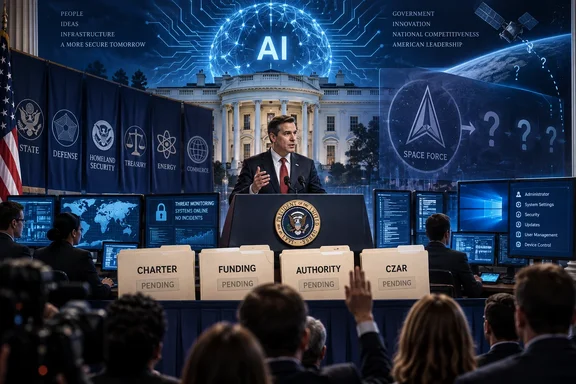
Reuters first reported the announcement after Trump posted it on Truth Social, saying the United States would not “hinder or stifle” AI’s growth and that harmful uses could be addressed through the existing criminal and civil justice system. CNN and Axios independently reported that the White House had not provided the basic details needed to define the initiative, including where it would sit in government, what authority it would have, what budget it would receive, or whether it would be a civilian office, a national-security coordination body, or something else.
The immediate practical takeaway is simple: there is no AI Force program for enterprises to join or comply with yet. There is also no named czar, no published charter, and no indication that existing federal AI work has been consolidated under a new authority.
The Space Force comparison does not describe what has been created
Trump’s reference to the U.S. Space Force gives the announcement rhetorical weight, but the legal history points to a much larger gap between a social-media declaration and a new armed service. Congress established the Space Force on December 20, 2019, through the fiscal 2020 National Defense Authorization Act, placing it within the Department of the Air Force and providing statutory authorities, personnel structures, and appropriations.
An “AI Force” that actually resembled the Space Force would require Congress to define its mission, authorities, leadership structure, funding, and relationship to agencies that already control federal IT, intelligence, civilian regulation, procurement, and defense operations. Nothing released on Saturday says that process has begun.
A president can direct agencies, establish White House-led initiatives, appoint advisers, and set procurement or national-security priorities without creating a military branch. That is the more plausible reading of the announcement until the White House releases an executive order, a budget proposal, agency memorandum, or legislative package.
Axios reported that Trump did not explain what the AI Force would do, where it would be housed, or what funding it would receive. Reuters likewise reported that the White House did not immediately respond to questions. Those omissions are not minor administrative blanks; they determine whether the name becomes a coordinating office, a procurement initiative, a regulatory body, or remains a political message about accelerating AI deployment.
The administration already has an AI policy machinery
The new branding also arrives after the administration had already assembled a substantial AI agenda across multiple agencies. The White House’s July 2025 America’s AI Action Plan identified more than 90 federal actions across innovation, AI infrastructure, and international diplomacy and security. The administration has separately promoted faster permitting for data-center infrastructure, a national AI legislative framework, and a June 2026 national-security directive focused on deploying advanced AI systems to military and intelligence users.
That means the unanswered question is not whether the federal government has AI policy. It plainly does. The question is what the AI Force would change inside that existing structure.
The June national-security memorandum described a framework for putting advanced, secure, and reliable AI systems into the hands of military and intelligence personnel, including provisions around system robustness, controllability, accountability, high-security compute infrastructure, and access to outside technical experts. Those are concrete operational mechanisms. Trump’s Saturday announcement provided none of that detail for the AI Force.
For IT professionals, that makes it premature to treat the proposal as a new standard for AI governance or federal cybersecurity. Agencies already procure and deploy AI through established authorities, and contractors already navigate requirements set by individual customers, sector regulators, procurement rules, export controls, privacy law, and state law. A new White House title does not erase those obligations.
It could, however, become the vehicle for coordinating them. If an eventual AI czar is placed in the White House, the role could influence federal buying preferences, model-security testing, data-center policy, export strategy, and the administration’s response to state AI laws. Those choices could matter materially to firms selling Windows endpoints, cloud services, identity tooling, developer platforms, AI infrastructure, or security products to the federal government. But none of those outcomes has been announced.
Growth first, with enforcement after the fact
Trump’s position is not a call for no government role. His post says the government will “watch over” AI and look for harmful conduct, while arguing that the criminal and civil justice system already supplies the necessary response. Reuters reported that he framed AI policy around preserving U.S. leadership over China and dismissed calls for new restrictions that he says could slow the industry.
That framing favors enforcement after a legally actionable event over pre-deployment technical requirements. In plain terms, it suggests a policy preference for prosecuting fraud, theft, discrimination, cybercrime, or other unlawful conduct rather than requiring broad advance reviews of AI models before they are released.
There is a significant implementation problem in that approach. Existing laws may reach fraudulent outputs, unauthorized access, intellectual-property disputes, discriminatory decisions, deceptive marketing, or other conduct depending on the facts. They do not automatically specify how a developer should test a frontier model for autonomous cyber capabilities, prevent sensitive-data leakage, document model provenance, or prove that an AI agent stays within authorized actions inside an enterprise network.
Those gaps are especially relevant to security teams deploying generative AI in Microsoft 365, Windows environments, code repositories, help desks, and security operations centers. Organizations still need to set their own guardrails for identity permissions, retrieval data, logging, human approval, prompt-injection defenses, AI-agent containment, software supply-chain review, and incident response. Saturday’s announcement does not substitute for any of them.
The White House’s earlier national-security AI directive is telling on this point. It emphasized secure systems, responsibility, and clear accountability precisely because deploying AI into operational environments creates risks that general criminal-law enforcement does not prevent in advance. Whether the AI Force adopts similarly specific controls, rejects them, or takes on a different mission is unknown.
The czar appointment will reveal whether this is a policy office or a campaign for faster deployment
The person Trump selects will provide the first meaningful signal about the AI Force’s direction. A technology-policy coordinator with authority over the Office of Science and Technology Policy, the Office of Management and Budget, Commerce, Defense, and intelligence agencies would indicate an effort to centralize executive-branch strategy. A national-security figure could push the initiative toward defense adoption, model security, chip supply, and competition with China. A business-focused appointee could place infrastructure, data centers, energy capacity, exports, and deregulation at the center.
Trump offered no timetable beyond saying the appointment would come “in the near future.” Reuters reported that U.S. officials expect AI to be among the topics in talks with China next week, adding an international-competition context to the announcement. But a diplomatic talking point is not an operating plan.
There is also no evidence yet that the AI Force will displace existing White House AI advisers or federal programs. The administration’s previous initiatives already include an AI Action Plan, a legislative framework, a national-security memorandum, infrastructure policy, and procurement-related AI work. Creating another coordinating banner without defining responsibilities could increase overlap rather than reduce it.
For now, the announcement is best read as a declaration that the administration intends to champion rapid AI expansion while reserving the option to intervene against conduct it considers harmful. The first documents that matter will be an executive order, a formal appointment announcement, a budget request, or legislation. Until one of those appears, “AI Force” is a name in search of authorities.
References
- Now Trump says he's creating an AI Force Engadget · 2026-09-19T19:22:20+00:00