

As reported by The Register and detailed in TypeSafe’s September 15 launch materials, Jev is the first model in the startup’s self-defined “System One” category. Rather than produce text, it takes a supplied state plus a defined set of questions and returns values such as a selected category, a scored rubric, a probability distribution, and a confidence estimate. TypeSafe says it is bringing developers into the service from a waitlist, which means the product remains a launch-stage API rather than a broadly tested production platform.
The significant change is architectural at the interface level. A conventional LLM can be instructed to emit JSON, but it still generates that JSON token by token and requires the caller to handle malformed output, unexpected fields, refusals, or prose leaking into an otherwise machine-readable response. Jev removes free-form string generation from the public product boundary. Developers declare the valid decision space first, then receive an answer that matches it.
That makes Jev relevant to software development and enterprise IT administration, but TypeSafe’s headline performance and reliability claims should be read as vendor measurements on workflows designed around the vendor’s approach, not as a settled replacement for general-purpose models.
What Jev actually returns
TypeSafe exposes three question forms. A Choice selects from a fixed set of options and returns probabilities for each option; a Score evaluates a state against an ordered scale; and a yes-or-no primitive called Noul returns a probability from zero to one. Multiple questions can be evaluated against the same input state in one request.
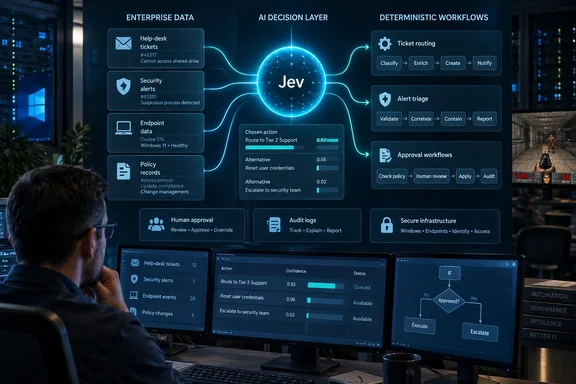
Take a help-desk workflow. An application could provide the ticket text, device record, user history, and relevant policy as the state. It might then ask Jev whether the issue concerns billing, access, malware, hardware, or an outage; whether the ticket has enough evidence for automatic closure; and whether the user is likely to need human contact. The application, not the model, would translate those outputs into an action.
That division of labor is the strongest part of the product’s design. A team can keep permissions, escalation paths, ServiceNow assignments, Intune remediation actions, Microsoft Defender containment, and audit logging in deterministic code. The model is asked for bounded semantic judgments where rules alone become brittle: whether a user’s message reports credential compromise, whether an endpoint alert looks benign, or whether an invoice description conflicts with its receipt.
TypeSafe’s own documentation recommends splitting broad judgments into smaller questions and combining them in code. That approach is less glamorous than giving a chat model a large prompt and asking it to “handle” an entire process, but it gives an administrator a place to inspect and change policy. If “high-risk sign-in plus impossible travel” must always create a priority-one incident, that rule belongs in the workflow, not in a model’s unstated reasoning.
The tradeoff is equally important: Jev cannot compose the human-facing explanation afterward. A support workflow that needs to write a reply, summarize a security incident, draft PowerShell, or produce a customer email will still need a generative model, a template system, or a human operator.
The Doom demo is a structured-control test, not visual gameplay
TypeSafe’s most shareable demonstration has Jev making roughly 10 decisions per second to control a Doom bot at an estimated cost of about $7 an hour. The company’s own launch post supplies a qualification that the headline omits: the bot receives structured game state containing text, not screenshots or raw video, and TypeSafe says a conventional non-AI Doom bot could play better.
That does not make the demo meaningless. It demonstrates a tight feedback loop in which software can feed a model state, receive an action choice quickly, and repeat. The model is being used as a flexible decision function—given enemy locations, health, ammo, objectives, and allowed actions, choose what to do next—not as a vision system learning the game world from pixels.
For enterprise automation, that is closer to the intended use than the game itself. Consider a security operation receiving an endpoint event, identity data, asset criticality, prior alerts, and vulnerability status. A typed decision model could score the event for analyst review or recommend a pre-approved response path. It could not safely be treated as the authority to isolate devices or disable accounts merely because it emitted a high confidence value.
This is where the distinction between valid output and correct output matters. Jev’s interface can prevent an answer outside the configured choice list. It cannot prove that “contain immediately” is the right selection for a particular endpoint. A well-formed wrong decision remains wrong—and could be more dangerous in an automated pipeline precisely because software can act on it so easily.
“Zero hallucinations” has a narrow, useful meaning
TypeSafe markets Jev as hallucination-free. In the company’s technical explanation, that claim means the model does not create invalid types or output structures outside the requested schema. It is an important reliability property for a machine-to-machine API. A workflow waiting for one of five escalation states should not receive an invented sixth state, an unrelated paragraph, or broken JSON.
But schema safety is not factual accuracy, calibrated confidence, or operational safety. Jev may still misclassify a phishing report, interpret an ambiguous invoice incorrectly, or score an alert too low. TypeSafe says every decision includes probabilities and confidence so developers can route uncertain cases to review; that is a sensible control mechanism, provided the confidence values are actually calibrated on the organization’s data.
The startup says its Reinforcement Learning for Calibrated Decisions, or RLCD, trains the model to attach probabilities that honestly reflect its chance of being right. That is a meaningful claim, because an automated system needs to identify its hard cases rather than merely emit a confident-sounding answer. Yet the public launch materials do not include a research paper, model weights, or a reproducible independent calibration study that would let outside researchers verify the method.
RuntimeWire, which reviewed the launch documentation, highlighted a second limitation: TypeSafe’s public workflow evaluations use reference labels derived from the average answers of two other frontier models, GPT-6 Astra and Claude Fable 5.1, rather than independently established ground truth. TypeSafe openly acknowledges this design. It says the workflows were made by members of its own model-capabilities team and may contain bias, even if they were not selected to flatter Jev.
That means the evaluations answer a narrower question than the marketing suggests: how closely does Jev match a specific structured workflow whose reference answers come from selected LLMs? They do not yet establish that Jev is correct on an organization’s real incident queue, billing data, or customer messages.
Speed and price may matter most in repeated workflows
TypeSafe lists Jev at $0.042 per million input tokens, with no output-token charge, and claims typical end-to-end response times between 70 milliseconds and 500 milliseconds. The company’s homepage advertises one workflow result as 193.6 times faster and 444.6 times cheaper than its LLM comparisons. Those figures may be achievable in the narrow workload shape Jev was designed for, but they are not universal measures of AI capability.
The speed advantage comes from a real product constraint. Generative models repeatedly predict the next token in a sequence; Jev returns structured judgments in parallel. If an organization needs many compact classifications against the same body of state—for example, categorizing thousands of tickets, tagging documents, ranking agent traces, or evaluating hundreds of policy checks—the latency and cost savings can compound.
Gihyo’s reporting on the release similarly notes that Jev can group multiple questions around one state in a single API call. For a Windows administrator, the potential value is not asking a model to replace a troubleshooting engineer. It is reducing the cost of the repetitive judgments surrounding that engineer’s work: priority assignment, duplicate detection, routing, initial policy checks, and deciding which cases need the expensive model or a human.
There is a catch. TypeSafe’s own technical post says its published evaluation runs were generally performed from laptops on the U.S. West Coast, where its service is currently hosted. A 70-millisecond response observed near the service is not a latency guarantee for a company operating from another region, through a proxy, or across a chain of ticketing and security tools. The company also says it cannot yet prove that the launch pricing is not subsidized; it says long-term pricing sustainability will have to be demonstrated over time.
How IT teams should test it without handing it the keys
Jev is best treated as a candidate classifier or policy-adjacent decision service, not an autonomous administrator. Its output shape creates a useful foundation for a staged evaluation because every result has a known set of possible values and can be compared with a labeled historical outcome.
A sensible pilot would keep the model in shadow mode:
- Feed it a historical or live-but-non-actionable sample of service desk tickets, Defender alerts, or identity-risk cases.
- Record every decision, the complete probability distribution, the confidence score, the expected action, and the final human disposition.
- Measure accuracy separately for high-confidence and low-confidence results to determine whether TypeSafe’s confidence estimates predict real-world reliability.
- Define an abstention threshold before the pilot begins, and route every result below it to existing human procedures.
- Keep containment, account changes, payment approvals, and other irreversible actions behind deterministic policy checks and explicit approvals.
The most useful question is not whether Jev beats a chatbot in a vendor benchmark. It is whether it can replace a specific repeated LLM call—or reduce a manual queue—without raising the rate of costly semantic mistakes. For a triage workflow, a 200-millisecond decision has little value if it silently sends genuine compromise reports to the wrong queue.
TypeSafe has delivered a concrete alternative to the familiar “prompt an LLM and parse its answer” pattern. The Doom bot makes for a memorable demo, but the real test will be whether Jev’s constrained outputs and stated confidence estimates hold up against an enterprise’s own labeled data. Until then, its proper role is a fast, closely monitored decision component with code and people retaining control over what happens next.
Update: Additional details (September 23, 2026)
The Register reports that developer experimentation has expanded in the week since Jev’s launch. A site called Jevable is collecting prototype applications, including spreadsheet urgency scoring, writing tools, game-control projects, and an image-based clothing mockup. The outlet reports that the latter quotes about $0.0011 per decision and roughly 620 ms response time—an example of real-world prototype performance rather than a TypeSafe service guarantee.
The report also notes developer interest in using Jev as a routing layer for tools and Model Context Protocol calls. That reinforces the article’s core caution: Jev may be useful for narrow, bounded choices inside a larger system, but the surrounding application must still enforce permissions, validation, and actions.
References
- TypeSafe AI debuts model for machines that plays Doom The Register · 2026-09-16T01:35:16+00:00
- Shut up and calculate: Jev's new AI primitives for coders The Register · 2026-09-23T07:27:00+00:00