

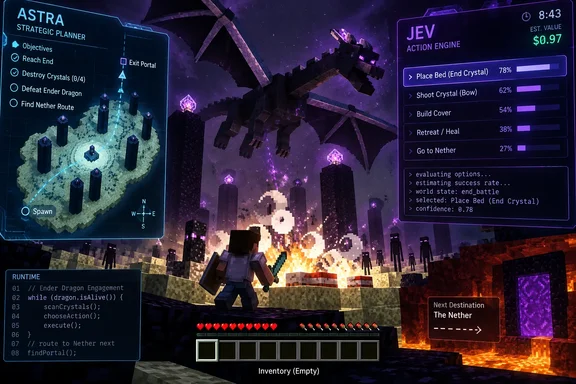
Ronak Malde announced the run and released its code. MakeUseOf covered the experiment on September 21, while ASCII.jp reports that it used Minecraft Java Edition 1.16.5, began in a new world with an empty inventory, and traveled through the Nether before defeating the dragon with bed explosions. Those details establish a specific PC-game experiment—not a capability available across Minecraft editions or an announcement of a built-in Minecraft assistant.
What the two models contributed
According to MakeUseOf, Astra set objectives, item targets, and travel waypoints. Jev then made decisions to carry those instructions forward. This separates the question of what the agent should accomplish from the repeated choices needed to execute its plan.
TypeSafe’s September 15 announcement explains why Jev is suited to the second role. The company describes it as a model that accepts information about the current state and returns predefined, typed decisions with probabilities rather than generating unrestricted text. Software specifies the possible output structure in advance.
For example, selecting from a defined set of actions gives surrounding software a predictable interface. The application can act on that selection without interpreting a conversational answer. The developer still has to define useful choices, provide relevant state, and implement the actions themselves.
TypeSafe calls this a “System One” model, borrowing the distinction between quick judgment and slower deliberation. That terminology describes the intended division of work; it does not establish that either model thinks like a person.
The Minecraft run reportedly involved 131 Jev calls and 35 Astra calls, according to ASCII.jp. Those counts show that the two models were used at different frequencies. They do not mean that every movement or game update required an AI request, nor do they measure how much supporting software contributed to the finished run.
What “under $1” actually means
Malde reported approximately $0.01 in Jev charges and $0.96 in Astra charges, figures also carried by ASCII.jp. The combined reported model bill was therefore 97 cents; the one-cent figure applies only to Jev’s portion.
That distinction changes the interpretation of the headline. Almost all the reported model spending came from the planner, even though it was called fewer times. Call count alone is consequently a poor substitute for measuring an agent’s operating cost.
The figures describe model usage for this run. They should not be read as an established all-in price for developing, hosting, testing, and repeatedly operating the system. The timing and charges remain Malde’s reported results; publication of those figures by other outlets does not make them independently reproduced measurements.
TypeSafe lists Jev’s input pricing as $0.042 per million tokens, with no output-token charge, and claims response times of 70–500 milliseconds. Those are vendor-published figures, not latency measurements from this Minecraft run. Jev was announced in early access, so developers should also distinguish the demonstrated architecture from a generally available, ready-made game automation product.
The 141-hour Astra run is not a controlled comparison
The result attracted attention partly because of a separate Astra experiment that ran for 141 hours. Tom’s Hardware reports that a Creeper destroyed a chest containing valuable items and the agent’s bed, after which the model spent hours farming potatoes.
That provides an example of an agent failing to make useful progress. It does not establish how much faster Jev made Astra in a matched test.
A meaningful speed comparison would require the same game configuration, world information, permitted actions, control software, and completion rules. The two reported elapsed times alone cannot isolate the effect of adding Jev. Likewise, descriptions of the earlier agent becoming “demotivated” are human interpretations of its behavior, not measurements of an emotional state.
The practical lesson for agent developers
The supported engineering lesson is that planning and repeated decision-making can be assigned to different components. A model capable of open-ended reasoning can set goals, while a faster decision model handles bounded choices within software-defined limits.
There is an important distinction between valid output and a correct decision. TypeSafe says Jev guarantees outputs that match the specified structure. A structurally valid choice can nevertheless be inappropriate for the situation. Applications still need to determine whether an action is allowed and whether execution actually advanced the task.
For developers evaluating this approach, the Minecraft result offers a concrete architecture to investigate—not proof of reliable performance across arbitrary worlds or production workflows. Its strongest contribution is showing a reported completed task with a small model-use bill, while making clear why the planner, decision model, and surrounding application should be evaluated separately.
References
- Minecraft's toughest challenge just fell to an AI tag team that costs pennies to run MakeUseOf · 2026-09-21T13:44:26+00:00
- Introducing System One Models & Jev - TypeSafe AI Blog typesafe.ai
- github.com github.com