

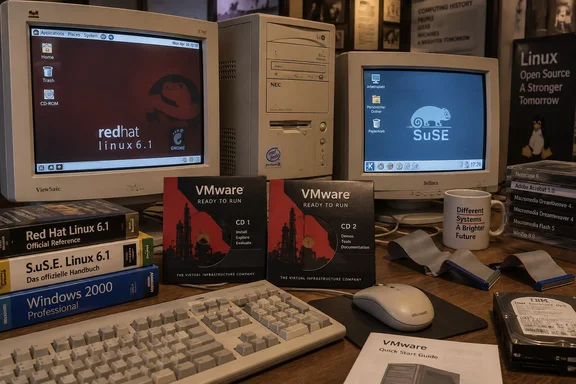
VMware's Ready to Run CDs Put a Finished Linux Desktop Inside Windows 2000
The discs came back to light when a viewer, David from Virginia Beach, mailed YouTuber Michael MJD a pair of forgotten promotional CDs he picked up at Linux World 2000. MJD covered them in a video titled "Virtual Machines… on a CD?", and TechEBlog wrote up his findings. According to TechEBlog, VMware handed them out as marketing pieces that let Windows users try popular Linux distributions without hunting down ISOs or partitioning a hard drive.
The contents explain the pitch. Each disc carries VMware 1.0.1 for Windows NT and Windows 2000 plus the Linux host version, a short readme, and a compressed virtual disk image already configured with a working guest OS. So these were not install discs. A regular Linux CD in 2000 dropped you into an installer and a partitioning screen. This one handed you a hypervisor and a working machine to run in it, and your Windows disk layout stayed as it was.
The Computer History Museum confirms the discs were real. Its catalog entry 102801286 lists 3 copies of VMware Ready to Run Virtual Machine software CDs in cardboard sleeves, with red and black graphics, and photograph of company founders. The museum got them through the VMware Founders Collection, which VMware set up with CHM for its 25th anniversary. The collection's archivist, Kristin Morris, dates the Ready to Run CDs to 2000 and credits VMware's founding technologists as Mendel Rosenblum, Scott Devine, Ellen Wang and Edouard Bugnion.
TechEBlog adds that according to the Computer History Museum's archives, VMware donated matching copies to the museum, along with a third disk containing a copy of TurboLinux 6.0. The catalog confirms three discs. The TurboLinux identification comes from that write-up.
A Kraftwerk Parody Sleeve Sold Virtualization as Pop Culture
The packaging got as much attention as the software inside it. TechEBlog describes the artwork as a dead ringer for Kraftwerk's The Man-Machine album, with the exception that the title has been changed to Virtual Machine and the band members have been Photoshopped to resemble VMware's founders. The museum's catalog puts it more plainly: Cover looks like a Kraftwerk album. Nothing suggests Kraftwerk was involved. It reads as a trade-show visual joke.
The joke fits what VMware was selling. In Morris's account of the Founders Collection, the late-1990s problem VMware set out to fix was that a computer could run only one operating system. Some business applications took up a whole machine while using less than 20 percent of it. A sleeve dressing the founders as a band called "Virtual Machine" got that idea across at a booth better than a whitepaper could.
Getting VMware 1.0.1 Running on Windows 2000 Hit a Licensing Wall
MJD tried to rebuild the original experience as closely as he could, and the obstacles he ran into are the most useful part of the story. He started with the Red Hat disc on a period Windows 2000 PC. The disc showed no autorun prompt, so he opened its Windows folder, ran the VMware 1.0.1 installer, and went through the usual network and desktop-icon prompts.
After the reboot, VMware refused to start and showed an "invalid license" error. The package expected users to get a 30-day evaluation key from VMware's website, which no longer exists. MJD ended up putting together a working key himself. That makes the recovery an archival experiment, not a procedure anyone should treat as a normal way to use VMware software. It also exposes a weakness in the whole model: everything on the disc survived, but the online activation it depended on did not.
With VMware running, the rest of the Red Hat disc worked as intended. A self-extracting program in the Ready to Run folder unpacked a virtual disk and a configuration file, and VMware accepted them after about a minute. The guest booted through the LILO boot loader to a login prompt. The username and password were both "VMware." After login, MJD got a GNOME desktop with VMware Toolbox already installed, which handled mouse integration and let him leave the guest window with a single key press.
The display was the one rough spot. The resolution started out wrong, and an edit to the XFree86 configuration file fixed it, giving a 640×480 guest desktop that fit on the host screen. Ethernet worked and the menus scrolled smoothly.
The SuSE Disc Shows How Preinstalled VM Images Rot
The SuSE disc was a harder case. Its self-extractor said it had finished but left behind a corrupted image. MJD moved the raw tar.gz archive to a newer PC, unpacked it with 7-Zip, and renamed the configuration file so a current VMware release would accept it. The guest then booted into a German-language KDE desktop with a stone-textured wallpaper that seems to be unique to the SuSE disc. The same "VMware" credentials worked, and Toolbox again handled the mouse.
The failure mode here is worth noting. The guest's data was still intact inside the compressed archive; the Windows-side unpacker was what broke. Pulling the archive out with a modern tool and adjusting the configuration for a modern hypervisor got around the problem. Anyone who has inherited old virtual appliances will recognize this: the disk image usually outlasts the wrapper that was meant to deploy it.
The write-up does not give the exact SuSE release on the disc, so it is simply "SuSE Linux" here. The Red Hat guest is identified as Red Hat Linux 6.1.
Pentium III Benchmarks Showed Early VMware Was CPU-Bound
MJD also ran both guests on period hardware, and the results show where early hosted virtualization hit its limits. Per TechEBlog, running both guests at once on period hardware pushed the Pentium III to 100 percent CPU and introduced lag, frozen input, and occasional freezes during login. Running one guest at a time worked best.
Memory was not the limit. Usage sat well below the 512 MB specified, and the system was CPU-bound more than anything else. A 2002 Linux textbook from the University of Warwick made the same trade-off explicit: it listed a speed hit on guest operating system as a drawback of VMware, along with a price of about €300 at the time.
Modern hardware brought its own trouble. Newer processors regularly produced kernel panics, so MJD shifted the experiment to a 733 MHz Pentium III that was downclocked to match the original requirements, which called for a Pentium II 266 MHz. So a faster CPU was the wrong fix. These guests had been built around the hardware of their day, and they ran most reliably on something close to it.
Current VMware releases still need adjustments for legacy guests. A community guide to running Windows 2000 in modern VMware Workstation, for example, explains that certain legacy settings may need to be configured to run older guest operating systems. These include CPU and MMU (memory management unit) handling options and turning off the Vulkan renderer. That guide covers a different guest, not these Linux images, but the approach is similar: expect to change settings when a 25-year-old OS meets a current hypervisor.
Windows 2000 Users Could Try Linux Without Repartitioning
The discs' historical point is simple. In 2000, trying Linux on a Windows PC usually meant dual-booting, and dual-booting meant repartitioning a disk you probably could not afford to lose. VMware's disc removed that risk. As TechEBlog puts it, simply insert the CD, install a brief trial of VMware, and a configured desktop showed up with no download and no partitioning.
By 2002, VMware's host and guest list had grown well beyond this first package. The Warwick textbook describes hosts including Windows XP, 2000 and NT, Red Hat Linux, SuSE Linux and Linux-Mandrake, with the same systems plus Windows 3.x/9x supported as guests. The Ready to Run CDs belong to the earliest part of that history, when VMware Workstation was still at version 1.x and the company had to show people what a virtual machine was before it could sell them one.
The distribution model also looks familiar now. A preconfigured disk image, a small configuration file and a default login is essentially what later virtual appliances and vendor-supplied VM images became. The main difference was the delivery method: a cardboard sleeve at a trade show instead of a download link.
What this means for you
If you collect or preserve old software, the Ready to Run discs are a reason to image your promotional CDs now, and to keep the raw archives as well as the installers. For everyone else, the practical lessons are about how preconfigured VM images age.
- The VMware Ready to Run discs are verified artifacts, with three copies held by the Computer History Museum under catalog number 102801286.
- The VMware 1.0.1 installer on these discs expects a 30-day evaluation key from a website that no longer exists, so the original activation path is dead.
- The Red Hat Linux 6.1 guest booted through LILO to GNOME with the default "VMware"/"VMware" login after an XFree86 resolution fix.
- When a bundled self-extractor fails, as it did on the SuSE disc, extracting the underlying tar.gz with 7-Zip and adjusting the configuration file for a newer VMware release can recover the guest.
- Period-appropriate CPU speed matters more than extra RAM for these guests, since newer processors triggered kernel panics and running two guests at once maxed out a Pentium III.
- TechEBlog reports the disc files are on the Internet Archive. No specific archive record was confirmed for this article, so check any download against a known-good source before running it.
VMware's LinuxWorld 2000 giveaway worked because it handed a curious Windows user a finished Linux machine instead of a manual. The same packaging is why it is now hard to revive: the installers, licensing and hardware assumptions have aged badly, while the disk images inside have mostly held up. MJD's recovery and the museum's three sleeved copies are now the best records of that early giveaway.