

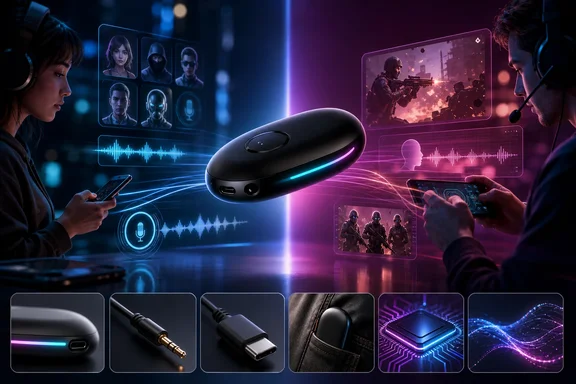
The problem is not that those two ideas inherently conflict. The problem is that the claimed Key Pocket hardware route has not yet been verified by first-party setup instructions, an active vendor checkout path, or independent hands-on testing in the material available here. For buyers, especially Windows users accustomed to Voicemod’s desktop workflow, the useful distinction is between a reported new mobile accessory and the older, documented console-only Voicemod Key.
That distinction can prevent a bad purchase. The older Key has specific, confirmed console and headset limits. Key Pocket has a more ambitious reported role, but major questions about buying it, connecting it, and using it in specific apps remain open.
Two products with similar names, very different evidence
Voicemod has a public page for a product called Voicemod Key Pocket. In the dated public-page snapshot available for this research, that page says the device is not available in the visitor’s country and that reservations are open only in the United States. It specifies iOS 16.0 and Android 10 or later.
That page is meaningful, but it is not a conventional purchase listing. It establishes that Voicemod has publicly presented Key Pocket and is taking U.S. reservations. It does not, in the available snapshot, provide a buy button, shipping terms, setup guide, or a detailed compatibility matrix.
The shop snapshot adds a second important distinction. It shows the older product, named simply Voicemod Key, at $56.90 and marked sold out, with a one-month Voicemod Pro trial. It does not show Key Pocket.
This absence should not be treated as categorical proof that Key Pocket cannot be bought in the United States. Storefronts can be regional, incomplete, or behind a reported announcement. But it does mean the snapshot does not independently verify an active U.S. Key Pocket checkout route.
Meanwhile, The Verge reported on September 15, 2026 that Key Pocket was available for $99.90, or $129.90 with Pro. The same report described it as a hardware audio bridge for real-time altered audio on mobile devices. That is evidence of a reported launch, not equivalent to current first-party confirmation of retail availability and bundle terms.
The buyer-safe conclusion is precise: Key Pocket has been publicly identified by Voicemod and separately reported by The Verge as launched, but the available first-party public pages document U.S.-only reservations rather than a fully documented retail purchase path. Do not confuse that uncertainty with the older Key’s sold-out shop status; these are separate products.
The Google Play warning applies to the app, not automatically to hardware
Voicemod’s Google Play description states that real-time voice use is desktop-only and that the app does not work live in voice-chat apps or games. The listing was updated September 4, 2026. This is the strongest available guidance for anyone who expects the phone app, by itself, to function as a system-wide virtual microphone for Discord, a game lobby, or a call.
That limitation makes technical sense in light of Voicemod’s earlier explanation that platforms including iOS and Android restrict system-level sound-input access. A Windows PC can support a desktop audio-processing workflow that a mobile app may not be permitted to reproduce across other apps.
Key Pocket is relevant because The Verge reports a separate hardware approach, rather than a claim that the app has suddenly gained unrestricted system-level audio access. In principle, an external accessory could provide another audio path around a limitation faced by software running only on the phone. That is an inference about why hardware could matter, not confirmation of Key Pocket’s internal design or of its success with every phone and app.
The two propositions should therefore remain separate:
- Standalone mobile app: Voicemod’s own Play listing says it cannot change a voice live in mobile voice-chat apps or games.
- Key Pocket hardware route: The Verge reports that the accessory is intended to make live altered audio available in mobile apps, games, and calls. The supplied first-party Pocket page does not yet document the required connections, supported app list, routing behavior, or performance guarantees.
The disclaimer is not a contradiction of Key Pocket itself. It is a warning against assuming that installing the app alone creates live cross-app microphone processing. Key Pocket’s more consequential promise remains plausible as a separately reported hardware route, but unverified in the ways that matter at setup time.
What The Verge reports—and what remains unconfirmed
The Verge attributes a broad set of capabilities to Key Pocket. Its report says the accessory uses USB-C with Android, iOS, and iPadOS devices; can take Bluetooth-microphone input; attaches magnetically; includes six programmable buttons, a mute button, and an LED dial; and is intended for services and apps including Fortnite, Roblox, Discord, and calling apps.
Those details may be exactly what prospective buyers want. They also all change the practical value of the device. Yet the available official Pocket reservation page confirms only the product name, U.S. reservation status, and minimum iOS and Android versions. It does not confirm the reported hardware controls, Bluetooth behavior, mounting system, USB-C coverage, or third-party app support.
That gap has real-world consequences:
- USB-C is not a universal compatibility guarantee. A port alone does not establish that every Android phone, iPhone, or tablet will accept the same accessory audio route.
- Bluetooth input needs more than a feature label. A buyer needs to know whether a particular wireless headset microphone is supported, how it pairs, whether monitoring is available, and whether audio remains stable during a call or game.
- Target-app support is the central question. A device can process audio locally yet still fail to send the processed microphone signal to a particular game, chat client, or calling service.
- Controls affect usability, not just specification-sheet appeal. Six programmable buttons and an LED dial could be helpful for live sound triggering, but their configuration options and reliability are not documented in the first-party Pocket material provided.
The Verge also reported the two prices and a Pro bundle. These should likewise be attributed to The Verge, not treated as confirmed Voicemod store terms. The available shop snapshot does not list Key Pocket, a $99.90 price, a $129.90 bundle, or a lifetime offer attached to the product.
Voicemod’s Pro support material does confirm a broader licensing fact: mobile Pro can be purchased as a monthly, yearly, or lifetime plan; it unlocks voices and soundboards; and the license can synchronize with Voicemod’s PC and macOS apps. That supports the idea that a Pro license can span a Windows and mobile setup. It does not establish that The Verge’s reported Key Pocket bundle includes lifetime Pro, particular cloud rights, custom-voice tools, or any specific catalog size.
For a Windows user, the important question at checkout is not merely whether “Pro” appears in the package name. It is whether the checkout page explicitly states the plan duration, account terms, refund conditions, and entitlement scope.
The older Voicemod Key is the documented console option
The older Voicemod Key is not a previous name for Key Pocket. It is a distinct console-focused accessory, and Voicemod’s documentation gives it limits concrete enough to guide a purchase.
Voicemod says the older Key supports direct-to-console connections with PlayStation 4, PlayStation 5, Xbox Series X|S, and Nintendo Switch 2. It explicitly does not support the original Nintendo Switch. That last point deserves emphasis: a generic reference to “Switch” is not enough. Owners of Switch 1 should not infer compatibility from Switch 2 support.
The headset rule is equally important. The older Key requires a wired 3.5 mm TRRS headset, and Bluetooth headsets are unsupported. Someone with an all-wireless console setup may need a compatible wired headset as well as the accessory, changing both the cost and convenience of the purchase.
Its mobile operating-system requirement is also distinct from Key Pocket’s. The Pocket reservation page names iOS 16.0 and Android 10 or later. Documentation for the older Key lists iOS 16.0 and Android 8.1 or later. Those requirements should not be blended when checking an older device.
The older Key’s storefront snapshot—$56.90, sold out, and including one month of Pro—does not verify anything about Key Pocket pricing or bundle entitlements. It does, however, give console users a much clearer set of technical boundaries than the currently available Pocket documentation.
A pre-purchase check that focuses on the actual use case
Until Key Pocket receives detailed first-party setup and commerce documentation, buyers should validate the outcome they need rather than buy on the strength of a product category.
Confirm the exact product. Determine whether you need the documented older Key for a supported console, or whether you are waiting for Key Pocket’s reported mobile-focused functionality. Similar names conceal very different support expectations.
Confirm the purchase route. The Pocket public-page snapshot supports U.S. reservations. The Verge reported availability and prices. Before paying, look for a current Voicemod ordering page that identifies price, inventory, territory, shipping, returns, and bundle contents.
Map the entire audio chain. Write down the phone or tablet model, operating-system version, headset type, target app, and desired destination for the audio. A device described as compatible with Android is not automatically verified for every Android handset and voice service.
Ask the decisive question. Will another person hear the altered voice live in the particular game, chat app, or calling app you use? Playing sounds locally, recording a clip, and sharing an exported file are all different from transmitting a processed microphone feed in real time.
Do not assume Bluetooth parity. The Verge reports Bluetooth-microphone input for Key Pocket, but first-party setup material in this dossier does not confirm it. Conversely, Bluetooth is explicitly unsupported on the older console-only Key. Treat the two products independently.
Read the Pro terms at checkout. A lifetime mobile Pro option exists, but a Key Pocket lifetime entitlement has not been independently confirmed by the available Voicemod commerce material.
The sensible position for Windows users
Key Pocket is interesting because it addresses a genuine divide between Voicemod’s familiar Windows-style real-time audio use and mobile operating systems’ tighter input-routing controls. The Verge’s report describes a hardware route intended to narrow that divide. If that route works as reported across target phones and apps, it could be more valuable than a mobile soundboard for creators and players who want live voice effects beyond their PC.
But the evidence currently supports caution, not dismissal. The standalone mobile app’s Play Store limitation is documented and clear: it does not provide live voice changing in mobile chat apps or games. The claimed Key Pocket hardware route is separately reported, and it is not refuted merely by that app disclaimer. It nevertheless remains unverified by first-party setup documentation or hands-on testing in the supplied material.
For console buyers, the answer is more concrete: the older Key supports PS4, PS5, Xbox Series X|S, and Switch 2—not Switch 1—and requires a wired 3.5 mm TRRS headset rather than Bluetooth. For mobile buyers, wait for product-specific documentation that confirms the actual purchase path, required connections, supported devices, target-app behavior, and bundle terms before treating Key Pocket as a replacement for the proven desktop experience.