

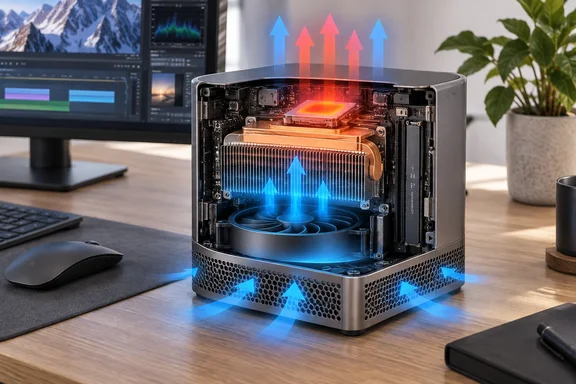
The company’s release, distributed through PR Newswire, describes a complete cooling arrangement rather than a vapor chamber alone. For buyers considering a small Windows workstation, the useful question is how that arrangement handles prolonged workloads—not simply whether the specification sheet includes vapor-chamber cooling.
How V-Cooling moves heat
VZMORE describes three connected elements: a vapor chamber that spreads heat across a larger area, wider high-density cooling fins, and a vertical airflow path supplied by intakes around the base. Its website also identifies a custom fan as part of the architecture.
On its iX9 Max product page, VZMORE explains that working fluid inside the chamber cycles through evaporation and condensation to transfer heat. The intended benefit is to distribute heat away from a concentrated source more evenly, making more of the cooling assembly useful.
Heat spreading is only part of the process. The fins and airflow provide the route for removing that heat from the system. VZMORE says its design also uses polymer fan blades to reduce vibration and operating noise, alongside what it calls “intelligent thermal management.” The announcement does not establish a user-adjustable fan curve or a particular control algorithm, so that phrase should not be read as a documented software feature.
For sustained workloads, the design’s potential value is straightforward: better heat distribution and removal could help a compact PC maintain performance over longer sessions. The announcement does not, however, demonstrate shorter rendering times, faster compilation, or higher sustained frame rates.
What the performance claims establish
VZMORE compares V-Cooling with conventional dual-heat-pipe cooling and reports approximately 40% more heat-spreading area and 50% higher “thermal conductivity efficiency.” The release does not define the latter measurement sufficiently to translate it into an application-performance gain. A claimed 50% cooling-efficiency improvement does not establish a 50% faster PC.
The principal figures need to be read within their stated boundaries:
| Manufacturer claim | What it does—and does not—describe |
|---|---|
| Approximately 40% greater heat-spreading area. | This concerns the cooling assembly, not a measured increase in computing performance. |
| Approximately 50% higher thermal-conductivity efficiency. | This is VZMORE’s comparison with a conventional dual-heat-pipe solution; the release does not provide a reproducible test method. |
| High-load noise as low as approximately 38 dB. | This is a best-case claim under unspecified high-load conditions, not a guaranteed noise level for every workload or model. |
| Approximately 12 dB less noise than some conventional mini PCs. | The comparison uses an approximately 50 dB baseline without naming the competing systems. |
The missing test conditions are material: the announcement does not specify the processor configuration, workload, ambient temperature, measurement distance, or fan profile behind these comparisons. Those omissions prevent a like-for-like buying comparison. Available coverage here establishes the announcement, but provides no independent thermal or acoustic measurements.
VZMORE also says its cooling module costs approximately three times as much as a conventional dual-heat-pipe module. That is a component-cost claim; it does not establish a threefold system-price premium.
Which PCs use it, and when?
V-Cooling is attached to identifiable products. VZMORE’s iX9 Max product page lists an Intel Core Ultra 9 185H processor, integrated Intel Arc graphics, and Windows 11 Pro. It advertises up to 65 watts of sustained processor power alongside noise under 38 dB.
Those remain system-level vendor claims. The page does not provide enough measurement detail to establish that buyers will see both figures together across their own workloads.
The September announcement also follows an earlier presentation. In its September 4 account of ShowStoppers at IFA 2026, VZMORE described V-Cooling alongside its AX9 Max and iX9 Max systems. That company post scheduled the broader AX9 Max, iX9 Max, iX9 Ultra, and AX9 Ultra lineup for a global launch in mid-October 2026.
The iX9 Max storefront now presents a purchasable configuration, while the earlier launch post leaves regional availability to a later announcement. These records do not establish a single worldwide availability date.
For prospective buyers, V-Cooling supplies a concrete design to evaluate: a vapor chamber, base-fed vertical airflow, and coordinated fan management. A purchasing decision still needs model-specific evidence showing sustained workload performance and noise measured together; the headline percentages alone cannot establish which mini PC will be faster or quieter on a desk.