

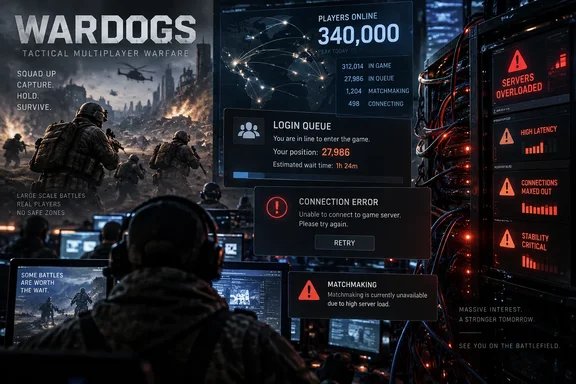
For Windows PC players, the immediate result was simple: a paid game that many customers could launch but could not reliably enter. Bulkhead reported login queues, join failures and players being kicked from active matches, then pushed an emergency client hotfix and began admitting people in controlled batches. PC Gamer, which tracked the outage as it unfolded, reported that Bulkhead temporarily took servers offline while it worked on a fix.
The useful correction to the headline figure is that sales, Steam concurrency and usable server capacity are three different numbers. Wardogs had an extraordinary commercial opening, but the launch-day failure occurred in the services that authenticate players, process the queue and place them into games—not because 1.25 million people were playing simultaneously.
The beta did not reproduce launch conditions
Bulkhead had warning signs that Wardogs could draw an audience beyond a typical Early Access release. The studio’s final pre-launch playtest reached 245,118 concurrent players on September 5, according to SteamDB, and the developer had described the event as an attempt to test large-scale load before release.
Launch still exceeded that test by a meaningful margin. SteamDB tracking and subsequent developer updates put Wardogs above 300,000 concurrent players on release day, while Everplay’s September 11 market announcement cited more than 340,000. By September 13, Bulkhead said it had reached 400,000 peak concurrent users.
The size of the gap explains why calling this merely a shortage of game servers misses the mechanism. A 100-player shooter can add more match instances, but every new customer first hits a shared chain of services: Steam entitlement checks, authentication, anti-cheat initialization, queueing, player profiles, server-browser queries and matchmaking or server placement. A weakness in any of those systems can stop players at the front door even when individual game servers have room.
Bulkhead’s own status update identified the immediate pressure point. The studio said it was being rate-limited and was working with Valve to bring its rate limit in line with larger titles. That is a more specific explanation than a generic claim that “the servers broke”: the bottleneck included a platform-facing login or service limit, alongside the game’s own capacity problems.
It also means the 245,118-player beta was not a clean capacity guarantee for a 340,000-plus-player paid launch. The beta used a separate Steam Playtest application, ran under different access conditions and did not necessarily generate the same simultaneous flood of purchases, first-time entitlements, downloads, anti-cheat checks and launch-day restarts. Stress tests only validate the traffic patterns they actually generate.
The emergency fix slowed entry on purpose
Bulkhead’s September 10 “Launch Stability Hotfix #1” named three faults: players unable to join servers, players unexpectedly kicked during play, and extended login queue times. The remedy required everyone already logged in to restart the client, download the update and return to the queue.
The studio then chose controlled admission rather than reopening the floodgates. Its post said players would be allowed in gradually and that the batches would increase only after the team confirmed they were entering and populating servers successfully. This is a standard containment decision for an overloaded online service: reducing the rate of new sessions gives authentication, session and game-host systems space to recover, while preventing a retry storm from making the outage worse.
It is a sensible operational response, though it is a poor customer experience when people have already paid $39.99. Reports in the Steam discussion forums described queue positions jumping upward, authentication errors after waiting, and being thrown back into the line after disconnects. GamesRadar and PC Gamer separately reported the queues and connection failures, corroborating that this was a broad launch problem rather than scattered player-side troubleshooting issues.
Bulkhead later said the queues should have cleared around midnight UTC, but the studio has not published a technical postmortem explaining which service failed first, what the original throughput limits were, or whether it has permanently changed its capacity arrangements with Valve. It has acknowledged symptoms and described mitigations; it has not yet offered the root-cause record that server operators and technically minded players would want.
That omission is significant because the same symptoms can arise from very different failures. A Steam API or entitlement throttle needs a different fix from overloaded database writes, insufficient regional hosts, a broken server browser, or anti-cheat service contention. “We scaled” tells customers the immediate incident is being handled. It does not tell them whether the launch architecture is ready for the next surge.
The server browser remained a separate problem
The launch outage was not the only infrastructure issue Bulkhead had to address. In a September 12 announcement for Patch 0.11, the studio said the community-server experience and the server browser had been poor, then split the front end into separate Community and Official browsers and removed some filtering from official servers.
Bulkhead also made a candid observation in that update: a game with an audience this large would realistically use matchmaking, while a traditional server browser is not especially well suited to the task. Yet the developer also said it did not want to damage community admins and hosts, which are important for a game expected to remain in Early Access.
That is a real design trade-off rather than a cosmetic interface patch. Matchmaking can distribute player demand, steer users toward suitable regions and modes, and conceal the constant churn of full or dying lobbies. A browser gives players and communities more agency, especially in a tactical shooter built around persistent groups and hosted servers. Combining both without creating fragmented populations, misleading capacity indicators or priority disputes is difficult at hundreds of thousands of concurrent users.
Patch 0.11 also increased capacity in Asia, which indicates the launch response involved regional provisioning as well as global queue controls. The company has not published region-by-region player counts, host numbers or latency targets, so there is no basis to judge whether the new capacity matches demand outside its main European audience.
Day-one sales are a win, but Early Access is still the contract
The commercial result is unambiguous. Everplay, the company with a strategic relationship to Bulkhead through Super Media Group and owner of Wardogs publisher Team17, used a formal market announcement to celebrate the million-copy milestone. Bulkhead followed with its more precise 1.25-million figure. On September 15, the studio said Wardogs had passed two million copies sold in fewer than five days.
The distinction between those announcements is worth preserving. Everplay’s filing said “exceeded one million” copies and more than 340,000 concurrent Steam users; Bulkhead’s post put its 24-hour total at 1.25 million. They do not conflict. They are snapshots issued at different thresholds and times, and neither establishes how many buyers successfully reached a match on launch day.
For prospective players, Early Access remains the operative label, not a technicality buried beneath the sales headline. Bulkhead’s chief executive, Joe Brammer, has said the team still has systems to fix and more work to build. The studio’s quick hotfix, browser changes and regional capacity increase support that assessment: Wardogs has found its audience before its online plumbing was fully ready for it.
The launch-day incident should therefore be read as both a success and a deployment failure. Bulkhead proved it can sell a tactical shooter at a scale few independent studios reach. It also demonstrated that a pre-release peak of 245,118 did not prepare its launch stack for the behavior of more than a million new paying customers arriving at once.
Wardogs is playable on Windows through Steam Early Access, and the company’s immediate work has moved from the initial login crisis toward server-browser improvements and regional capacity. The next meaningful update should be a technical accounting of the September 10 failure—what was rate-limited, what was expanded, and whether the revised system has been tested at the 400,000-plus peak the game has already reached.
Update: Steam peak rises to 428,666 as Bulkhead weighs its post-launch workload (September 16, 2026)
Wccftech reports that Wardogs reached a Steam peak of 428,666 concurrent players on September 13, sharpening the earlier “400,000-plus” figure. That confirms the game continued to draw substantially more simultaneous users after the initial September 10 authentication and queue failures, increasing the importance of proving that the revised login, capacity and server-browser arrangements can withstand another surge.
In the same report, Bulkhead CEO Joe Brammer said the studio is not accelerating a console version and does not expect it before 2028, arguing that the team needs to restore balance after the final months of development. For Windows players, that suggests the PC Early Access build should remain the studio’s primary operational focus rather than sharing near-term attention with a console launch.
However, the new reporting does not add the missing technical accounting of the launch incident. Bulkhead still has not publicly identified the precise rate limit, service failure sequence, or load-testing evidence showing that the system is now prepared for the 428,666-player level.
References
- WARDOGS Hit Two Million Units Sold in Five Days, as Bulkhead’s CEO Says He Expects His Team to Crunch Wccftech · 2026-09-16T13:00:00+00:00
- Wardogs sold over a million copies on day one but immediately broke its own servers as a result Notebookcheck · 2026-09-16T10:44:00+00:00