

That design makes the project noteworthy for technically adventurous Linux and Steam Play users, but it also makes its constraints unusually important. The documented setup depends on proprietary NVIDIA components, a particular Wine or custom Proton environment, and game-specific behavior that has not yet been independently benchmarked at scale.
What DLSS5VKLayer Actually Does
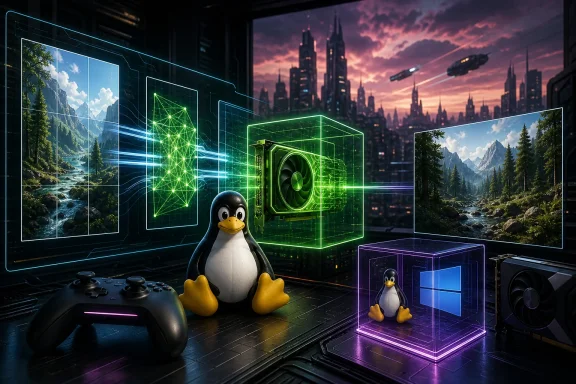
DLSS5VKLayer is described as an experimental implicit Vulkan layer for native Linux games and games running through Proton. Rather than providing a fully native Linux implementation of NVIDIA’s DLSS 5 Neural Rendering runtime, the layer forwards presented frames to a Windows NGX neural-rendering helper running under Wine or a custom Proton-based compatibility tool.
In practical terms, the Vulkan layer sits in the path between a game and the final presentation of its frames. The project’s documented pipeline uses the Windows neural-rendering component, nvngx_dlssnr.dll, for processing. This is a compatibility bridge, not evidence that a Linux title can simply load the same DLSS 5 functionality as a normal, supported Linux graphics feature.
That distinction matters. “DLSS on Linux” can describe several very different situations: a game may use a Linux-native implementation; it may run a Windows DLSS path through Proton; or an additional layer may attempt to add processing at presentation time. DLSS5VKLayer belongs to the last category, with a Wine-backed Windows helper at its core.
NVIDIA already publishes Linux x86_64 assets in its broader DLSS SDK materials. Therefore, this project should not be treated as proof that DLSS in general was previously impossible on Linux. The narrower unanswered question is whether NVIDIA offers a native Linux equivalent to the particular DLSS 5 Neural Rendering DLL that this layer is designed to use. The available material does not establish that such an equivalent has been released.
Why DLSS 5 Is Drawing Attention
NVIDIA announced DLSS 5 in March 2026 as a real-time neural-rendering model that uses frame color and motion-vector information. By early September, NVIDIA said DLSS 5 3D-Guided Neural Rendering was available for NBA 2K27 through GeForce NOW on cloud systems equipped with RTX 5080-class hardware.
Those announcements establish that DLSS 5 is a real NVIDIA technology with an early official deployment. They do not, however, establish that DLSS5VKLayer is supported by NVIDIA, ready for ordinary desktop use, or equivalent to NVIDIA’s own intended integration path.
This is the central reason to separate the technology from the community project. NVIDIA’s DLSS 5 rollout and this Vulkan-layer experiment are related by the Windows NGX component the layer seeks to use, but they are not the same product, support channel, or distribution model.
The Setup Is More Demanding Than a Typical Proton Tweak
The project documentation lists several prerequisites: an NVIDIA GPU and driver, the Vulkan loader, and either system Wine or a suitable custom compatibility tool. Crucially, the public package does not include NVIDIA’s proprietary NGX DLLs. Users are expected to supply the required nvngx_dlssnr.dll component themselves for neural processing.
There is also a documented “personal” package variant that bundles the DLLs, accompanied by an explicit warning about redistribution rights. That is not a small legal footnote. Proprietary driver-adjacent or game-adjacent binaries can carry licensing and distribution terms that differ substantially from the open components around them. A package that works in one person’s local setup is not necessarily something a project or third party may redistribute.
Standard Valve Proton releases and Proton Experimental are not presented as the primary target environments. According to the project’s own requirements, they lack the necessary DXVK-NVAPI stack. That means the familiar Steam workflow of selecting Proton Experimental may not be sufficient. A custom tool or carefully configured Wine path may be necessary before a user can even begin testing the layer.
For users accustomed to Windows graphics features arriving through GeForce drivers or game patches, this is a substantially different support model. The practical burden moves to the user: selecting a compatible runner, sourcing the required binaries appropriately, configuring the Vulkan layer, and troubleshooting interactions among Steam, Proton, Wine, DXVK-NVAPI, drivers, and the game itself.
Motion Vectors Are an Option, Not a Quality Guarantee
DLSS5VKLayer documents optional synthetic motion-vector generation using VK_NV_optical_flow where that Vulkan capability is available. It also documents a graphical interface built with Qt, a command-line manager, and an optional layer-order configuration for Smooth Motion.
These details indicate that the project is trying to address the data and ordering problems involved in applying neural rendering near the end of the display pipeline. Motion information is particularly relevant to temporal and neural image processing, so an optical-flow option is technically understandable.
But the presence of an optical-flow path does not demonstrate a particular visual result. There is no independent image-quality comparison in the available evidence showing that the layer removes shimmering, reduces flicker, improves temporal stability, or matches a game’s native motion-vector data. Nor is there a verified performance or latency analysis.
Synthetic vectors may be useful in some situations, but they are not automatically interchangeable with vectors produced by a game engine. An engine understands its own scene transformations, object motion, camera movement, animation, and rendering history. A later-stage optical-flow estimate has to infer motion from images. It is reasonable to expect that these approaches can have different strengths and failure cases, but specific outcomes for DLSS5VKLayer remain unproven without reproducible testing.
Compatibility Is Explicitly Experimental
The project’s own README calls the work experimental and says it is intended for local testing and research. That wording is more important than the promise implied by a feature-rich interface or a dramatic technology name.
The documented behavior is designed to fail open: if initialization does not succeed, the layer falls back to the original frames. That is a sensible defensive choice because a failed presentation-stage experiment should not necessarily prevent a game from displaying anything. Yet it also means users need a reliable way to tell whether the neural-rendering path is actually active, whether it is receiving the expected data, and whether any visual or performance difference is attributable to the layer rather than a changed game setting or compatibility configuration.
The project also warns that some games may require swapchain-layout adjustments and Steam runtime debugging. A Vulkan swapchain is central to how rendered images are presented. Different games, engines, runtimes, and overlays can make assumptions about image layouts and synchronization that are not universal. A layer that has worked with a set of tested applications may therefore encounter edge cases in another title.
No independent compatibility matrix was available covering native Linux games, Proton titles, GPU generations, driver versions, display servers, HDR configurations, or specific games. As a result, users should avoid interpreting “native Linux and Proton games” as a promise of wide-ranging compatibility. It describes the intended scope, not a verified list of working titles.
An Important Authorization and Distribution Question
The technical notes associated with the project describe loading nvngx_dlssnr.dll and using an import-address-table hook to report the caller module as nvngx.dll. Those notes characterize this mechanism as a signature or authorization bypass.
That is a material concern, not merely an implementation detail. The description is the project’s own characterization; the available evidence does not independently verify that the method works, that it behaves consistently across environments, or that it is authorized by NVIDIA. No NVIDIA statement was identified that endorses this Wine/Proton bridge or its reported caller-identity mechanism.
Users should be especially cautious where a project appears to work around a vendor’s authorization checks or caller expectations. Beyond stability risks, such behavior can raise questions about software terms, account and platform rules, driver interactions, and the future viability of a configuration after an update. The absence of a demonstrated vendor endorsement is not proof of a violation, but it is a clear reason not to present the setup as a normal supported feature.
Licensing is unresolved on the project side as well. Its attribution information says GPL-3.0-derived code requires GPL-3.0 distribution, while also stating that the base project has no license file and that author-side licensing must be resolved before a public release. That conflicts with an unqualified description of the project as an open-source release. Some code may be GPL-derived, but the legal status of the combined project and its distributable form has not been settled by the available documentation.
What Windows and Linux Gamers Should Take From It
For Windows users, DLSS5VKLayer is a reminder that a Windows graphics DLL can become a dependency even when the game itself is being played on Linux. That may sound counterintuitive, but it reflects the reality of cross-platform PC gaming: compatibility layers can extend access to software components while simultaneously adding more moving parts than a conventional native game integration.
For Linux users, the project is best understood as a research-oriented test bed, not a recommended universal enhancement. It may be of real interest to people who are comfortable diagnosing Vulkan-layer behavior, replacing compatibility tools, reading logs, and recovering from game-specific failures. It is not yet supported evidence for claims of higher frame rates, reduced artifacts, lower latency, or broad Steam-library coverage.
A careful testing approach would keep the original game configuration reproducible, change one element at a time, and preserve a working fallback. Users should verify whether the layer initializes, confirm that the game remains stable, and judge output with the original presentation path available for comparison. They should also treat proprietary DLL sourcing and redistribution as separate questions from whether a local technical experiment can be made to run.
The larger significance is architectural rather than consumer-ready. DLSS5VKLayer demonstrates continued interest in adapting new Windows-focused rendering techniques to Linux and Steam Play workloads. Its existence may help researchers and power users explore what is technically possible at the Vulkan presentation layer. But until there are independent benchmarks, broader game testing, clarified licensing, and clear answers around the described authorization mechanism, it remains an experiment whose caveats are at least as important as its promise.