

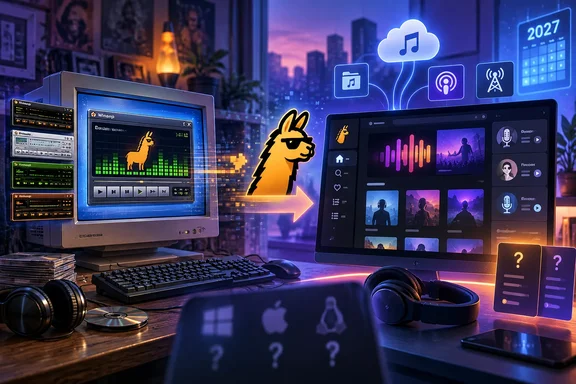
The announcement has resurfaced in reporting by Engadget, while Winamp’s own release and coverage from What Hi-Fi describe the same central plan: one player intended to combine a Deezer-backed streaming subscription with local music libraries, internet radio, podcasts, personal cloud collections, and other audio sources. What has not been announced is equally consequential: no price, country availability, audio-quality tier, supported operating systems, mobile-app plan, desktop build number, or migration path for users of the existing Winamp client.
For Windows users, then, this is a product roadmap—not a download announcement. The company has offered a release window, but none of the technical detail needed to tell whether the next Winamp will be a native Windows application, a web-based shell, a cross-platform client, or a service layered onto the aging desktop player.
Deezer solves the licensing problem Winamp could not solve in 2019
The 2027 project revisits an idea Winamp announced eight years ago and never delivered. In October 2018, Alexandre Saboundjian, then chief executive of Winamp owner Radionomy, told TechCrunch that a reinvented Winamp would arrive in 2019. It was meant to unify locally stored MP3s, cloud libraries, podcasts, streaming radio, and third-party streaming services across devices.
That proposal had a flaw beyond engineering. A neutral player that connects users to Spotify, Apple Music, Pandora, and similar services needs commercial agreements and API access from businesses whose incentives favor keeping users inside their own apps. Engadget noted at the time that Winamp had provided no specifics about those integrations, and no broad, cross-service Winamp 6 aggregator appeared in 2019.
The Deezer deal changes the model. Instead of seeking permission to pull rival streaming services into Winamp, Winamp will sell its own branded subscription using Deezer’s white-label platform and licensed catalog. Deezer supplies the difficult and expensive elements—music rights, catalog delivery, streaming infrastructure, and the machinery behind a commercial service—while Winamp controls the player experience and customer-facing brand.
That is a more achievable proposition than the 2018 pitch, but it also narrows the promise. A Deezer-powered Winamp subscription is not evidence that users will be able to sign into Spotify, Apple Music, YouTube Music, Tidal, or other competing services from a single interface. Neither Winamp nor Deezer has announced such integrations.
The practical reading is straightforward: Winamp is becoming another streaming storefront with a local-library component, rather than a universal control panel for every subscription a listener already pays for.
The existing Windows player has not been replaced yet
Winamp’s official statement says its “legendary Winamp desktop player” will receive the subscription service after the new platform launches. That wording confirms an intention to connect the older desktop product to the paid service, but it does not say whether the 2027 player is a successor to Winamp 5.x, a separate client, or an embedded service upgrade.
The last clearly documented stable release of the classic Windows client remains Winamp 5.9.2, released in April 2023. Its release notes included Windows 11 detection improvements, but it was fundamentally a maintenance-era continuation of the old local-player codebase—not the streaming platform now being advertised.
That matters to anyone managing a carefully organized local collection. Winamp’s appeal was historically rooted in file playback, plug-ins, skins, library management, visualizations, and a lightweight Windows desktop workflow. The new announcement promises a customizable interface and new discovery and organization features, yet it does not state whether classic plug-ins, Media Library metadata, skins, playlists, file associations, DSP plug-ins, or Shoutcast workflows will survive the transition.
Users should not assume compatibility merely because the Winamp name will appear on both products. Companies regularly use a legacy desktop application as a subscription entry point while rebuilding the core experience around a separate account-based platform. Until Winamp specifies the client architecture and migration behavior, existing installations should be treated as independent from the forthcoming service.
Winamp also has not said whether a paid subscription will be required to use local files, whether offline downloads will be available, or how the application will distinguish licensed streamed tracks from a user’s own MP3, FLAC, AAC, or Ogg library. Those are basic design decisions for a player that claims to unify local and cloud audio.
A subscription service needs details Winamp has not provided
Winamp calls its planned subscription model “fundamentally different” from existing streaming services. At present, that is a marketing claim rather than a product specification.
There is no published monthly price, annual option, free tier, family plan, student plan, trial period, lossless tier, spatial-audio support, or list of launch territories. There is also no explanation of whether the subscription will mirror Deezer’s catalog and regional restrictions exactly, or whether Winamp will negotiate its own variations.
The omission of platform information is particularly notable. The press release repeatedly refers to the “Winamp Player” and later to the “desktop player,” but it does not explicitly name Windows, macOS, Linux, iOS, Android, browsers, or connected devices. That leaves a major gap between the nostalgia-driven expectation of a Windows app and what has actually been committed to paper.
Winamp Group says the platform will add social capabilities. Social features in a subscription music product can range from shared playlists and following friends to public profiles, activity feeds, or collaboration tools. The company has not said which it intends to build, what privacy controls will exist, or whether listening activity will be public by default. Those details matter before users attach an account, payment method, and music history to an application historically used without a cloud identity.
The company’s claim that more than 40 million people still actively use the desktop player should also be understood as a vendor figure, not an independently audited measure disclosed with a methodology. Winamp has not explained whether it counts active installations, monthly launches, downloads, web accounts, or another measure.
Winamp’s recent engineering record creates a credibility test
The 2027 promise arrives after a difficult attempt to modernize Winamp’s software development process. In September 2024, Winamp published source code for its legacy player on GitHub under a custom “Winamp Collaborative License” that initially restricted forking and distribution of modified versions. The repository was removed within weeks.
Ars Technica and Germany’s Heise Online reported that developers criticized the restrictive licensing and identified material that appeared to include proprietary components, including code associated with Dolby, Microsoft, Intel, and the SHOUTcast server software. The incident did not establish that Winamp’s current streaming project is technically unsound, but it does mean the company has recent history to overcome when asking users and developers to trust a new, account-linked music platform.
The difference this time is that Winamp is not claiming to build its catalog and delivery stack alone. Deezer is an established streaming provider, and the agreement gives Winamp a partner that already operates licensed music infrastructure. That should reduce the licensing and operational burden that made the 2019 universal-aggregator concept difficult.
It does not answer the client-side questions. A stable, secure Windows application still requires clear support policies, update mechanisms, account protections, privacy terms, export options, and a credible answer for users who only want a local media player.
What Windows users should do before 2027
There is no action required for existing Winamp users today. The sensible approach is to keep local music libraries and playlists independently backed up, especially where they depend on old plug-ins or formats that a future subscription-first client may not carry forward.
Users interested in the service should wait for concrete announcements in four areas:
- Winamp needs to name the supported operating systems and clarify whether the next-generation player replaces, updates, or sits beside Winamp 5.9.2.
- Winamp needs to publish pricing, countries, audio formats and quality levels, and whether its catalog differs in any way from Deezer’s direct service.
- Winamp needs to state what happens to local libraries, playlists, skins, plug-ins, and media metadata when a user connects a legacy desktop installation to the subscription service.
- Winamp needs to describe account security, data collection, social-feature privacy settings, and whether users can export playlists and listening data.
For now, the concrete milestone is the first half of 2027. Winamp has finally found a way to attach a licensed streaming catalog to its brand, but its success on Windows will depend less on the llama logo than on whether it protects the local, customizable player experience that made the software worth preserving in the first place.
References
- Winamp will be reborn in 2027 to take on streaming Engadget · 2026-09-20T13:30:00+00:00
- Winamp plans 2027 return with a new streaming subscription - Mashable Mashable · 2026-09-20T16:56:49+00:00