

What changes during setup?
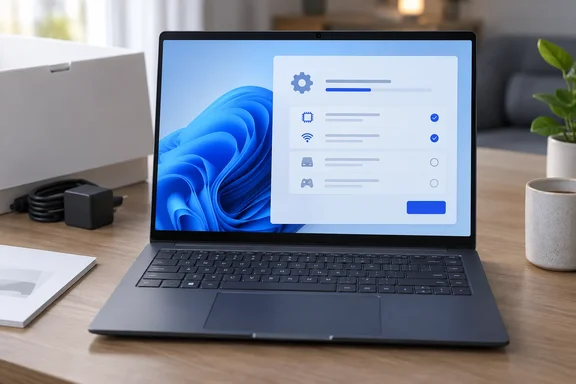
A System Manifest can coordinate driver and firmware updates for Windows on ARM devices. Neowin reports that OOBE previously received the latest applicable manifest, potentially bringing along updates that were not essential before first use. Under the new approach, a manufacturer can establish a version-specific baseline for OOBE: devices below that baseline receive the needed update during setup, while later, nonessential updates can wait until afterward. Neowin identifies the scope as ARM systems running Windows 11 version 24H2 or later.
Think of it as packing for the first trip rather than every trip the PC might take. A fix needed to complete setup belongs in the bag; a minor refinement need not keep a new owner waiting at the welcome screen.
That distinction also limits the claim. Microsoft has not promised a faster setup for every ARM PC. Any benefit depends on a manufacturer using the capability, obtaining approval, and having updates that can safely wait.
What it does not skip
System Manifest delivery is only one part of Windows setup. Microsoft’s OOBE documentation says critical zero-day patch updates begin downloading after a device connects to a network and cannot be declined during setup. Depending on the OS build, a device may also be offered a newer Windows version; Microsoft says that installation can take 30 minutes or more and may require a restart. The new manifest selection does not eliminate those separate update flows.
Microsoft’s guidance, as reported by Neowin, reserves the partner capability for critical problems—such as a fault that prevents setup from finishing or makes the initial experience poor enough to risk a return. Routine fixes and cosmetic changes should use the usual Windows Update path. That is a sensible boundary: a stable factory image should do the heavy lifting, not leave OOBE to perform emergency repairs on every new machine.
Bottom line: this is a targeted improvement to which ARM device updates must arrive before the desktop, not a promise that Windows 11 setup will become update-free. For buyers, the test will be whether manufacturers use that narrower first-run path without compromising the reliability of the PC they ship.
References
- Windows 11 OOBE is getting a major upgrade for some devices Neowin · 2026-09-29T11:48:01+00:00
- Updates during OOBE | Microsoft Learn learn.microsoft.com
- Windows 11 OOBE on ARM PCs Is Getting a Smarter Way to Install Critical Updates - Windows Report Windows Report · 2026-09-29T12:14:41+00:00